
Your AutoCAD Drawing Is Lying to You — Why Perfect Plans Build Imperfect Buildings
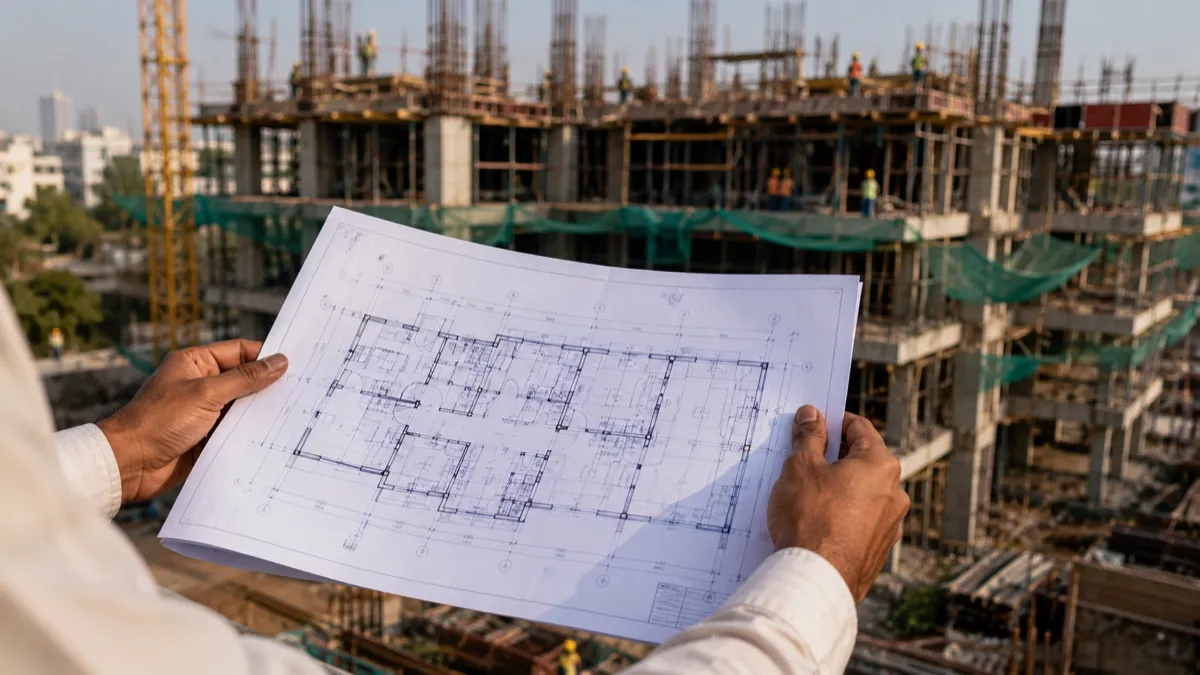
You spend three weeks perfecting a residential design. Lines crisp, dimensions precise to the millimetre, tolerances marked per IS standards. You hit print, satisfied. Then the site engineer calls: "Sir, the wall won't align with the line you drew."
Welcome to the AutoCAD Illusion — the gap between what you draw and what actually gets built. Your immaculate 1:100 drawing quietly assumes perfect materials, perfect masons, perfect site conditions and perfect execution. On an Indian site, not one of those exists. The problem isn't your drawing skill. It is that you designed for the screen, not the site.
The Perfect Drawing Trap
You draw a 300mm wall from point A to point B. The mason lays the first course at 305mm, the next at 302mm, and by completion the wall is 298mm at one end and 307mm at the other. This isn't carelessness. Bricks vary 2-3mm between batches, mortar joints are never exactly 10mm, site levels drift, formwork flexes, and human hands are not robots.
Your drawing said the window sits exactly 1200mm from the corner. The wall is now 12mm longer, so the window lands at 1212mm. If your dimensions were tight, the window no longer fits. If a column was locked to that wall, the column is now out of position — and the domino effect begins. The structural engineer's column drifts, the beam misses the slab edge, the contractor calls, and everyone is annoyed. The real fault? You assumed zero tolerance on site.
How a Wall "Creeps" Five Floors Up
On a five-storey building in Chandigarh, an eastern wall was drawn at 10.5 metres. The ground floor finished at 10.52m — 20mm over, well within IS tolerance, nobody worried. By the second floor, cumulative variation pushed it to 10.58m. By the fifth floor, it measured 10.68m — 180mm more than the drawing.
Now the false ceiling didn't align with the columns. The electrical conduits designed to run inside the wall wouldn't fit, so the MEP team started cutting holes in places nobody had marked. The toilet block, designed at 1.8m × 1.2m, became 1.82m × 1.18m. The prefab toilet pod had to be trimmed, the waterproofing tore, and the bathroom floor cracked within months. All from treating a drawing as an absolute instruction manual instead of a guide with built-in flexibility.
Why Tolerance Beats Precision
Indian architects confuse precision with accuracy. Precision means the drawing is exactly as you intend. Accuracy means it reflects what can actually be built. You can be precisely wrong, or accurately good enough. IS standards exist precisely because real buildings vary:
- Wall thickness: roughly ±10mm per course
- Length over 6 metres: around ±50mm
- Height over 3 metres: around ±30mm
These aren't mistakes. They are expectations. Your design must survive every point in that band — not sit on the absolute centreline and hope.
The Site Visit You Skipped
Most architects don't visit the site until the walls are already up — and that is backwards. The most important visit is the first one, when the land is still empty. That is when you discover what the drawing couldn't: the eastern side sitting 800mm higher than the contour map suggested, a 50-year-old tree planted exactly where your setback ends, clayey soil that holds water under your parking, or a tall building to the north that kills the "open view" you promised. As one Mohali contractor put it: "We built what was possible. It's not the same as what you drew."
Designing for Real Construction
The fix is to design for the site, not the screen. From the book, four practical shifts:
- Assume variation, not perfection. Don't place a window 200mm from a corner — place it 250mm. That extra 50mm is your insurance against wall creep.
- Specify, don't assume. A line isn't a wall. Note "Solid 230mm brick wall, cement mortar 1:6" and "Column position tolerance: ±10mm from centreline." Leave nothing to the contractor's imagination.
- Visit during execution, not after. Once concrete sets, you can't change it. Visit after foundation, before masonry; after one floor, before the next. Catching a column shifted 150mm early costs two days — catching it after handover costs months.
- Build feedback loops in. A drawing is a conversation, not a command. A good contractor who flags an impossible eight-line corner detail is saving your building, not insulting it.
How an Integrated Partner Closes the Gap
This entire illusion exists because design, approvals and execution sit in separate silos that only meet when something has already gone wrong. The architect draws, hands over, and disappears until the monthly visit; the contractor builds what is physically possible; and the two versions of the building only get compared after the concrete has set. At Secured Engineers Pvt. Ltd., design, MEPF coordination and site execution live under one roof. Our engineers walk the plot before the drawing is finalised, design with real IS tolerances baked in, specify materials and finishes explicitly rather than leaving them to assumption, and inspect at every phase — foundation, masonry, structure, rough-in — instead of arriving after it is too late to change anything cheaply. Because the same team that drew the line is the team standing on the slab, wall creep gets caught at the second course, not the fifth floor. The drawing stops being an illusion and becomes an instruction real masons can actually build.
From the upcoming book by our founder — get notified at launch. Building soon and want a drawing that survives contact with the site? Talk to our engineers.
More insights
VRF vs Chiller Plant: Which HVAC System Should You Choose in India?
A direct, India-specific comparison of VRF and chilled-water plants — by capacity, running cost, plant room, payback and the building types each one suits best.
Solar EnergyWhy Most Industrial Solar Underperforms (It Starts on Day 1)
Solar is not a product you buy — it is an engineering outcome. The decisions made before a single panel goes up quietly decide whether your plant saves money or loses it for 25 years.