

Er. Ankur Kaplesh
Engineer-entrepreneur, TEDx speaker and published author. Founder & CMD of Secured Engineers Pvt. Ltd. — 15+ years and 535+ MEPF & Solar EPC projects across 18+ Indian states.
15+ years turning drawings into working buildings
Er. Ankur Kaplesh is an engineer-entrepreneur, TEDx speaker and the CMD & Founder of Secured Engineers Pvt. Ltd. — an ISO 9001:2015-certified MEPF & Solar EPC contractor he founded in 2011 and grew into a pan-India force with 535+ projects delivered across 18+ states in industrial, commercial and infrastructure work.
His conviction is simple: most projects don't fail in construction — they fail in coordination. He built Secured Engineers around one integrated team for HVAC, Electrical, Plumbing, Fire and Solar, backed by a strict pre-execution discipline of coordinated drawings, procurement planning and testing & commissioning fixed upfront.
Under his leadership the firm has saved clients over ₹11.7 crore, delivered 93.32% of projects early, and earned an 89.77% repeat-client rate — including landmark work for the Indian Army, NXP and WHO-GMP pharma facilities, over 1,13,880+ safe man-hours with zero safety incidents.
He writes and speaks to close the industry's biggest gap — the distance between the drawing board and the actual site. The insights below are drawn from that hands-on experience.
“Solar is not a product — it's an engineering outcome. We design for 25-year yield, not contractor margin.”
Books by Er. Ankur Kaplesh

11 Deadly Facts You Must Know to Save up to 27% of Your Project Value
A bestseller distilling 15+ years and 31,000+ on-site hours into the exact checks that protect project value.
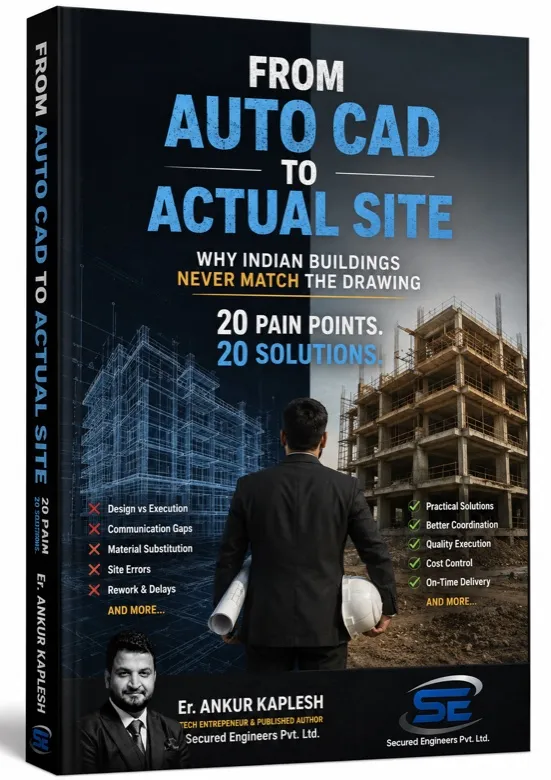
From AutoCAD to Actual Site: Why Indian Buildings Never Match the Drawing
20 pain points, 20 solutions — why projects drift from drawing to site, and how to close the gap. This blog series is adapted from it.
Articles by Er. Ankur Kaplesh
Field-tested lessons on MEPF, solar and why projects drift from drawing to site — written for the project managers, architects and owners who live these problems.
VRF vs Chiller Plant: Which HVAC System Should You Choose in India?
A direct, India-specific comparison of VRF and chilled-water plants — by capacity, running cost, plant room, payback and the building types each one suits best.
Read → Solar EnergyWhy Most Industrial Solar Underperforms (It Starts on Day 1)
Solar is not a product you buy — it is an engineering outcome. The decisions made before a single panel goes up quietly decide whether your plant saves money or loses it for 25 years.
Read → Project ManagementWhy Projects Get Delayed: It Is Coordination, Not Concrete
Most construction delays do not come from civil work — they come from multiple contractors who do not coordinate. Here is how a single MEPF execution partner keeps projects on schedule.
Read → HVACIs Your HVAC Costing You More Than It Should?
Poorly maintained commercial HVAC can waste up to 40% more energy every month. A simple, disciplined maintenance routine pays for itself many times over.
Read → Pharma & CleanroomsMEPF for WHO-GMP Pharma: The Audit Is Won in the Services Design
In a pharma plant, civil structure is not your compliance risk — your MEPF systems are. HVAC pressure cascades, cleanroom classification and fire design decide whether you pass a WHO-GMP audit.
Read → EngineeringThe Future of MEP Engineering: 5 Technologies to Watch
From AI-powered BIM clash detection to digital twins and net-zero design, five innovations are changing how buildings are engineered, built and operated.
Read → Fire SafetyHow to Get a Fire NOC in India: A Step-by-Step Guide
A Fire NOC is mandatory for most commercial and industrial buildings in India. Here's exactly what it is, who needs it, and the steps to get it cleared the first time.
Read → Solar EnergyRooftop Solar Payback in India: What Businesses Should Expect
For commercial and industrial rooftops, solar typically pays back in 3–5 years and then delivers free power for two decades. Here's how the maths works.
Read → EngineeringWhat is MEPF? The 'F' That Most Contractors Forget
MEPF stands for Mechanical, Electrical, Plumbing and Fire-fighting — the core systems that make a building work. Here's why integrating all four matters.
Read → MEP EngineeringMEP vs MEPF: What Indian Developers Should Look For in an MEP Contractor
MEP or MEPF? What the terms mean, why 'MEP contractor' is the global standard, and why the 'F' — fire protection — is what separates a safe building from a risky one.
Read → MEP EngineeringWhat Does an MEP Contractor Do? (And Why Fire Protection Belongs In-House)
A plain-English guide to what an MEP contractor delivers — the mechanical, electrical, plumbing and fire scope — and why the smartest teams keep fire protection under one roof.
Read → Project ManagementChoosing an MEP Contractor for a Factory or Warehouse: The Fire-Safety Checklist
Industrial buildings punish weak engineering. How to choose an MEP contractor for a factory or warehouse — with the fire-safety checklist owners most often miss.
Read → Design & DrawingsYour AutoCAD Drawing Is Lying to You — Why Perfect Plans Build Imperfect Buildings
Your drawing is precise to the millimetre. Your building won't be — and the gap between the two is where lakhs quietly disappear into rework.
Read → Design & DrawingsThe Client Conversation Every Architect Botches — and How to Say No Without Losing Them
The client wants a Manhattan penthouse on a 250 sqm plot. Say yes and you'll redesign for six weeks for free. Here's the conversation that saves the project.
Read → Site ExecutionWhy Your Building Quietly Shrinks Between the Drawing and the Site
You drew a 5-metre setback. The contractor built 3.5. The officer 'doesn't mind' — until a new officer does, and the owner sues you.
Read → MEP CoordinationThe Silent War Between Your Architect and Structural Engineer Is Costing You Lakhs
Your architect drew a perfect grid. Your structural engineer moved every column. Nobody coordinated — and your building now looks compromised instead of intentional.
Read → MEP CoordinationYour Plumber Has Never Seen Your Drawing — and That Leak Will Prove It
Your plumber is skilled, fast, and has never opened your drawing. He routes a pipe under a load-bearing beam — and two years later, the ceiling grows mould.
Read → ElectricalWhere Wires Go to Die: Why Indian Electrical Layouts Fail Every Single Time
Your switches end up at shoulder height, your lights cast shadows on your desk, and your bathroom has no ELCB. None of it was on the drawing — and all of it was preventable.
Read → Design & DrawingsThe Column That Wasn't on the Drawing — How One Beam Ruins a Living Room
You designed an open living room. The structural engineer added a column in the middle of it to save on beam depth — and nobody told you until the slab was poured.
Read → Design & DrawingsVastu vs. Your Floor Plan: The Fight That Quietly Wrecks Indian Homes
The client approves your design — then hires a Vastu consultant at 60% construction who wants the kitchen moved three metres. Here's how to integrate Vastu instead of fighting it.
Read → Site ExecutionYour Contractor Reads '1:100' Differently Than You Do — and It Shows on Site
You mark 3 metres on the drawing. The room gets built at 2.7. The gap between your AutoCAD file and physical reality is where designs quietly die — here's how to close it.
Read → Materials & QualityWhat You Specified Is Not What's in Your Wall: The Substitution Scam in Plain Sight
You specified Kajaria tiles and 53-grade cement. Three weeks later it's a local tile and a dropped cement grade — same colour, half the price, all the risk. Here's how to stop it.
Read → Quality & Safety'Don't Worry, I'll Supervise' — The Four Words That Cost You the Most
A site supervisor paid by the contractor is not your quality control — he is the contractor's. Here is why most Indian site supervision is theatre, and the system that turns it back into reality.
Read → Quality & SafetyWhy Indian Staircases Are Secretly Dangerous — and the One Number Everyone Gets Wrong
Staircases are the most commonly botched element in Indian construction — and the most dangerous. The villain is one number: the riser height nobody keeps uniform.
Read → Site ExecutionEvery Contractor Promises It. Every Monsoon Breaks It: The Truth About Waterproofing
Waterproofing is not a technical problem — it is a design problem. Treat it as an afterthought and two monsoons later your terrace is a pond and your bathroom is in the bedroom below.
Read → MEP CoordinationThe Lakhs-Sized Mistake of Treating AC and Wiring as an Afterthought
Design a clean 200 mm false ceiling, then call the MEP contractor three months later — and watch your floor height collapse. AC, wiring and fire systems are not afterthoughts; they are the building.
Read → Approvals & ComplianceWhen the Municipality Quietly Redesigns Your Building — and You Pay for It
You designed 2.2 FAR; the authority calculated 2.0 and told you to cut 20%. When you skip the regulations before designing, bureaucracy redesigns your building for you — at your cost.
Read → Site Execution'Skilled Labour' on Paper, Experiment on Your Site: How to Tell the Difference
A mason with 15 years of experience can still wreck a facade he has never built before. On Indian sites, 'skilled' is a label — not a guarantee. Here is how to close the gap before it cracks your drawing.
Read → Construction StrategyThe Budget Cut That Looks Smart on Day 1 and Haunts You for 20 Years
Mid-project budget cuts are not a maybe in India — they are inevitable. The difference between value engineering and value cutting decides whether you save money or quietly destroy your building.
Read → Materials & QualityWhere Good Buildings Go to Die: The Finishing Stage Nobody Watches
The structure can be flawless and the building still feels cheap — because finishes are what you touch, see, and feel. And finishing is exactly where Indian quality collapses.
Read → Site ExecutionThe Most Expensive Lie in Construction: The 'As-Built' Drawing Nobody Updates
The drawings you hand over at the end of construction rarely match the actual building. Everyone agrees to the fiction — until a pipe leaks and nobody can find it.
Read → Construction StrategyCan an Indian Building Ever Match Its Drawing? The Honest Answer — and the Fix
In India, buildings are inspired by the drawing, not built to it. The gap is real — but it is not destiny. Here is how to make it smaller, and why one accountable partner shrinks it fastest.
Read →Ready to start your project?
Get a free consultation and quote. We design, take all approvals, and execute — you stay stress-free.