
The Budget Cut That Looks Smart on Day 1 and Haunts You for 20 Years
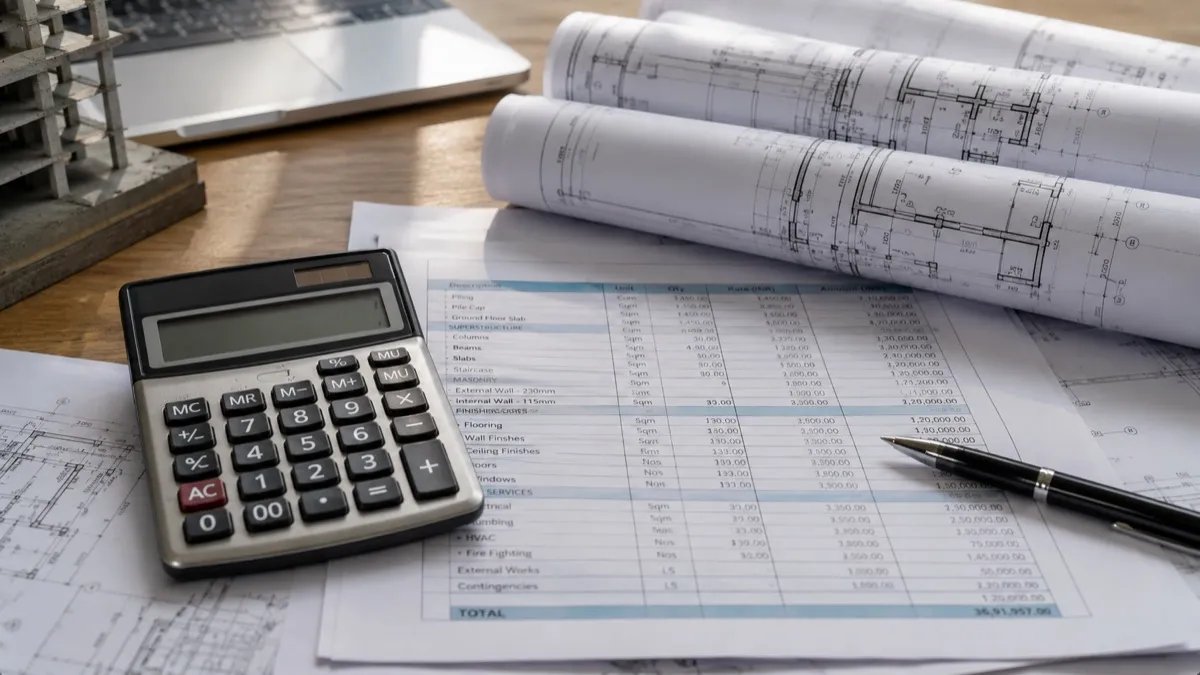
You spent three months designing the perfect office in Ludhiana. The client loved it. Approvals came through. Construction started. Then month four happens — a loan stalls, a payment slips, the CEO gets nervous about quarterly numbers. The call comes: "We need to cut the budget by 20%. Can you make it work?"
Every architect and project owner in India dreads this moment. The problem is not just the money. It is the speed — you have days to redo what took months. It is the pressure — the contractor is waiting. And it is the blame — when the building feels wrong later, someone points and says, "This isn't what we approved."
Here is the truth most people miss: the client does not want a worse building. They want to spend less money. Those are two completely different things — and confusing them is how good buildings turn mediocre.
Value engineering vs value cutting
Value engineering means getting the same quality for less money. Value cutting means getting less for less. Most of what happens on Indian sites is value cutting dressed up in the language of value engineering.
- Real value engineering: You specified Italian marble for the lobby. You find a high-quality Indian marble that looks similar, costs around 40% less, and performs just as well. The lobby still looks beautiful. Everyone wins.
- Value cutting: You swap the marble for cheap ceramic. It looks cheap, wears fast, and in five years it is stained and broken. You "saved" 30% on materials and created a maintenance nightmare.
Before any cut, you need a hierarchy that the client signs off on:
- Tier 1 — non-negotiable: structural integrity, waterproofing, ventilation, electrical capacity, fire safety. Cut here and you buy serious problems.
- Tier 2 — flexible with limits: interior finishes, premium materials, landscaping, comfort features. Reducible, but with real consequences for how the building feels.
- Tier 3 — first to cut: decorative extras and premium options that do not affect function.
The domino effect nobody prices in
Every cut has downstream effects. A Mohali developer cut Italian corridor stone for cheap ceramic and saved roughly Rs. 8 lakh. The corridors looked institutional and cheap, buyers noticed, sales slowed, and the project lost far more in pricing and pace than it ever saved on tiles. A Ludhiana commercial building downgraded its HVAC zoning to save around Rs. 15 lakh; three years later, uneven cooling and high energy bills meant retrofitting a proper system at roughly double that, plus a damaged reputation.
The pattern repeats: cut the facade and the building looks cheap from the street; cut MEP and systems fail early with spiking maintenance; cut structure and durability problems surface in 5–10 years. Worst of all, cut without a plan and you lose the narrative — when something looks bad later, the client forgets they made the call and remembers your original design as something better.
Protecting design intent on a tight budget
The professionals do not improvise under pressure. They prepare:
- Build the cut scenario before it is needed: base case, value-engineered (10–15% reduction), and tight case (20–25%). When the call comes, you pull out a prepared option instead of panicking.
- Pre-approve alternatives: for every expensive material, identify Indian options that look acceptable and perform adequately — and get them signed off in advance.
- Carry contingency: show a 10–15% contingency openly so cost increases do not force design cuts.
- Phase the build: sometimes the answer is not lower quality but staged construction — core first, enhancements later — so the client never has to cut at all.
- Document every change in writing, with the consequence stated and the client's sign-off attached.
Smart cost management starts before the cut
The real defence begins on day one. Track costs relentlessly and weekly — most projects do not know their true number until the end, by which time a small drift has become a crisis. A minor correction at month three is infinitely cheaper than a brutal cut at month seven. Negotiate with suppliers early, build relationships, and get competitive quotes well before you need the material, so that when you need a price break you have suppliers who trust you. Favour local materials and local labour: imported items are expensive, harder to source, and often perform worse in local climate than well-chosen Indian alternatives. And whenever you present options, show the cost-versus-quality trade-off openly — Italian marble at one price and lifespan, Indian granite at another, ceramic at a third — so the client makes informed decisions and already knows what trade-off they are accepting if money gets tight.
How Secured Engineers Pvt. Ltd. keeps the cut from haunting you
Budget cuts go wrong when design, costing, and execution sit in separate hands — the designer does not know the real site cost, and the contractor cuts whatever is easiest to source. Secured Engineers Pvt. Ltd. runs MEPF and Solar projects as one accountable chain, so cost intelligence lives inside the design. We tier the scope with you from day one, carry contingency openly, and keep a library of pre-approved Indian alternatives — so when the budget tightens, we protect the Tier-1 systems that keep your building working for 20 years and cut only where it genuinely does not hurt. Because the same team owns design and execution, every change is documented, costed, and consequence-checked before it touches the slab.
If you are heading into a project where the budget might move mid-way, plan the cuts before they are forced on you. Get a free MEP quote with a tiered, contingency-backed scope. And for the full playbook on protecting design intent, read "From AutoCAD to Actual Site" by Er. Ankur Kaplesh — get notified at launch.
More insights
VRF vs Chiller Plant: Which HVAC System Should You Choose in India?
A direct, India-specific comparison of VRF and chilled-water plants — by capacity, running cost, plant room, payback and the building types each one suits best.
Solar EnergyWhy Most Industrial Solar Underperforms (It Starts on Day 1)
Solar is not a product you buy — it is an engineering outcome. The decisions made before a single panel goes up quietly decide whether your plant saves money or loses it for 25 years.