
Why Your Building Quietly Shrinks Between the Drawing and the Site
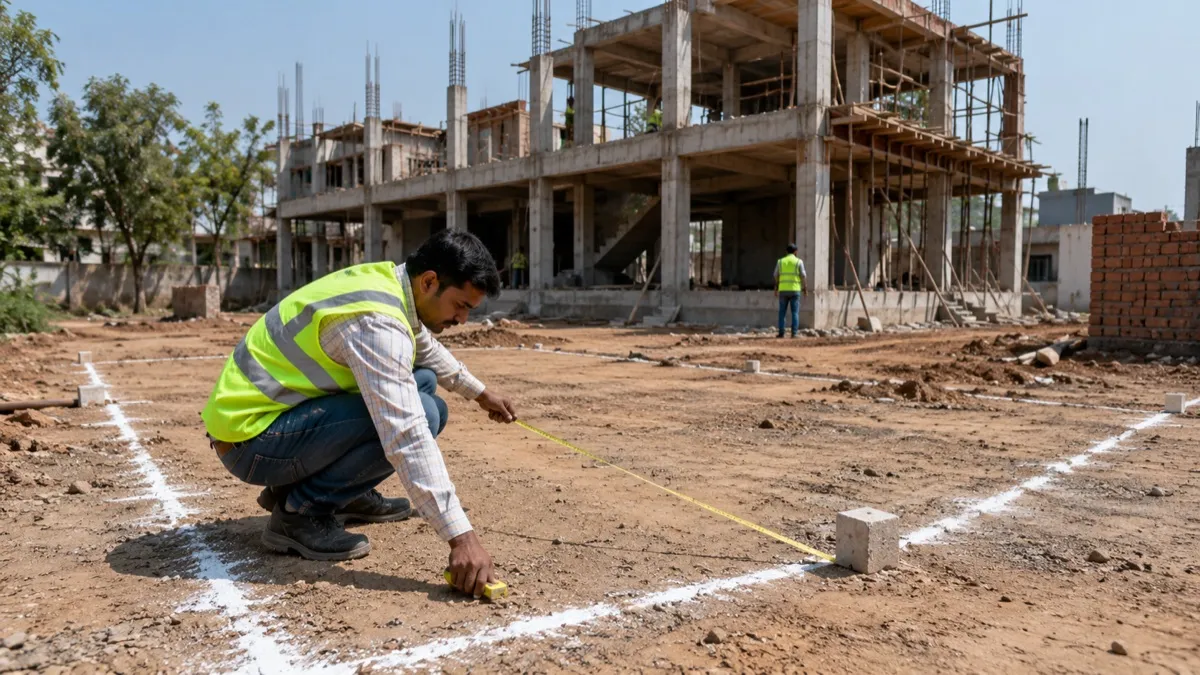
You design a residential building in Mohali, follow every NBC setback — 5m front, 3m sides, 2m rear — get written municipal approval, and issue the drawings. Six months later you visit. The building is closer to the front boundary than you drew. You measure: 3.5 metres, not 5.
The contractor shrugs: "The neighbour's wall extends further. Keeping 5 metres lost us 1.5 metres of usable area, so we reduced it. The officer came. He didn't mind." You call the authority. The officer confirms: "The approval is 5 metres. But many buildings here have 3.5. As long as nobody complains, I won't enforce it." Now you own a building that matches neither your approval nor your drawing — and may be violating bylaws. This is the setback problem: the gap between what's approved, what's drawn, and what's actually built.
The Neighbour Problem
Indian plots rarely stand alone. If the neighbour built 2 metres closer than the law allows, your full 5-metre setback looks like an odd gap — and they notice. They lean on the contractor: "Why are you taking so much setback when we didn't?" The contractor, who fears the neighbour more than the bylaw, decides to shave a metre and "blame the architect if there's a problem."
Sometimes it turns to outright blackmail. In one Jalandhar case, a builder lawfully kept a 3m setback next to a neighbour's illegal-but-old 2m building. The neighbour complained that the new gap was "ugly." The officer reasoned that the legal new building would be seen as the problem — and the builder was pushed to cut his setback from 3m to 2.5m just to keep the peace.
Municipal Rules Nobody Follows
Bylaws are inconsistent and change constantly. Ludhiana, Jalandhar, Chandigarh and Delhi each measure setbacks differently, and the rules shift between submission and construction. A Delhi architect designed to the 2016 DDA bylaws; by the time work started two years later, the rules were stricter and the whole scheme had to be redesigned. In Derabassi, an officer gave "informal approval" for a 4m setback instead of 5m. A year later a new officer declared the previous one had no authority, called it a violation, and threatened to seize the building. The owner sued the architect.
Approval Is Not Compliance
Here is the trap most architects fall into: they assume an approval stamp means the design is compliant. It doesn't. Approval means an officer stamped it on a given day — not that he reviewed it properly, not that the rule won't change, not that it will be enforced as written. One Chandigarh building was "approved" with parking for 75 cars when the law required 100; the officer never checked the calculation. When an auditor caught it, the builder sued the architect — even though the officer had approved it — simply because the architect had submitted it.
Design for Compliance, Not Approval
Competent architects design for compliance — the reality of whether the building breaks the law — not for a stamp. The book lays out a clear protection plan:
- Research the bylaws in full. Not the summary — the complete text. What counts as the plot boundary? Do balconies count? Is setback measured from finished surface or boundary? What are the exemptions and who enforces them? Where it's unclear, ask in writing.
- Design for the strictest interpretation. Today's lenient officer is tomorrow's strict one; today's friendly neighbour can turn hostile. If your design survives the strictest reading, it survives any officer. If the law says 3m, design for 3.5m.
- Mark setbacks physically on site. A Mohali architect had the contractor paint the 5-metre line in bright yellow at the site entrance. Every truck parked outside it, every worker saw it, nobody had an excuse to creep closer. It costs almost nothing and works better than any drawing.
- Get written clarification from the authority. If your design leans on an interpretation — say, a planter exempt from the setback — get it in a letter. When a Jalandhar project faced a violation claim three years after handover, written correspondence from the (now retired) officer confirming the exemption ended the case instantly.
A Setback Protection Timeline
- Research and clarify: obtain official bylaws, meet the authority, get setback definitions and exemptions in writing.
- Design with conservative margins: add 10-15% to setbacks and document the margin.
- Get formal approvals: submit with full setback calculations and bylaw citations, then secure a dated approval letter.
- Mark physically before construction: survey precisely, paint the lines, photograph them, hand the photos to the contractor.
- Monitor continuously: check at foundation and at wall stage; correct any deviation immediately, before it compounds.
- Close with a compliance certificate: get it after inspection and keep it on file for any future dispute.
How an Integrated Partner Protects You
Setbacks vanish in the silence between design, approvals and execution — where the architect is reachable once a month and the contractor decides on the spot. At Secured Engineers Pvt. Ltd., design, statutory approvals and site execution run as one accountable team. Our engineers research the local bylaws, secure written clarifications, physically mark the setback lines before a single foundation is poured, and verify them at every stage. Your building stays exactly where it was approved to stand — and you stay out of court.
From the upcoming book by our founder — get notified at launch. Worried your approvals and your site won't match? Talk to our engineers.
More insights
VRF vs Chiller Plant: Which HVAC System Should You Choose in India?
A direct, India-specific comparison of VRF and chilled-water plants — by capacity, running cost, plant room, payback and the building types each one suits best.
Solar EnergyWhy Most Industrial Solar Underperforms (It Starts on Day 1)
Solar is not a product you buy — it is an engineering outcome. The decisions made before a single panel goes up quietly decide whether your plant saves money or loses it for 25 years.