
Your Contractor Reads '1:100' Differently Than You Do — and It Shows on Site
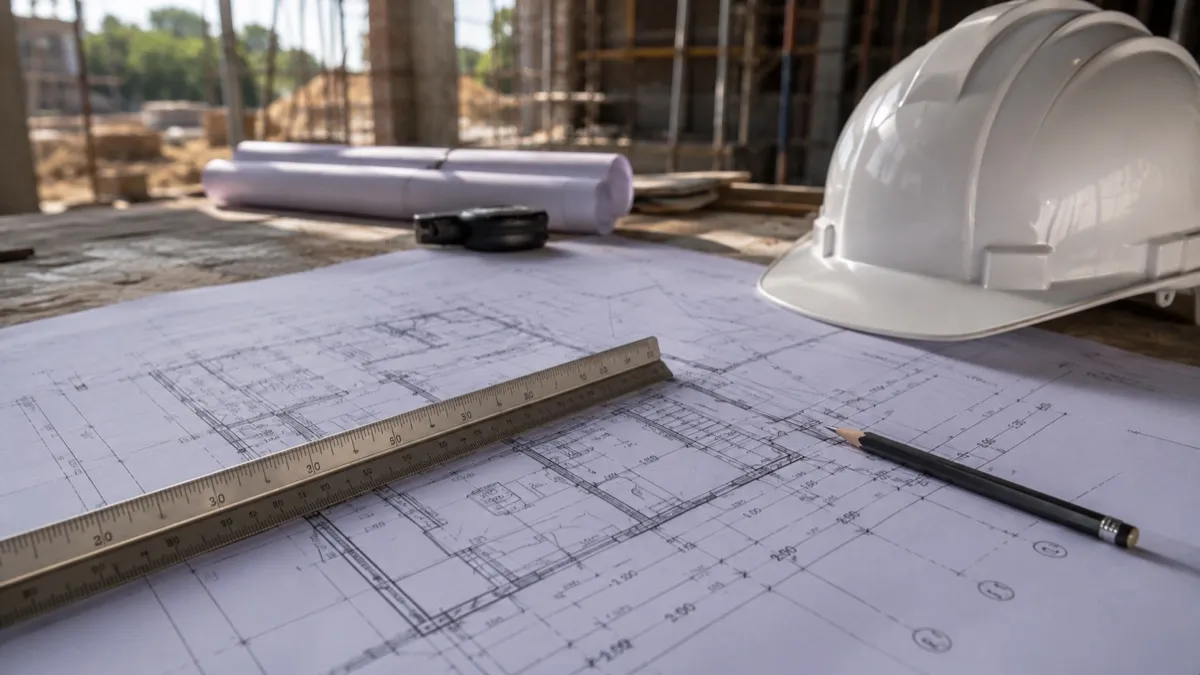
You spend two weeks perfecting a floor plan in AutoCAD. Everything is to scale, every dimension clear. You mark 3 metres. Three months later you visit the site in Ludhiana and the room is 2.7 metres. The contractor looks puzzled: "Sir ji, the drawing is on paper only. We built what looked right." A 30-centimetre miss in a bedroom seems small until you try to fit furniture; a 15-centimetre error in ceiling height breaks a minimalist design; a 5-centimetre slip on a staircase becomes a safety hazard. The gap between your digital drawing and physical reality is where designs quietly die.
Why contractors can't read your drawings
Be honest about skill levels. A structural contractor in Jalandhar may have learned the trade in the 1990s and build flawless walls — but reading a 1:100 AutoCAD sheet is a different world. Most contractors learn by doing, not by reading. They understand hand sketches, physical demonstrations, "make this corner like that corner." A sheet of abstract lines is foreign. And many won't admit it — they'll nod, smile, guess, and ask the mason, who asks the supervisor, until the interpretation reaching the person with the hammer is a game of broken telephone. In one Chandigarh case a "12-foot ceiling" was read as 12 feet to the bottom of the beam instead of the finished ceiling — and the office ended up looking like a basement.
When 1:100 means nothing
You think setting the drawing to 1:100 makes it clear. But ask a contractor what scale means and half will guess; some don't know a scale is marked at all and will literally lay a tape measure on the printed line. Even those who know 1:100 may misjudge a 3 cm line as 2.5 cm — and you're 50 centimetres short. Worse, drawings get reprinted at the wrong size: you issue A1 at 1:100, the supervisor prints it from email at A4, and now it's effectively 1:200. In one Jalandhar project a wrong-scale printout turned a 3.6 m room into 1.8 m — a 50% error that meant demolition and rebuild, roughly ₹3,50,000 in lost time and materials, with the contractor blaming "poor quality drawings." Most Indian contractors have never used a scale ruler in their life. The solution is not to teach scale better — it's to design drawings that work even when scale is ignored.
Dimension chains that confuse everyone
A single dimension line is ambiguous: is it wall-to-wall, centre-line, outside edge or inside edge? In Rajpura a corridor dimensioned at 2.5 m was measured wall-outside to wall-outside; with 200 mm walls each side, the usable width collapsed to 2.1 m. Dimension chains are worse — contractors add them wrong, measure only the middle segment, or skip the last one assuming the wall "accounts for it." A Derabassi kitchen island ended up centred instead of offset because the contractor read only the island width and ignored the dimensions on either side. Your dimensioning has to be so clear that even someone who hates reading drawings gets it right.
Making drawings contractor-proof
Stop assuming the contractor will read your drawing the way you intended — assume he won't, and design so he can't get it wrong:
- Explicit written dimensions on everything: not "3000," but "3.0 M CLEAR WIDTH," or better, "3.0 M from centre line of column A to face of wall B."
- Reference fixed points: contractors think in columns, walls and slabs. "Window at 2.5 M from centre of column C5" beats "5.5 M from the start of the corridor."
- A separate Contractor's Verification Sheet: blow-up details, bold callouts, reference photos of the final result, and a checklist of critical dimensions. One Ludhiana fit-out used exactly this — 12 photos and 8 checks per room, hung on site — and finished with zero errors, first time.
- One consistent print standard: every sheet at 1:100 on A1, professionally printed, three controlled sets on site. One Jalandhar firm did this and errors dropped by 70%.
- Colour-code criticality and build in redundancy: red for safety dimensions, blue for quality, green for flexible — and show each critical dimension in plan, section, grid and specification so a wrong reading gets caught.
That redundancy is the quiet hero. On one Chandigarh job a 3.6-metre corridor was shown five different ways: marked on the floor plan, marked on a building section, defined as the distance between two grid lines, broken into a dimension chain (1.2 + 1.2 + 1.2), and written into the specification as "3.6 M clear width, exclusive of wall thickness." When the contractor measured it wrong the first time, the sheer number of cross-references made him re-check — and he caught his own error before a single wall went up. That is the whole game: don't rely on the contractor reading one line correctly; give the correct answer so many times that getting it wrong is harder than getting it right.
How Secured Engineers Pvt. Ltd. closes the drawing-to-site gap
The reason a drawing becomes 2.7 metres instead of 3 is that design and execution are handled by different people who never share a language. Secured Engineers Pvt. Ltd. is an integrated MEPF execution contractor — the team that produces the coordinated drawings is the team that runs the site. That means contractor-proof drawings backed by real on-site verification: dimensions referenced from fixed structures, critical measurements checked with a tape on day one, and the same source of truth in the site office, with the engineer and the execution crew. The gap where designs die simply doesn't get a chance to open up.
This is Chapter 9 of Er. Ankur Kaplesh's "From AutoCAD to Actual Site — Why Indian Buildings Never Match the Drawing." Twenty pain points, twenty solutions — get notified at launch. And if you want your next project built to the drawing, not to "what looked right," get a free MEP quote from Secured Engineers Pvt. Ltd.
More insights
VRF vs Chiller Plant: Which HVAC System Should You Choose in India?
A direct, India-specific comparison of VRF and chilled-water plants — by capacity, running cost, plant room, payback and the building types each one suits best.
Solar EnergyWhy Most Industrial Solar Underperforms (It Starts on Day 1)
Solar is not a product you buy — it is an engineering outcome. The decisions made before a single panel goes up quietly decide whether your plant saves money or loses it for 25 years.