
Where Wires Go to Die: Why Indian Electrical Layouts Fail Every Single Time
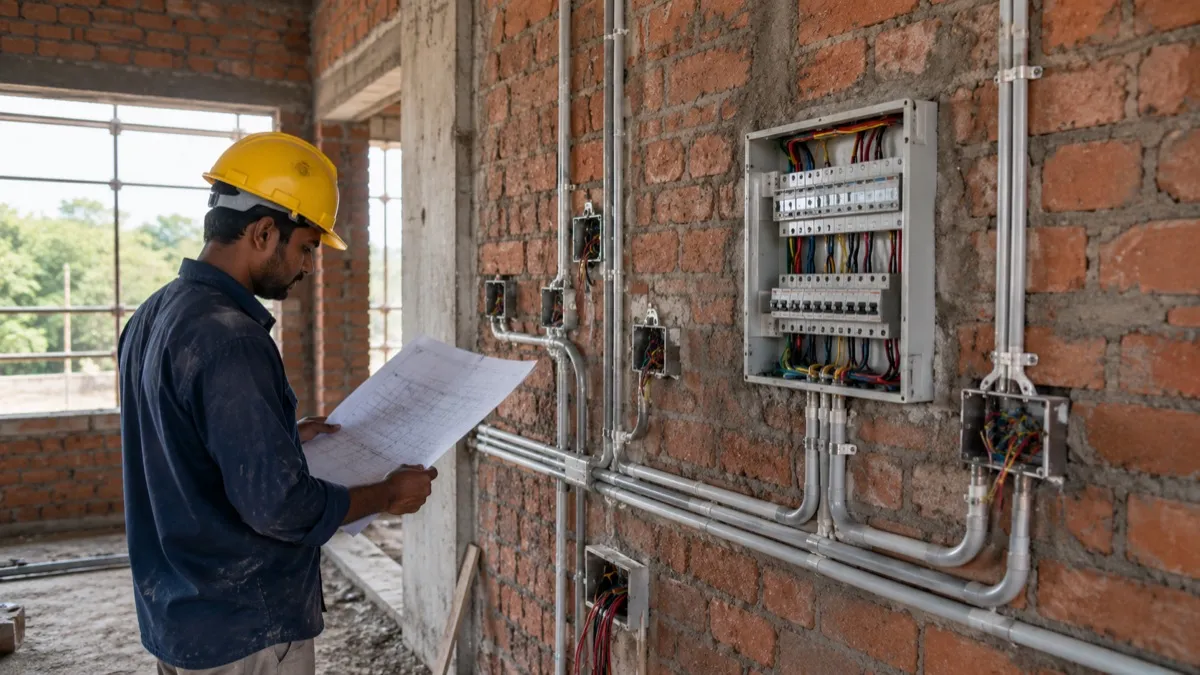
You design a clean, minimal office in Mohali. Switches at the standard 1.2 metres. Ceiling lights placed for even illumination. Then the electrician arrives — he has three other sites and is in a hurry. The instruction he gets is one line: "Install lights and switches." No detailed layout. No reflected ceiling plan. No coordination meeting.
So he installs the main switch at 1.8 metres, because that is easy to reach from a ladder. He drops ceiling lights wherever the conduit happens to run — one centred over a desk, casting a shadow exactly where you work; another stranded at the edge of the room. An AC conduit runs diagonally across the ceiling, fully visible from below. The client moves in, reaches for a switch at 1.2 metres out of habit, and touches bare wall. This happens in roughly 90% of Indian commercial and residential projects.
The switch height problem: small detail, big damage
Every architect knows the standard — switches at 1.2 m, lights centred over the spaces people actually use, fans positioned for airflow rather than parked under a light fitting. But that knowledge almost never reaches the electrical contractor in writing. He works with what is convenient, and convenient is not the same as correct.
- Switches too high (1.6–1.8 m): easy to install, but they waste wall space, look amateurish, and are uncomfortable for shorter people and children.
- Switches too low: get bumped by furniture and look odd on a tall wall.
- Random light positions: installed wherever the conduit naturally runs, so illumination is uneven and shadows fall exactly where you read or cook.
The root cause is simple: architects don't communicate electrical layouts in detail, and electricians have no reference — so they make convenience-based decisions and quietly become the designers.
The ceiling that should never have been visible
On a 600-square-metre office fit-out in Ludhiana's Focal Point, an electrician was handed a basic floor plan — no electrical layout, no conduit routing plan, no reflected ceiling plan. To save cost he ran conduit in the most direct path he could: one line diagonally across the full width, another parallel to it, a third perpendicular, forming a visible grid above the false ceiling. When the ceiling was later opened for maintenance, it looked like a 1990s factory. The fix — strip the false ceiling, re-route every conduit cleanly, reinstall — ran to around ₹75,000 and ten days of delay, all of it avoidable.
The load calculation nobody does
This is where bad electrical planning stops being ugly and starts being dangerous. A kitchen with a cooktop, water heater, microwave and the usual appliances can demand 14–15 kW if a few run together — but a single 20 A circuit at 240 V handles only around 4.8 kW continuously. The breaker trips during peak cooking. Worse, the electrician sometimes "fixes" the nuisance by bypassing the breaker — and now you have a fire risk baked into the wall. Proper load calculation accounts for installed capacity, demand and diversity factors, and future expansion. IS 1365 spells this out. Very few electricians follow it, and most architects never specify it.
The safety standard nobody follows
Indian bathrooms are high-moisture rooms full of geysers, exhaust fans and pumps. IS 1365 requires an ELCB (Earth Leakage Circuit Breaker) on every bathroom circuit — a device that trips on a leak as small as 5 mA and cuts power instantly. Yet in a large share of apartments the ELCB is simply missing, because it costs a little extra, it isn't visible when absent, and nobody specified it. Everything works fine — until a corroded geyser element develops a fault and a family member is standing in water. That is the difference between a ₹1,500 device and a hospital bill.
How an integrated MEP partner prevents all of this
Every one of these failures shares the same cause: the electrical work is treated as an afterthought, handed to a separate contractor with no coordinated drawing. That is precisely what Secured Engineers Pvt. Ltd. is built to prevent. As an integrated MEPF (Mechanical, Electrical, Plumbing, Fire) contractor, we do the electrical design and the execution under one roof — so the layout, the reflected ceiling plan, the conduit routing and the load schedule are coordinated before anyone picks up a drill.
- Detailed layouts and RCPs: every switch, outlet, light and fan is positioned and dimensioned — switches verified at 1.2 m, lights centred over real functional zones.
- Real load calculations: circuits separated and sized for simultaneous use, with breaker ratings and cable gauges to match (2.5 sq mm lighting, 4 sq mm for 16 A, 6 sq mm for 32 A).
- Safety by default: ELCBs on bathroom, kitchen and outdoor circuits, proper earthing in moist soil, and megger plus trip testing before power-on, all to IS 1365.
- Coordination with structure and plumbing: conduits that don't clash with pipes, beams or HVAC — because the same team owns all of it.
The maths is brutal in your favour. A few hours of proper electrical coordination — detailed layout, specifications and a pre-execution meeting — costs a fraction of the rework it prevents. As the book puts it, every hour invested in electrical coordination saves many times that in future corrections.
This chapter is one of twenty in Er. Ankur Kaplesh's book "From AutoCAD to Actual Site — Why Indian Buildings Never Match the Drawing." Want the full set of 20 pain points and 20 solutions? Get notified at launch. And if you'd rather your next project simply be wired right the first time, get a free MEP quote from Secured Engineers Pvt. Ltd.
More insights
VRF vs Chiller Plant: Which HVAC System Should You Choose in India?
A direct, India-specific comparison of VRF and chilled-water plants — by capacity, running cost, plant room, payback and the building types each one suits best.
Solar EnergyWhy Most Industrial Solar Underperforms (It Starts on Day 1)
Solar is not a product you buy — it is an engineering outcome. The decisions made before a single panel goes up quietly decide whether your plant saves money or loses it for 25 years.