
Why Indian Staircases Are Secretly Dangerous — and the One Number Everyone Gets Wrong
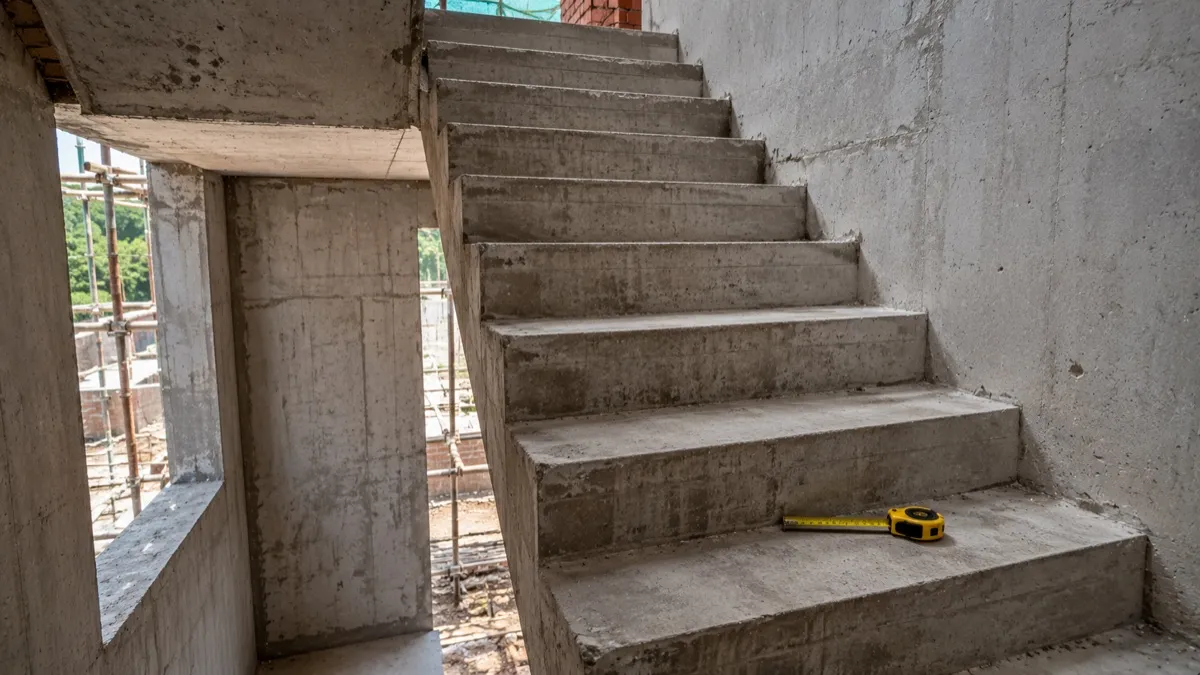
You have seen it on every project. Treads so narrow you walk sideways. Risers so high that climbing feels like mountaineering. A flight that does not quite fit between floors — so someone hacked the top step to make the maths work. Staircases are the most commonly botched element in Indian construction, and also the most dangerous. A bad staircase causes falls; falls cause injuries; injuries cause liability. And still they get built wrong, again and again.
Why staircases go wrong
A staircase is three connected problems, and all three must succeed: the maths must be perfect, the contractor must understand the maths, and the contractor must execute it precisely. Usually one fails.
The maths itself is not hard. Take 3000 mm floor-to-floor: at a 180 mm target riser you get 16.67 steps — but you cannot build two-thirds of a step. Sixteen steps means 187.5 mm each; seventeen means 176.5 mm each. Pick one, then divide the available run by the number of treads. That is the whole calculation. The trouble is that on most sites nobody actually does it. The crew eyeballs the opening, guesses the number of steps, starts building — and by the top floor the maths does not close, so they "fix" it by varying the last few steps.
The one number everyone gets wrong: riser height
The human body climbs stairs on a learned rhythm. If every riser is 175 mm, your foot lands predictably and you feel safe. The instant the heights vary — one step 160 mm, the next 190 mm — that rhythm breaks, your foot lands wrong, and you stumble. This is not aesthetic fussiness; it is the mechanism of the fall.
The codes are explicit. NBC and IS 4398 call for risers of 150–200 mm (175 mm preferred), treads of 250–300 mm, and — the part everyone ignores — all risers in a flight uniform, with a maximum variance of about 5 mm. "Roughly 175" is not the same as "exactly 175 each." A contractor who builds 168 mm here and 182 mm there is only 14 mm out per step, but across twenty steps that variation accumulates into a staircase that genuinely feels — and is — unsafe.
The classic killers:
- The top-step problem. Steps are correct until the last one does not fit, so the crew just makes it taller. Nineteen steps at 175 mm and one at 230 mm is a trip hazard waiting at the top.
- The floor-finish problem. The concrete is a perfect 180 mm — then tile, granite or carpet is added without accounting for thickness. Final risers now wander between 165 and 185 mm.
- The two-contractor problem. The structural crew casts the concrete steps; a separate finishing crew lays granite on top, assuming the concrete below is level. It is not. Some finished risers end up 195 mm, others 185 mm.
The hazards you cannot see until you walk it
Headroom disappears. NBC requires a minimum 2100 mm clear from the step to the soffit. Designers calculate to the tread and forget the nosing, the slab thickness, the duct crossing above, the plaster ceiling adding 25 mm. A staircase measured at exactly 2100 mm can still force tall users to duck once the nosing is counted — and ducking on stairs is dangerous.
Landings that do not exist. A landing must be at least the tread depth in the direction of travel and the full stair width across. "275 mm landing" gets misread as 275 mm × 275 mm — a tiny square where two people collide on a turn, where a door swings into the flight, where a wheelchair can never turn. One building had to redesign its entire staircase years later because the landings were too small to ever fit an accessibility lift.
Design that makes errors nearly impossible
Stop assuming the contractor will interpret a complex specification correctly. Engineer it so error is hard:
- A dedicated staircase layout sheet — every step numbered, every riser and tread dimensioned, headroom and landings marked, with the instruction in plain words: "ALL risers EXACTLY 175 mm, variance max 3 mm."
- A 1:1 template. Mark and verify the first three steps at full scale before the rest are built. For granite, cut a template block and check every step against it.
- Floor-finish accounted for upfront: "Finished riser must be 175 mm including finishes — cast the concrete 15 mm lower."
- Verification at every floor with a levelling staff (not a tape), measured at five points per step, photographed and logged, corrected before anyone proceeds.
Why one integrated team gets stairs right
Notice how many of these failures live in the seams — between designer and contractor, between the structural crew and the finishing crew, between the drawing and the code check. When those parties are strangers, the staircase is where their misunderstandings physically accumulate.
At Secured Engineers Pvt. Ltd., design, code compliance and execution run as one accountable workflow. The team that calculates the risers and checks them against NBC and IS 4398 is connected to the team verifying every step on site before the next floor goes up. Floor finishes are designed in from the start, not discovered at handover. There is no "structural crew assumed the finishing crew would fix it" — because it is one chain of responsibility.
This is one of the twenty pain points Er. Ankur Kaplesh tackles in From AutoCAD to Actual Site. Get notified at launch, and if you want a building where the most-used element is also the safest, get a free MEP quote.
More insights
VRF vs Chiller Plant: Which HVAC System Should You Choose in India?
A direct, India-specific comparison of VRF and chilled-water plants — by capacity, running cost, plant room, payback and the building types each one suits best.
Solar EnergyWhy Most Industrial Solar Underperforms (It Starts on Day 1)
Solar is not a product you buy — it is an engineering outcome. The decisions made before a single panel goes up quietly decide whether your plant saves money or loses it for 25 years.