
MEP vs MEPF: What Indian Developers Should Look For in an MEP Contractor
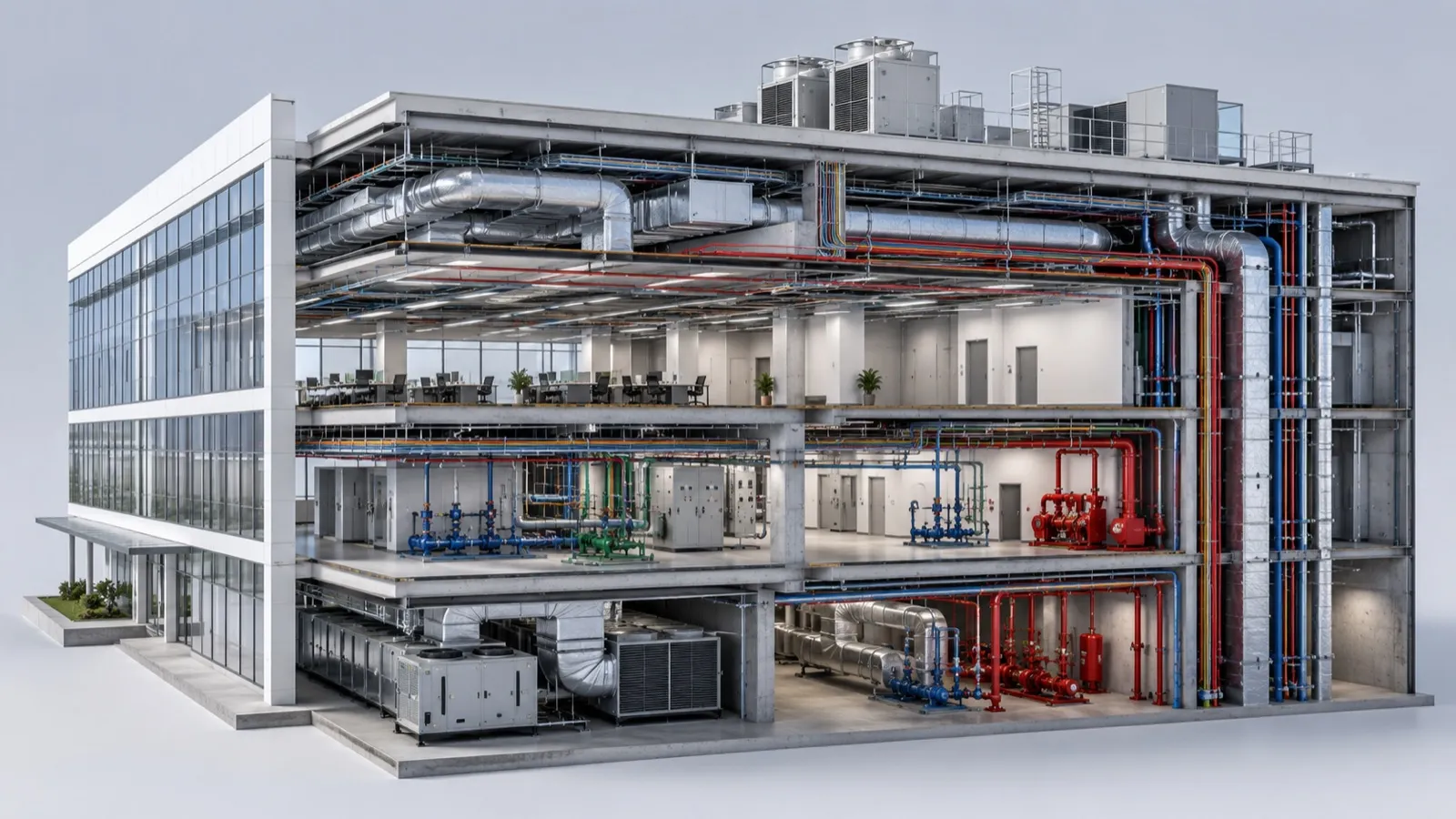
If you are shortlisting engineering partners for a commercial, industrial or institutional building, you have probably seen two acronyms used almost interchangeably: MEP and MEPF. They are closely related — but they are not identical, and understanding the difference is the quickest way to judge whether a contractor will actually keep your building safe, compliant and on schedule.
What does MEP stand for?
MEP stands for Mechanical, Electrical and Plumbing — the three core systems that make a building work. Mechanical covers HVAC (heating, ventilation and air-conditioning); Electrical covers power distribution, lighting and backup supply; Plumbing covers water supply, drainage and sanitation. "MEP contractor" is the globally recognised, industry-standard term for the firm that designs, installs and commissions these systems, and it is the phrase most architects, PMCs and international clients search for.
Then what is MEPF — and where does the "F" come from?
MEPF adds Fire-fighting — fire protection — to the same scope. In India this matters enormously. The National Building Code (NBC 2016) and state fire rules make hydrant systems, sprinklers, detection, alarm and a valid Fire-NOC mandatory for most commercial, industrial and high-rise buildings. That is why many Indian firms describe themselves as MEPF: the "F" reflects a discipline that is legally and physically inseparable from the rest of the building services.
The simplest way to hold both ideas together: every MEPF contractor is an MEP contractor — but not every MEP contractor handles fire protection in-house. That gap is exactly what you should check before you sign.
MEP vs MEPF at a glance
| Aspect | MEP | MEPF |
|---|---|---|
| Scope | Mechanical, Electrical, Plumbing | MEP + Fire-fighting / fire protection |
| Common usage | Global industry-standard term | Common in India, where fire is regulated separately |
| Statutory link | CEIG (electrical), water & drainage approvals | All of MEP plus Fire-NOC and fire-department liaison |
| Best for | Describing the overall engineering package | Signalling that fire safety is owned, not sub-let |
Why the "F" is the detail that separates safe from risky
When fire protection is sub-contracted to a separate vendor, it becomes the most common source of coordination failure on Indian sites. Sprinkler mains clash with ducts and cable trays because two teams drew their layouts in isolation. The Fire-NOC gets held up because the as-built reality never matched the approved fire scheme. The building is physically finished but cannot legally be occupied. An MEP contractor that also owns fire protection services in-house designs all four disciplines on one coordinated set of drawings — so clashes are resolved on paper, not with a cutting wheel on site.
How to vet an MEP contractor in India
- Ask who does the fire scope. If the answer is "we appoint a fire vendor", you are back to multi-party coordination. Prefer a single accountable team.
- Check statutory ownership. A strong partner takes Fire-NOC, CEIG electrical inspection and DISCOM approvals in-house, not "with your support".
- Look for coordinated drawings. Ask to see a combined services drawing — HVAC, electrical, plumbing and fire on one sheet. Its absence predicts site clashes.
- Verify track record and certification. ISO 9001, completed projects of a similar type, and real references matter more than the lowest quote.
The bottom line
"MEP contractor" is the term the industry uses; "MEPF" simply makes the fire discipline explicit. What matters is not the acronym on the brochure but whether one accountable team designs, approves and builds all of it. Secured Engineers Pvt. Ltd. is a single-window MEP contractor in India that owns mechanical, electrical, plumbing, fire and solar under one roof — with every statutory approval handled in-house. Get a free project blueprint and see the difference a coordinated team makes.
More insights
VRF vs Chiller Plant: Which HVAC System Should You Choose in India?
A direct, India-specific comparison of VRF and chilled-water plants — by capacity, running cost, plant room, payback and the building types each one suits best.
Solar EnergyWhy Most Industrial Solar Underperforms (It Starts on Day 1)
Solar is not a product you buy — it is an engineering outcome. The decisions made before a single panel goes up quietly decide whether your plant saves money or loses it for 25 years.