
Your Plumber Has Never Seen Your Drawing — and That Leak Will Prove It
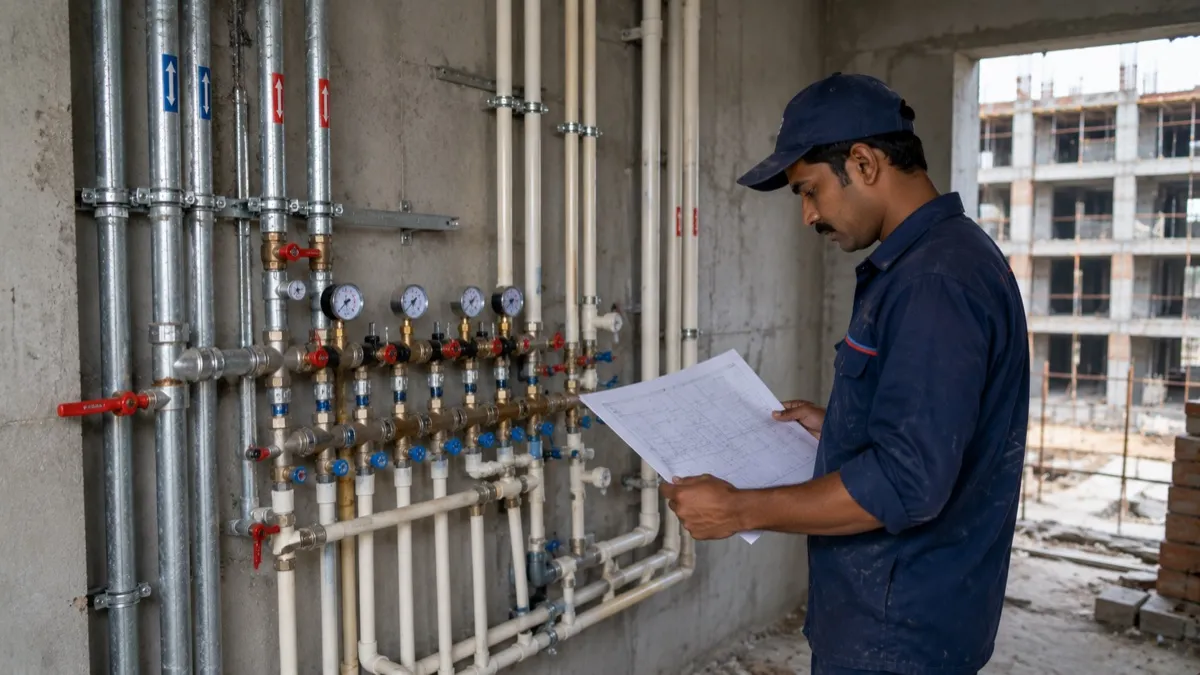
You design a beautiful apartment in Chandigarh — efficient bathroom, calculated kitchen plumbing, everything resolved. Then the plumber arrives. He's skilled, 15 years on the job, and he never opens your drawing. He looks at the walls, thinks about his connections, and routes a 40mm main directly below a load-bearing beam. By the time you notice, the concrete is set, the pipe is embedded, and you're staring at a three-week delay and Rs. 80,000 in extra cost. This happens in around 70% of Indian residential projects.
Why Plumbers Ignore Drawings — And It's Not Their Fault
Most Indian sites never use proper plumbing drawings. The architect draws one general layout; nobody prints coordinated plumbing plans. The plumber has zero reference, so he works from experience and on-site logic. From his seat, he's doing a fine job — connecting pipes efficiently, using standard fittings, working fast because 50 flats must be done by Friday. He was never trained to read architectural drawings, doesn't know that the beam in his way carries 150 tons, and isn't thinking about the electrical and AC piping coming later. The real problem: architects don't communicate plumbing plans in a format the plumber actually understands. And plumbing failures stay invisible — the pipe passes its test, works for six months, then leaks, and nobody can explain why.
The Bathroom Disaster: A Real Ludhiana Story
In a three-bedroom flat in Ludhiana's Sarabha Nagar, the plumbing was designed carefully — hot line from the terrace geyser, cold from the tank, drainage through the side wall to avoid the main RCC column, a separate vent stack, all per NBC. The site engineer said "theek hai" and put the drawing on the desk. The plumber arrived with no instruction, saw the client wanted the shower on the eastern wall, and ran every pipe straight up that wall — no routing plan, no protection.
Two months later, water was leaking into the adjacent bedroom. He'd run the high-pressure hot line right against the structural column base with no spacing. As the water heated and the pipe expanded, it stressed the concrete, fine cracks formed, water penetrated, and the damage spread. Cost to fix: Rs. 45,000. Delay: 10 days. The plumber never received marked guidance on site, so he chose convenience over coordination.
When Pipes Cross Beams and Stacks Go Crooked
A 15-metre main routed through the ceiling makes sense — until it meets a 350mm beam. With a 50mm pipe plus fittings plus conduit, you're at 70mm against 280mm of clearance. The plumber hangs it unsupported under the beam, it sags, a joint cracks after two years, and mould grows in the ceiling. Drainage is worse because it's nobody's focus: in a high-rise, the plumber on floor 4 uses a 90-degree elbow into the stack, the one on floor 8 uses 45 degrees, and by floor 20 the "vertical" stack zigzags, the pitch is wrong, solids collect, and floor 12 backs up two years after handover. A proper investigation runs Rs. 35,000; a real repair, Rs. 80,000 to Rs. 150,000 — all because each plumber worked to his floor's logic, not the building's.
Teaching Your Plumber to Read — and Mark — Drawings
You can't swap out the plumber your contractor brings, so you make sure he executes your design. The book's methods are refreshingly low-tech:
- Create a plumbing marking plan. Before work starts, print the layout on A1, bring markers to site, and with the plumber present mark every pipe route directly on the floors and walls — blue for cold, red for hot, green for drainage, arrows for slope. Thirty minutes and Rs. 200 in markers prevents Rs. 50,000 in rework.
- Give a one-page plumbing schedule. Your drawing has 12 layers and 200 annotations; the plumber ignores it. A single page in simple English — fixture locations, pipe sizes, slope direction, connection points, materials — actually gets read.
- Hold a joint site meeting before plumbing. Plumber, structural engineer, site engineer and you walk the space together: where pipes must NOT go, where drainage must keep slope, where future conduits will run. This one meeting prevents 80% of plumbing coordination disasters.
The Errors That Cause Leaks
- Drainage without slope: horizontal runs must fall at least 1:50 toward the stack, or water stagnates. Verify with a level before closing walls.
- Unsupported hanging pipes: install clamps every 1.5m or pipes sag and joints fail.
- Hot lines on exterior walls: they bleed heat and waste energy — route them inside.
- No isolation valves: without them you can't shut off one branch during a leak. Fit them at the main entry, each floor, major branches and fixture groups.
- Wrong material: check the relevant Indian Standards and match the pipe to the job rather than the budget.
The Maths of Prevention
The numbers are brutal in one direction only. A pipe through a structural element in Ludhiana totalled Rs. 100,000+. A misaligned drainage stack in a Chandigarh high-rise: Rs. 170,000+. A single leaking connection in Delhi: Rs. 68,000+. Against that, prevention — a detailed drawing, on-site marking, a coordination meeting and weekly checks — costs about Rs. 5,500. You're spending under 5% of the potential repair cost. As the book puts it: every hour you invest in coordination saves roughly Rs. 20,000 in future repairs.
How Secured Engineers Pvt. Ltd. Prevents the Leak
Bad plumbing isn't a careless plumber — it's a plumber working without information, on a site where design, structure and MEP never meet. As an integrated MEPF contractor, Secured Engineers Pvt. Ltd. closes that gap by design: our plumbing layouts are checked against the structural drawing so no pipe crosses a beam it shouldn't, routes are physically marked and colour-coded on site, the plumber, structural engineer and site team coordinate before a single pipe goes in, and we verify slope, supports and pressure before walls close. The leak that "nobody can explain" never gets built in the first place.
From the upcoming book by our founder — get notified at launch. Want plumbing that's coordinated with your structure from day one? get a free MEP quote.
More insights
VRF vs Chiller Plant: Which HVAC System Should You Choose in India?
A direct, India-specific comparison of VRF and chilled-water plants — by capacity, running cost, plant room, payback and the building types each one suits best.
Solar EnergyWhy Most Industrial Solar Underperforms (It Starts on Day 1)
Solar is not a product you buy — it is an engineering outcome. The decisions made before a single panel goes up quietly decide whether your plant saves money or loses it for 25 years.