
'Don't Worry, I'll Supervise' — The Four Words That Cost You the Most
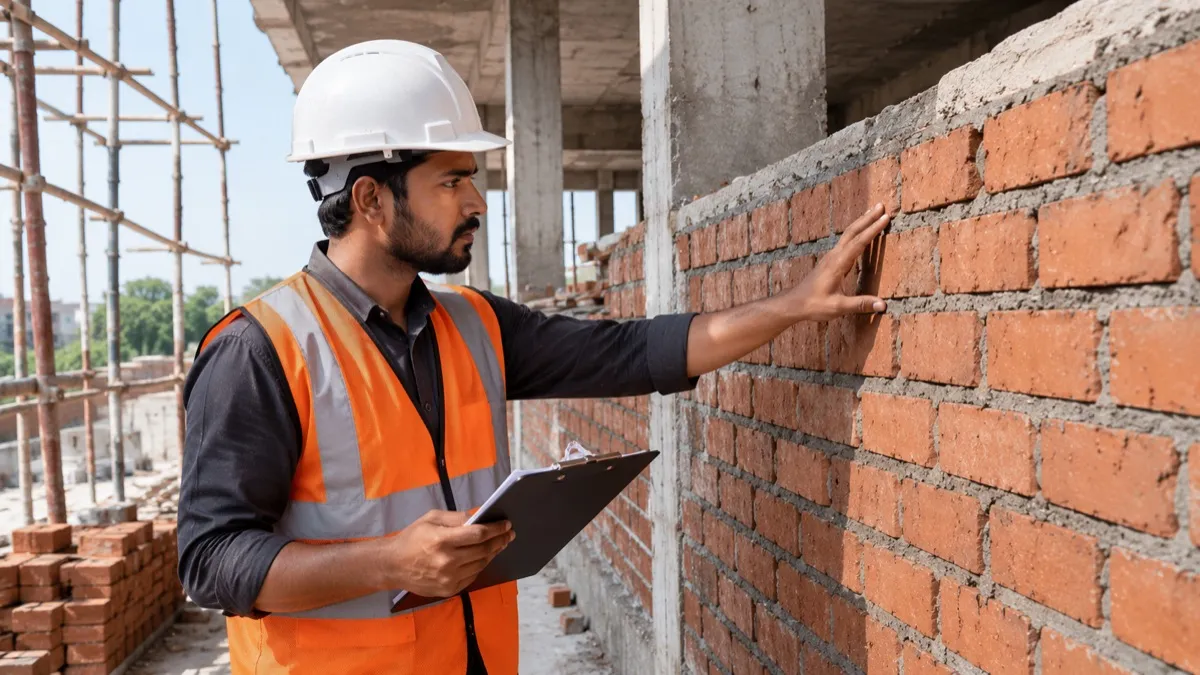
You visit site on Monday. The walls look straight, the concrete is setting, the foundation is coming along. You give feedback, take notes, and leave. On Wednesday — before you return — a rainstorm hits the exposed concrete. Instead of covering it, the crew trowels more cement on top to "seal" it. By Friday the concrete looks fine from outside. You will not learn it is compromised for six months.
This is the quiet truth about quality control on Indian sites: most of it is theatre. A performance that looks good while you are watching, and stops the moment your car leaves the gate.
The supervision gap nobody admits to
Do the arithmetic. An architect on a 12-month project visits site maybe twice a month — that is 24 days. Construction runs on roughly 250 days. So for 200 days, you are not there. On those days the crew decides how much water to add to concrete, whether to cover a slab in the rain, how tight to make a connection, whether to follow rebar spacing, and whether to take the shortcut that saves half a day. Most of those calls are fine. A few are catastrophic.
India's standard fix is to hire a "site supervisor." But here is the conflict everyone ignores: the supervisor is hired and paid by the contractor. His job is to keep work flowing, not to stop it for your approval. Every time he says "wait for the architect," the contractor loses money. He is structurally incentivised to say yes when he should say no.
What happens when you are not looking
These failures happen silently. The work looks complete; the problem surfaces months later:
- Rebar spacing drifts. Drawing says 200 mm centre-to-centre; the crew opens it to 250 mm to save steel. Concrete hides it. Capacity quietly drops — until an earthquake or heavy load finds it.
- Curing gets cut short. "7-day wet curing" becomes 2–3 days because faster drying means faster progress. Shrinkage cracks appear years later.
- Connections are hand-tight, not torqued. They look tight. Under load they loosen, and the building starts to creak.
- Hidden waterproofing is skipped. Visible corners get sealed; pipe penetrations and wall-slab junctions inside the structure do not. Two monsoons later, the basement leaks.
Why WhatsApp supervision is an illusion
So you stay connected through photos. The supervisor sends images, you approve, it feels like oversight. But photos lie. A photo of a pour looks identical whether the mix follows spec or not. It will not show you the slump, the air temperature, whether the concrete is being vibrated, or how long it has been since it left the mixer — and concrete must be placed within 90 minutes. A good photographer can make a corner-cut pour look perfect. WhatsApp creates the feeling of supervision while the actual supervision is zero.
Worse, the supervisor often stops supervising and starts designing. A detail is unclear, the crew needs to keep moving, your number is unreachable, so he decides "make it like the junction below." The junction below was for a different structural condition. Now the wrong detail is built across four floors before you ever see it.
From theatre to a real system
You cannot be on site every day. You do not need to be. You need a system that catches problems before they become permanent:
- Build a critical-work schedule. List the high-risk moments — every structural pour, every connection, waterproofing, critical MEP — and attend those, plus one surprise visit a week. Focused, not random.
- Run a photo protocol, not a photo dump. Daily images with a date stamp, a meter ruler for scale, the exact detail, and a 24-hour review cycle. Without the ruler you cannot tell a 5 mm gap from a 50 mm one.
- Hand supervisors checklists, not judgement calls. A concrete-pour checklist (temperature, slump, vibration time, age at placement, no water added in transit) turns a supervisor into a quality controller. There is no ambiguity left to "fix."
- Schedule unannounced inspections so nobody can stage a cleanup before you arrive.
- Use independent third-party testing for structural concrete and waterproofing — reporting to you, not the contractor. When corner-cutting carries a high chance of being caught, it stops.
- Keep a punch list. Every defect documented with photo and location, re-inspected after correction. Nothing gets buried.
How an integrated partner closes the gap
The deepest reason supervision fails is the split between the people who designed the building, the people who approved it, and the people who build it. When those are three different parties, the site supervisor sits in the gap between them — and the gap is where defects live.
At Secured Engineers Pvt. Ltd., design, approvals and execution sit under one accountable team. The engineer who specified the rebar spacing is connected to the team verifying it on site. Critical-work schedules, checklists and third-party testing are part of how we run a project, not an extra you have to chase. There is no contractor-paid supervisor quietly approving things he should reject — because the standard and the site answer to the same people.
This is exactly the kind of "from drawing to actual site" gap that Er. Ankur Kaplesh dissects in his book From AutoCAD to Actual Site — 20 pain points, 20 solutions. Get notified at launch, and if you want supervision that is a system rather than a performance, get a free MEP quote from our team.
More insights
VRF vs Chiller Plant: Which HVAC System Should You Choose in India?
A direct, India-specific comparison of VRF and chilled-water plants — by capacity, running cost, plant room, payback and the building types each one suits best.
Solar EnergyWhy Most Industrial Solar Underperforms (It Starts on Day 1)
Solar is not a product you buy — it is an engineering outcome. The decisions made before a single panel goes up quietly decide whether your plant saves money or loses it for 25 years.