
'Skilled Labour' on Paper, Experiment on Your Site: How to Tell the Difference
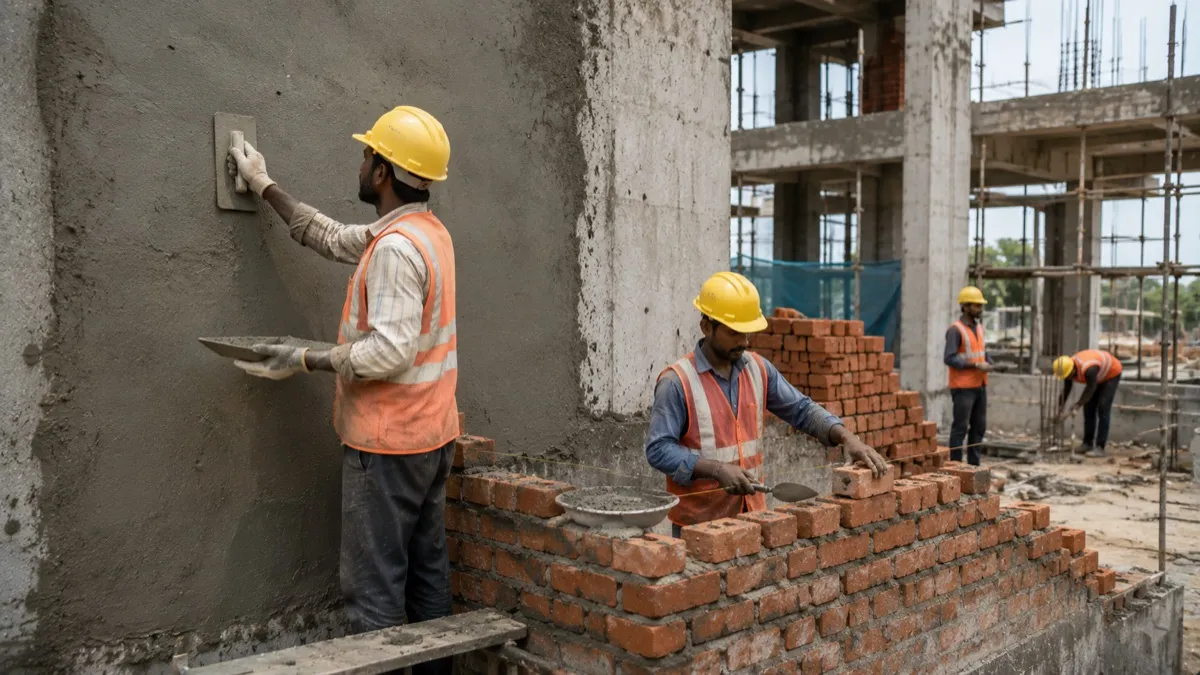
An architect in Gurugram specified a beautiful limestone facade — ashlar masonry, 50mm stone, 10mm joints, concave pointing, mortar tinted to match the stone. The contractor showed the drawing to a mason with 15 years of experience. The mason said, "OK, I will do it."
He had never done a 10mm joint in his life. He had always worked with 20–30mm joints because that was the standard he learned. He did not have the right tools or the right mortar. So he guessed. The result: joints that wandered between 5mm and 20mm, grey mortar instead of stone-matched, sloppy pointing. The work had to be ripped out and redone at double the cost. The architect got blamed.
The mason was not incompetent. He was skilled — at what he had learned. The drawing simply specified a detail beyond the skill level of the workforce that was actually available. That gap is the most under-discussed risk in Indian construction.
Why "skilled" means almost nothing on paper
Indian construction has a massive, structural skill gap. There is no formal certification for most trades. A mason learns by apprenticeship. An electrician learns from whoever happens to be experienced. A plumber learns on the job — and often learns the shortcuts, not the "why" behind the method.
So skill levels vary wildly. The same task — concrete finishing, tile laying, earthing — produces excellent work in one crew and failure in the next. The most common gaps show up in predictable places:
- Concrete finishing — surface patched without preparing the base, so cracks return.
- Tile laying — tiles set on cement mortar instead of adhesive, no waterproofing underneath; they look fine, then crack and lift within a couple of years.
- Plumbing — pipes laid with no thought to slope, so water stalls and the line becomes a stain factory.
- Electrical — wiring that quietly violates IS codes but "looks acceptable" until there is a fault.
- Painting — paint over dirty, unprepared walls; it peels within months.
These gaps survive because nothing enforces standards on site. A bad crew still produces a standing building. The owner discovers the truth after handover, when it is too late to fix cheaply.
When the helper becomes the mason
There is meant to be a hierarchy: skilled tradesman does skilled work, helper mixes mortar and fetches materials. On real sites, that line breaks constantly. A Ludhiana project needed herringbone marble in the living room. The one skilled marble layer was stuck on another building for two months. The contractor would not wait — he handed it to a helper who had "seen it done." The helper used cement mortar instead of marble adhesive, never checked level, and produced uneven tiles with mismatched joints. Two months later the work was ripped out and redone. Cost doubled.
It happens because skilled workers are scarce and expensive, helpers are cheap, and there is rarely any accountability — the contractor has moved to the next site before the defect surfaces.
The same disease shows up as quality that varies floor to floor. A 15-floor tower in Mohali ran the identical floor plan and finish spec on every level. Yet the concrete finish was excellent on floors 1–3, acceptable on 4–8, poor on 9–12, and frankly terrible on the top floors. Why? The excellent mason who started the job left after floor 3. Each replacement was a little less skilled than the last. Workers in Indian construction are transient — they work three or four months, get paid, and move on — so there is no continuity, no project-specific training, and no inspection until the poor work is already hidden under the next layer. This sits on top of a genuine, decade-long labour shortage: young people prefer office jobs, monsoon and migration disrupt supply, and COVID scattered crews back to their villages. When workers are short, contractors take whoever shows up, trained or not.
The fix: design and manage for the crew you actually have
You cannot wait for a perfect workforce. The honest move is to assess the real skill level and design to match it. Where local crews struggle with thin joints, specify generous joints. Where complex waterproofing fails, use a simpler membrane a helper can apply reliably. Larger-format tiles mean fewer joints and fewer chances to misalign. None of this means cheap or ugly — it means appropriate.
Then you manage it: photo references showing good versus bad work, task-specific training before critical activities, and testing during construction — water tests on waterproofing, pressure tests on plumbing, insulation and earthing tests on electricals — before the next layer hides everything. Build 10–15% rework time into the schedule, because something will fall short.
How Secured Engineers Pvt. Ltd. closes the gap
The Gurugram and Ludhiana failures share one root cause: design, approvals, and execution sat in different hands, and nobody owned the skill gap. Secured Engineers Pvt. Ltd. runs MEPF and Solar projects as a single integrated chain — the team that designs the layout is the team that selects the crew, sets the standard, and inspects the work. We assess trade capability before mobilising, simplify details that the available workforce cannot execute reliably, and run trade-specific testing at each stage instead of discovering defects at handover. When one accountable partner owns the line from drawing to commissioning, "skilled on paper" stops being a gamble — because the same people who drew it are standing on site when it is built.
If your last project surprised you with quality that varied floor to floor, that is a coordination failure, not bad luck. Get a free MEP quote and we will show you how an integrated team holds the standard. And to follow more lessons from the site, read Er. Ankur Kaplesh's book "From AutoCAD to Actual Site" — get notified at launch.
More insights
VRF vs Chiller Plant: Which HVAC System Should You Choose in India?
A direct, India-specific comparison of VRF and chilled-water plants — by capacity, running cost, plant room, payback and the building types each one suits best.
Solar EnergyWhy Most Industrial Solar Underperforms (It Starts on Day 1)
Solar is not a product you buy — it is an engineering outcome. The decisions made before a single panel goes up quietly decide whether your plant saves money or loses it for 25 years.