
Vastu vs. Your Floor Plan: The Fight That Quietly Wrecks Indian Homes
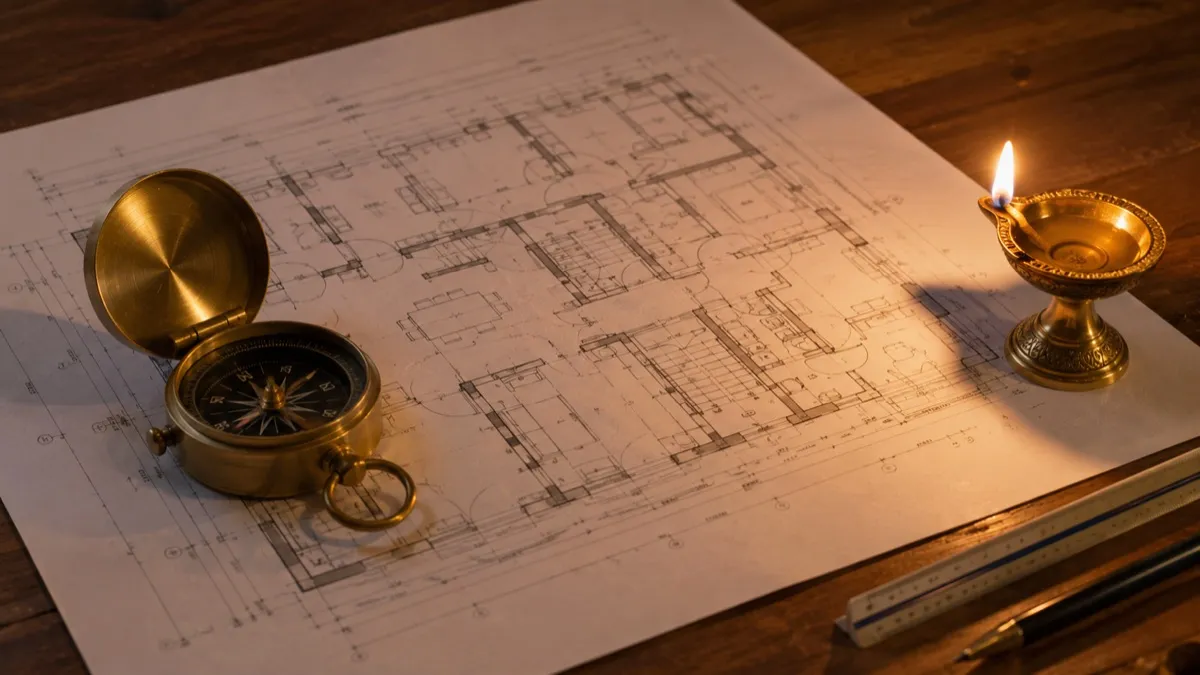
You design a clean, efficient apartment in Ludhiana. Bathrooms placed logically around the plumbing and structure. The client approves the renders, construction starts. Then, at 60% complete, the client hires a Vastu consultant — who looks at the drawings and declares the master bedroom is in the wrong direction, the kitchen is in the wrong corner, and the main door faces an inauspicious side. The client panics: "this could affect my family's health and prosperity." Now you're trapped between a rational, functional design and a belief system the client is convinced will shape his life. This conflict appears in roughly 40% of metro residential projects, and up to 70% in non-metro areas.
The Ludhiana kitchen that arrived too late
On a real three-bedroom flat in Sarabha Nagar, the client approved everything, then brought in a Vastu consultant at 60% construction with a list of twelve modifications — counter facing the wrong way, master bedroom in the wrong quadrant, main door facing south. These weren't cosmetic. They meant moving constructed walls, relocating fixed plumbing, changing door orientations. Implementing all twelve would have cost ₹18–22 lakhs and 8–10 weeks. The project ended in an uncomfortable compromise on three points that satisfied nobody fully — and all of it traced back to one thing: Vastu was introduced at 60% construction instead of at design stage.
The kitchen-in-the-wrong-corner problem
The single most common Vastu-versus-design clash is kitchen orientation. Vastu wants the kitchen in the southeast with the stove (the fire element) facing east and the sink placed away from it. The architect is thinking about something else entirely: natural light and ventilation, proximity to the dining area, an efficient work triangle between stove, sink and fridge, and — crucially — where the plumbing and structure actually allow a stove to go. Often both frameworks agree the kitchen belongs in the southeast, then collide on the internal layout: Vastu wants the stove on a secondary east wall, while the architect needs it on the main working wall where the services run. The client is left to choose between a Vastu-correct kitchen that's awkward to cook in and a functional kitchen that deviates from Vastu. Handled early, you rarely have to make that choice at all.
The authority problem behind the fight
The deeper issue is credibility. To the client, the architect is a technical professional who knows CAD and construction, while the Vastu consultant is a spiritual expert speaking about energy and harmony — two different domains that both feel true. But on the floor plan they collide on the same decisions, and the client must trust one over the other. In Indian culture, Vastu carries thousands of years of weight; modern architecture has existed seriously here for only a few decades. So when an architect says "Vastu isn't scientific" and the consultant says "energy flow shapes your future," many clients side with the consultant — and the architect loses authority.
The answer isn't to fight Vastu — it's to integrate it
The book's core insight is liberating: don't dismiss Vastu, don't argue with it, design with it. Many Vastu rules already align with good architecture in the Indian climate:
- Kitchen in the southeast happens to give excellent morning light.
- Master bedroom in the southwest stays cooler and more private, away from the afternoon sun.
- Main door to the north or east brings natural light into the entry.
- Open space on the north and east simply means better ventilation.
The rest — stove orientation, mirror placement, sleeping direction — are about internal arrangement and symbolism, and can usually be solved with creative interior design rather than demolition. A north-wall stove that "should" face east can be paired with an angled mirror; a bathroom door facing a bedroom can be offset with a short screen. Most concerns cost a few hundred to a few thousand rupees when handled at the right stage.
The framework that prevents the 60%-construction disaster
- Discover Vastu priorities early: ask, before designing, whether Vastu matters, which principles are non-negotiable, and whether the client already has a consultant.
- Design with Vastu as one constraint among function, light, structure and budget — and present the design in Vastu language so the client sees that good architecture and Vastu can agree.
- Get the consultant to review before construction, not during. It's going to happen anyway; far better at the drawing stage than at 60% complete.
- Sort recommendations into three buckets: structural (debate the cost-benefit), interior (easy to implement during furnishing), and symbolic (just do it).
Done this way, the difference is stark. Designing for Vastu from the start typically costs well under two lakhs in consultation and interior adjustments. Discovering Vastu issues at 60% construction can run to ₹25–30 lakhs in rework, delay and disputes. Proactive integration saves the rest.
Where an integrated execution partner helps
The recurring villain in this chapter is timing — beliefs colliding with already-poured concrete and already-laid pipes. Secured Engineers Pvt. Ltd. works as an integrated MEPF and execution partner, which means the spatial decisions, the plumbing routes and the structural reality are reconciled before work begins. When Vastu preferences are captured at the design stage, our coordinated approach can lock the kitchen, bathrooms and services around them once — rather than tearing them out at 60% and rebuilding. Respecting your client's beliefs and respecting good engineering aren't opposites; they just have to be planned together.
This is Chapter 8 of Er. Ankur Kaplesh's "From AutoCAD to Actual Site — Why Indian Buildings Never Match the Drawing." The full book covers 20 such pain points and 20 solutions — get notified at launch. And if you'd like a project where Vastu, function and execution are coordinated from day one, get a free MEP quote from Secured Engineers Pvt. Ltd.
More insights
VRF vs Chiller Plant: Which HVAC System Should You Choose in India?
A direct, India-specific comparison of VRF and chilled-water plants — by capacity, running cost, plant room, payback and the building types each one suits best.
Solar EnergyWhy Most Industrial Solar Underperforms (It Starts on Day 1)
Solar is not a product you buy — it is an engineering outcome. The decisions made before a single panel goes up quietly decide whether your plant saves money or loses it for 25 years.