
Your BOQ Said 1,000 M. Site Said 1,470 M. Who Pays for the Missing 470 M?
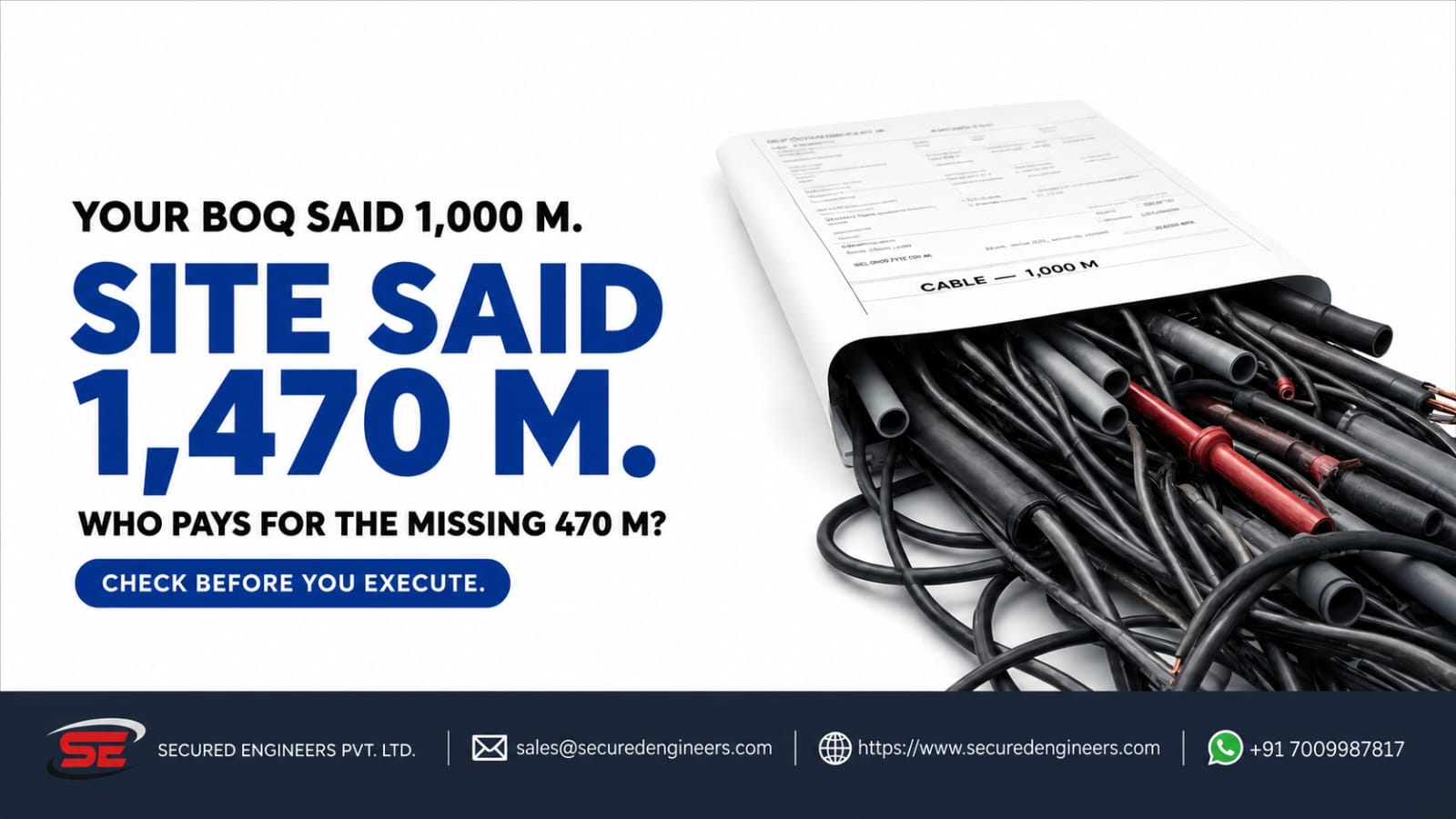
Your BOQ says 1,000 metres of cable. Procurement orders 1,000 metres. The commercial team builds the cost around 1,000 metres. Then execution starts, the actual route is measured — and the site needs 1,470 metres.
There is now a 470-metre gap.
Who pays for it?
The client may point to the approved BOQ. The contractor may point to actual site conditions. The consultant may refer to the drawings. Meanwhile, the project is still short of material and the execution team is waiting.
This is not simply a cable shortage. It is a quantity validation failure — and when it is discovered during execution, the cost is usually much higher than the price of the missing material.
The real cost of a BOQ quantity mismatch
A Bill of Quantities is one of the most important commercial documents in an engineering project. It defines quantities, supports pricing, guides procurement and becomes a reference point for billing.
But a BOQ is not the site.
When quantities are estimated from tender drawings, preliminary layouts or uncoordinated designs, the number on the spreadsheet may not represent the route the installation team will actually execute.
In practice, this is where the problems begin:
- Material shortages — Procurement is completed according to the BOQ, but the actual installation requires more cable, pipe, duct or accessories. Work slows down while additional quantities are calculated, approved and ordered.
- Emergency procurement — Materials required urgently may not be available at the originally negotiated price or delivery timeline. The team is forced to purchase under pressure instead of according to a planned procurement schedule.
- Commercial disputes — The client asks why the contractor needs additional material. The contractor argues that actual routing increased the quantity. Consultants review drawings, BOQs and scope documents while execution waits for a decision.
- Project delays — A missing quantity does not affect procurement alone. Manpower, installation sequencing, testing and downstream activities can all be impacted when critical material is unavailable.
The missing 470 metres may have a material value. But the delay surrounding those 470 metres can cost significantly more.
How does 1,000 metres become 1,470 metres?
The difference is not always caused by one major estimation error. In many MEPF projects, hundreds of additional metres are created by multiple smaller routing and coordination issues that were never included in the original quantity calculation.
A drawing may show a simple connection between a panel and a piece of equipment. The actual cable cannot always follow that direct line. It may need to travel through an approved cable tray, avoid an HVAC duct, enter a coordinated shaft, rise between floors, follow the ceiling service route and finally drop to the equipment termination point.
Every diversion adds distance. Every vertical rise adds distance. Every equipment relocation adds distance. Repeat those differences across dozens of circuits and the quantity gap grows quickly.
The same problem is not limited to electrical cables. Fire-fighting pipes, plumbing lines, HVAC ducts and cable trays can all face quantity variations when actual coordinated routes differ from the assumptions used during BOQ preparation.
Why this keeps happening
The root problem is often not poor execution. It is that quantity validation happens too late.
Tender drawings are sometimes treated as execution drawings. Preliminary routes are used for procurement quantities. Revised drawings move forward without corresponding BOQ updates. Electrical, HVAC, Plumbing and Fire Fighting services are measured separately before their routes are fully coordinated.
The BOQ says one number. The drawing suggests another. The site demands a third.
By the time the difference is discovered, materials may already be ordered and installation may already be underway. That is the most expensive stage of a project to discover a quantity gap.
The fix: validate quantities before execution
A BOQ should not move directly from spreadsheet to procurement without an engineering review of critical quantities.
Before major material orders are placed, the latest drawings should be checked against the actual execution strategy. Route-dependent quantities should be recalculated using coordinated layouts, equipment positions, shaft locations and practical installation paths.
At Secured Engineers Pvt. Ltd., that approach means:
- Drawing and BOQ review — Critical quantities are compared with the latest available engineering drawings before execution planning moves forward.
- Route-based quantity validation — Cable, pipe and other service quantities are reviewed according to practical routes, including horizontal travel, vertical rises, drops and equipment connections.
- MEPF coordination — Electrical, HVAC, Plumbing and Fire Fighting routes are considered together so service clashes and necessary diversions can be identified earlier.
- Quantity gap identification — Significant differences between BOQ quantities and engineering requirements are highlighted before they become emergency site requirements.
The objective is not to prove that someone calculated a number incorrectly. The objective is to identify the commercial risk while there is still time to manage it.
Measure the route, not just the drawing
For cable quantities, the real route may look more like this:
Panel → Cable Tray → Shaft → Floor Route → Vertical Drop → Equipment
Each section contributes to the final quantity. The same principle applies to other MEPF systems. A fire-fighting pipe network must account for actual branch routing. Plumbing quantities depend on shafts, offsets and fixture connections. HVAC duct quantities change with coordinated ceiling routes and structural constraints.
A straight line on a drawing may be useful for understanding design intent. It is not always enough for accurate procurement. Engineering quantity validation connects what was estimated with what will actually be installed.
Which quantities should you check first?
Not every BOQ item carries the same commercial risk. Start with high-cost, high-volume and route-dependent materials.
Power and control cables, cable trays, fire-fighting pipes, plumbing networks, HVAC ducts and major system accessories deserve early attention because even a relatively small percentage variation can have a significant impact on project cost and schedule.
The goal is simple: find the quantity gaps that can hurt the project before the project finds them for you.
Check before you execute
If your BOQ says 1,000 metres but the coordinated site route requires 1,470 metres, the missing 470 metres should not become a surprise halfway through installation.
Check the drawings. Validate the routes. Coordinate the services. Review the quantities. Then execute.
Because a quantity mismatch identified before procurement is a discussion. The same mismatch discovered during execution can become a delay, a variation and a commercial dispute.
Planning a project where cable, pipe and duct quantities carry real commercial risk? Talk to Secured Engineers Pvt. Ltd. about drawing and BOQ review — or request a free project blueprint to validate your quantities before execution begins.
More insights
Managing Multiple Contractors? Here's Why Your Project Keeps Falling Behind
Separate Electrical, HVAC, Plumbing and Fire Fighting contractors mean four schedules, four drawing sets and four points of failure — here's what that costs, and how one MEPF EPC partner fixes it.
HVACVRF vs Chiller Plant: Which HVAC System Should You Choose in India?
A direct, India-specific comparison of VRF and chilled-water plants — by capacity, running cost, plant room, payback and the building types each one suits best.