
You Have Awarded L1 Five Times. It Has Backfired Five Times. The Problem Is the Method.
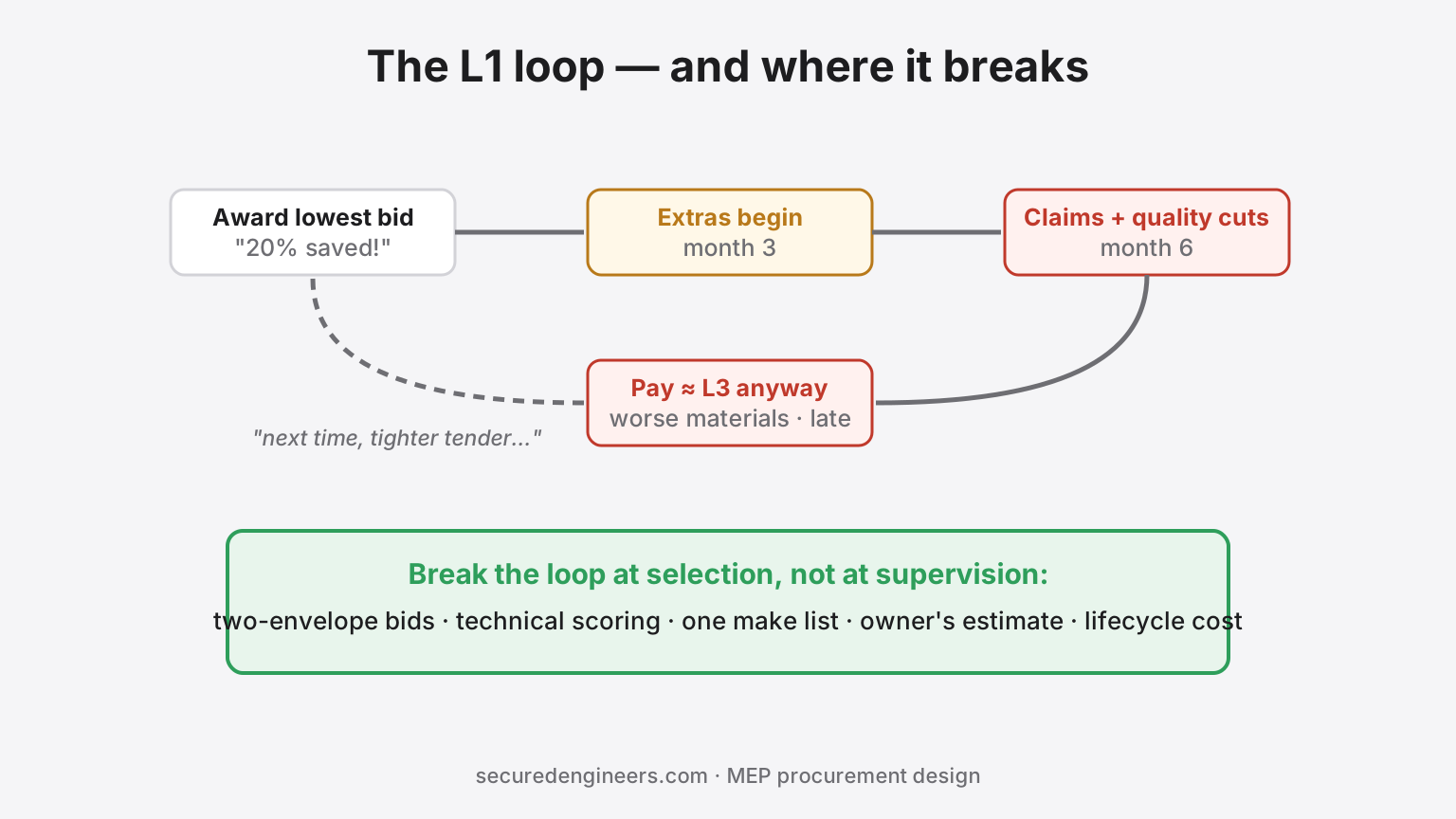
Here is the pattern, and if you have built more than two projects you have lived it: float the MEP tender, receive six bids, award the lowest. Three months in, the "extras" begin. Six months in, quality disputes. At handover, the L1 contractor has been paid roughly what L3 quoted — except with worse materials, a poisoned relationship and a delayed building.
The instinct is to blame the contractor. The engineering view is colder: L1 is a selection machine, and it selects exactly what it is designed to select — the bid most willing to be wrong about the project.
Why L1 structurally backfires on MEP
- MEP bids are not comparable by default. As we showed in the 40% quote-spread analysis, the spread between bids is mostly scope gaps and spec substitution — so the lowest number is usually the least complete one, not the most efficient one. L1 rewards incompleteness.
- The winner's curse is real. The bidder most optimistic (or most careless) about quantities, site conditions and coordination wins — then discovers reality on your site, at your schedule's expense.
- Recovery is a business model. A contractor who under-priced to win has three levers: variation claims, specification erosion, and slow-walking until you pay to accelerate. None of these are villainy; they are the predictable economics of the award you made.
- Lifecycle cost never appears on the comparative. The pump that costs 12% less and burns 20% more power for fifteen years wins every L1 evaluation and loses every honest one.
The fix is procurement design, not vendor hunting
Institutions that buy MEP well (large industrials, serious PMCs, government bodies that learned the hard way) all converge on the same architecture:
| Element | What it does |
|---|---|
| Two-envelope bidding | Technical bid opened and scored first; price envelopes opened only for technically qualified bidders. Junk bids exit before their number can seduce anyone. |
| Technical scoring with teeth | Past performance on similar scale, key staff CVs, methodology, safety record, financial health — scored, weighted, minimum threshold to qualify. |
| A frozen basis of comparison | One make list, one exclusions list, one BOQ measured the same way — the discipline from the tender-design guide. Bids become comparable before they become numbers. |
| Owner's estimate as an anchor | A realistic internal estimate (start with the MEPF cost calculator) lets you treat bids 20%+ below it as risk flags, not bargains. |
| Quality-cost weighting (QCBS) | 70:30 or 60:40 technical:price weighting for complex packages — the price still matters, it just stops being the only thing that matters. |
| Lifecycle line items | Efficiency-critical equipment (chillers, pumps, transformers, motors) evaluated on CAPEX + energised OPEX, not CAPEX alone. |
"But procurement rules force us to take L1"
Three honest answers. First, most private owners have no such rule — they have a habit wearing a rule's clothing. Second, where L1 is genuinely mandated, everything above still applies before the price comparison: strict pre-qualification and a gameproof tender make L1-of-qualified-bidders a defensible method. Third, the tighter your technical gate, the more the price spread collapses on its own — because the bids left standing are pricing the same project.
The one-page test for your next award
- Can every bidder pass a two-page pre-qualification (three similar projects, key staff, safety record)?
- Is there one make list, one exclusions list, one measurement basis — issued by you, not assumed by them?
- Do you have an owner's estimate you actually believe?
- Is anything on the comparative sheet evaluated on lifecycle cost?
- Does the contract price variations from the tendered rates — not "market rates" discovered later?
Five yeses and the L1 movie stops repeating — whoever you award to. (And if you would rather buy the outcome than run the machinery, that is what single-window turnkey EPC exists for: one accountable price for a defined result.)
FAQs
Is L1 always wrong?
No — L1 among rigorously pre-qualified bidders pricing an identical, gameproof scope is a perfectly good method. L1 among six incomparable bids is a lottery weighted toward trouble.
What technical:price weighting should we use?
For complex MEP packages, 60:40 to 70:30 technical:price is the common serious-buyer range. For commodity supply items, price-dominant is fine — the method should match the package's complexity.
How do we score past performance fairly?
Verifiable completions of similar scale and type in the last 5–7 years, client references actually called, and site visits to one running installation. An afternoon of diligence outperforms any affidavit.
Can you help structure a tender we are about to float?
Yes — procurement-design reviews (documents, make lists, evaluation matrix) are a short engagement. Start here.
Related services
More insights
Documents your EPC contractor should deliver — design basis, test records, asset register and as-builts
Four document sets an EPC contractor should deliver — design basis and approved drawings, inspection and test records, an asset register with warranties, and as-built and O&M files — with a checklist to attach to the contract and the payment each set should unlock.
Costing & ProcurementHow to Verify an MEP Contractor Before You Award the Work
Capability statements are written by whoever wants the job. The claims that predict delivery — comparable work in the role claimed, engineers who will be on your job, approvals experience and a scope accepted in writing — can each be checked against evidence before award.
More on Project Delivery & Commercial · all insights