
Two MEP Quotes. Same Building. 40% Apart. Which One Is Lying?
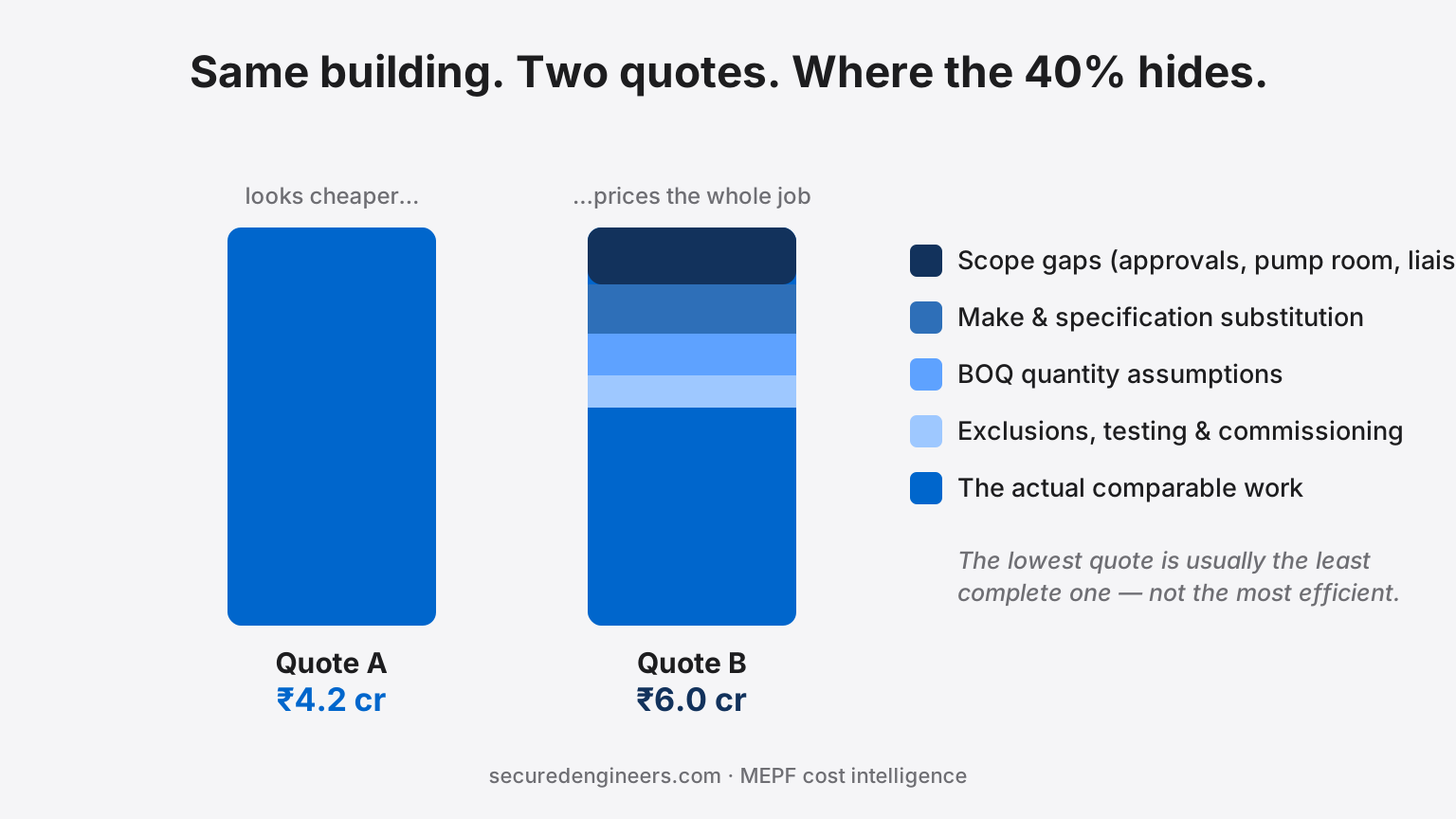
You send the same drawings to three MEP contractors. The quotes come back: ₹4.2 crore, ₹5.1 crore, ₹6 crore. Same building, same drawings, a 40% spread — and now the cheapest quote looks tempting and the highest one looks like profiteering.
Usually, neither is true. The three contractors priced three different projects — because your enquiry left enough undefined space for each to fill differently. Understanding where that space hides is the difference between buying an MEP system and buying a dispute.
Where the 40% actually lives
Across hundreds of tender comparisons, the spread almost always decomposes into the same six buckets:
| Driver | Typical share of spread | What it looks like |
|---|---|---|
| Scope gaps | 30–40% | One quote includes fire pump room civil works, external hydrant ring, or DISCOM liaison; another silently excludes them |
| Make & specification substitution | 20–30% | "Equivalent make" cabling, non-ISI fittings, lighter gauge ducting, a lower-tier switchgear series |
| BOQ quantity assumptions | 10–20% | Quantities taken from tender drawings vs. realistic coordinated routes — the classic 1,000 m BOQ that becomes 1,470 m on site |
| Exclusions & conditions | 10–15% | Scaffolding, crane time, storage, power for testing, statutory fees, "extra as actual" |
| Testing, commissioning & approvals | 5–10% | Third-party test certificates, fire NOC and CEIG liaison priced in — or left to you |
| Actual margin difference | 5–10% | The only bucket people assume explains everything. It explains the least. |
The uncomfortable conclusion: the lowest quote is usually the least complete one, not the most efficient one. The money doesn't disappear — it comes back later as variation claims, "extra items", and change orders, at post-award rates you no longer control.
What MEP realistically costs in North India
Broad planning bands we see across NCR, Punjab and Haryana projects (complete supply + installation, indicative only — the real number needs drawings):
- HVAC: ₹180–320 / sq.ft depending on system type and hazard
- Electrical (HT + LT): ₹140–260 / sq.ft
- Fire fighting & detection: ₹60–120 / sq.ft — sprinklered storage sits at the top
- Plumbing / public health: ₹50–90 / sq.ft
- ELV / low voltage: ₹40–80 / sq.ft
If a quote prices a trade materially below these bands, it is not a bargain — it is a question. Run your own numbers in two minutes with our MEPF cost calculator.
The 10-line checklist that makes quotes comparable
- Demand an itemised BOQ — lump-sum quotes cannot be compared at all
- Fix the make list per trade in the enquiry (switchgear, cable, pipe, sprinkler, panel fabricator) — "or equivalent" is where specs die
- Ask every bidder to price the same exclusions list — and to state their own additions in writing
- Check who owns approvals: fire NOC, CEIG, lift, pollution — line items or your problem?
- Check testing & commissioning: instruments, third-party certificates, authority witnessing
- Compare cable and pipe quantities between bids — a 25% lower quantity is an assumption, not a discount
- Ask how quantity variations will be priced post-award (rates from the same BOQ, not "market rates")
- Look for site establishment: supervision, safety, storage, scaffolding
- Confirm warranty and AMC handover terms per system
- Weight the comparison by completeness first, price second — then negotiate
The single-window alternative
The deeper fix is structural: when design, approvals and execution sit with one accountable partner, the space between quotes disappears — because there is no gap between the drawing, the BOQ and the site route to arbitrage. That is how we deliver turnkey MEPF EPC: one contract, one BOQ discipline, no "extra as actual".
FAQs
Is the highest MEP quote the safest?
No — completeness, not price, is the signal. A high quote can still hide exclusions. Compare itemised scope line by line; the checklist above takes under an hour per bid.
What is a reasonable MEP cost per sq.ft in India?
For complete MEPF in commercial/industrial buildings, planning bands typically run ₹350–800 / sq.ft across trades depending on building type, hazard and specification level. Treat anything far below as a scope question.
How do I stop variation claims after award?
Freeze makes and specs before award, validate BOQ quantities against coordinated routes, and fix variation pricing rules in the contract. Most claims are born in the enquiry, not on site.
Can Secured Engineers review quotes I already have?
Yes — a technical-commercial review of competing MEP bids is one of the most common ways new clients start with us.
Related services
More insights
Commercial MEP Renovation Cost: A Survey-Led Scope Checklist
A commercial MEP renovation is priced from a survey, not a rate per square foot. What to survey, how to decide retain or replace, what working in an occupied building adds, which exclusions move the price, and how to set contingency against what is still unknown.
Costing & ProcurementThe Quote Said "Plus GST". Whether You Can Reclaim It Is a Different Question.
MEP installation is a works contract, and works contracts have their own GST treatment. The trap is not the rate — it is that input tax credit on construction of immovable property is restricted, so tax that looks recoverable sometimes is not.
More on Project Delivery & Commercial · all insights