
Your Solar Plant Has Been "Awaiting Meter" for 11 Weeks. Here Is Why.
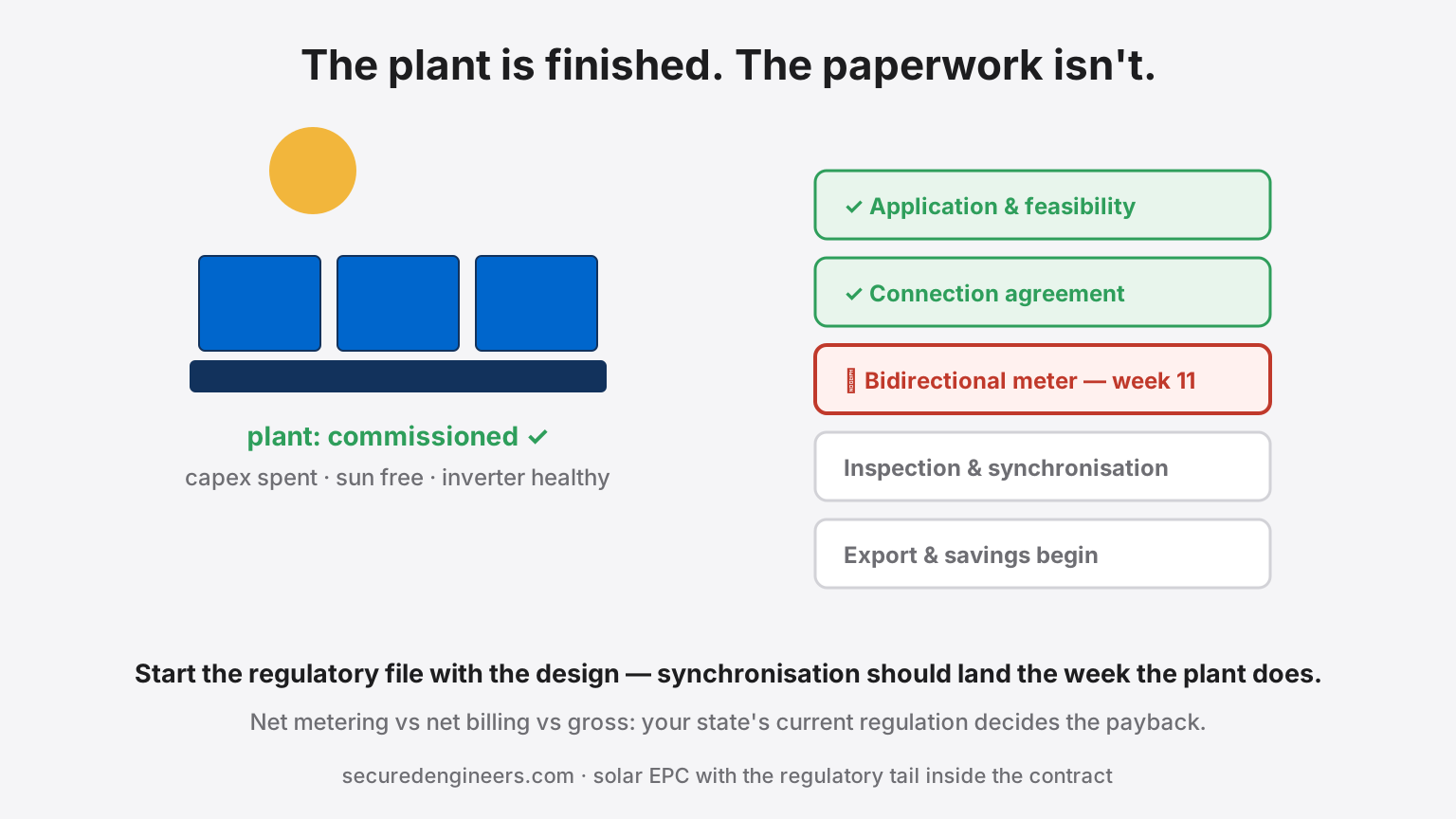
There is a special frustration reserved for a finished rooftop solar plant that cannot be switched on. The capex is spent, the sun is free, the inverter display shows everything healthy — and the plant sits idle (or worse, curtailed) because a meter and a signature are pending at the DISCOM.
This is not rare. Across UPPCL/NPCL, PSPCL and UHBVN/DHBVN territories, the regulatory tail is the least-managed phase of rooftop solar — because EPC attention ends at commissioning, while the money only starts at synchronisation.
The approval chain nobody budgets time for
- Application & feasibility — the DISCOM checks your sanctioned load, transformer capacity and network headroom against the proposed solar capacity
- Capacity & eligibility rules — state regulations cap net-metering by category and size, and they have been revised repeatedly (UP, in particular, has restricted classic net metering for larger/industrial consumers in favour of net-billing-type arrangements). Verify the current regulation before financial modelling — the tariff mechanism decides your payback more than the panel brand does.
- Connection agreement — the net-metering/net-billing agreement with the DISCOM
- Works & safety clearance — anti-islanding protection, earthing, and (above state thresholds) electrical-inspector clearance of the installation
- Bidirectional meter — procurement/testing of the export-capable meter, the single most common physical bottleneck
- Inspection & synchronisation — joint inspection, then formal permission to parallel with the grid
Each step is individually reasonable. Unmanaged, they queue up to 6–12+ weeks after mechanical completion — with the plant depreciating and the loan EMI running.
Where files actually stall
- Capacity vs sanctioned load: proposing solar beyond the permitted percentage of sanctioned load (or beyond transformer headroom) bounces feasibility — right-size at design, or pair the file with a load enhancement from day one
- The meter queue: bidirectional meters are procured/tested in batches; asking for the meter at commissioning instead of at agreement stage donates a month
- Protection paperwork: missing anti-islanding test certificates and relay settings — the inspection fails on documents more often than on hardware
- Consumer-category confusion: the plant was modelled on net metering, the category only qualifies for net billing/gross — a financial surprise discovered administratively
- Nobody owns the file: the EPC's scope ended at commissioning; the customer assumes the EPC is following up; the DISCOM is waiting for a reply nobody knows was asked for
Sequencing it right
The fix is boring and completely reliable: start the regulatory file with the design, not after commissioning. Application and feasibility during engineering; agreement and meter request during procurement; inspector file prepared alongside installation; joint inspection booked for commissioning week. Run this way, synchronisation lands within days of mechanical completion — we scope solar EPC with the regulatory tail inside the contract, because a plant that cannot export is not commissioned, whatever the completion certificate says.
And before any of it: model the project on the current tariff mechanism for your category and state — the solar savings calculator gives the engineering-side numbers; the regulation decides the export-side ones.
FAQs
How long does net-metering approval take?
Managed in parallel with the build: the file finishes with the plant. Started after commissioning: commonly 6–12+ weeks of idle plant. The variance is process management, not the DISCOM's mood.
What is the difference between net metering, net billing and gross metering?
Net metering offsets exported units against consumed units; net billing values exports at a (usually lower) tariff; gross metering sells all generation at a fixed rate. Which applies depends on your state's current regulation and consumer category — and it materially changes payback.
Can industry still get net metering in UP?
UP's rules have tightened for larger/industrial consumers, pushing toward net-billing-type arrangements; specifics have changed more than once. Verify against the current UPERC regulation for your category before committing capital — we do this check as part of feasibility.
Does rooftop solar need CEIG approval?
Above state-notified capacity/voltage thresholds, yes — the installation needs electrical-inspector clearance before synchronisation. It rides alongside the DISCOM file and should be prepared with it.
Frequently asked
What is the net-metering approval chain?
It starts with application and feasibility, where the DISCOM checks your sanctioned load, transformer capacity and network headroom against the proposed solar capacity, and then moves through the state's capacity and eligibility rules. Each stage is a place a file can stop, which is why the chain deserves programme time of its own.
Why do net-metering files stall in UP, Punjab and Haryana?
Most often on capacity: proposing solar beyond the permitted percentage of sanctioned load, or beyond the transformer's headroom, bounces feasibility. The fix is design-stage, not appeal-stage — right-size the plant against the sanctioned load, or pair the sizing with a load enhancement.
How do I avoid a net-metering delay?
Check the proposed capacity against sanctioned load and transformer headroom before the design is frozen, rather than after the application is filed. Most "authority delay" in practice is resubmission delay caused by a capacity that was never going to clear feasibility.
Related services
More insights
Your Solar ROI Model Assumed Average Sun. December in Punjab Isn't Average.
Rooftop solar payback models often use an annual average generation figure — but North India's dense winter fog belt (Punjab, Haryana, western UP) can cut December–January generation sharply for weeks at a time. Realistic ROI needs month-wise generation, not an annual average smoothed flat.
SolarCan an Existing Factory Roof Take Solar? Four Checks Before the Quote
Whether an existing factory roof can take solar is settled by four checks before anyone fixes the kW: the roof's condition and remaining life, a structural engineer's assessment, the wind and fixing design, and how the array works with waterproofing and fire access.
More on Solar & Renewables · all insights