
The Jockey Pump Died in March. You Will Find Out in a Fire.
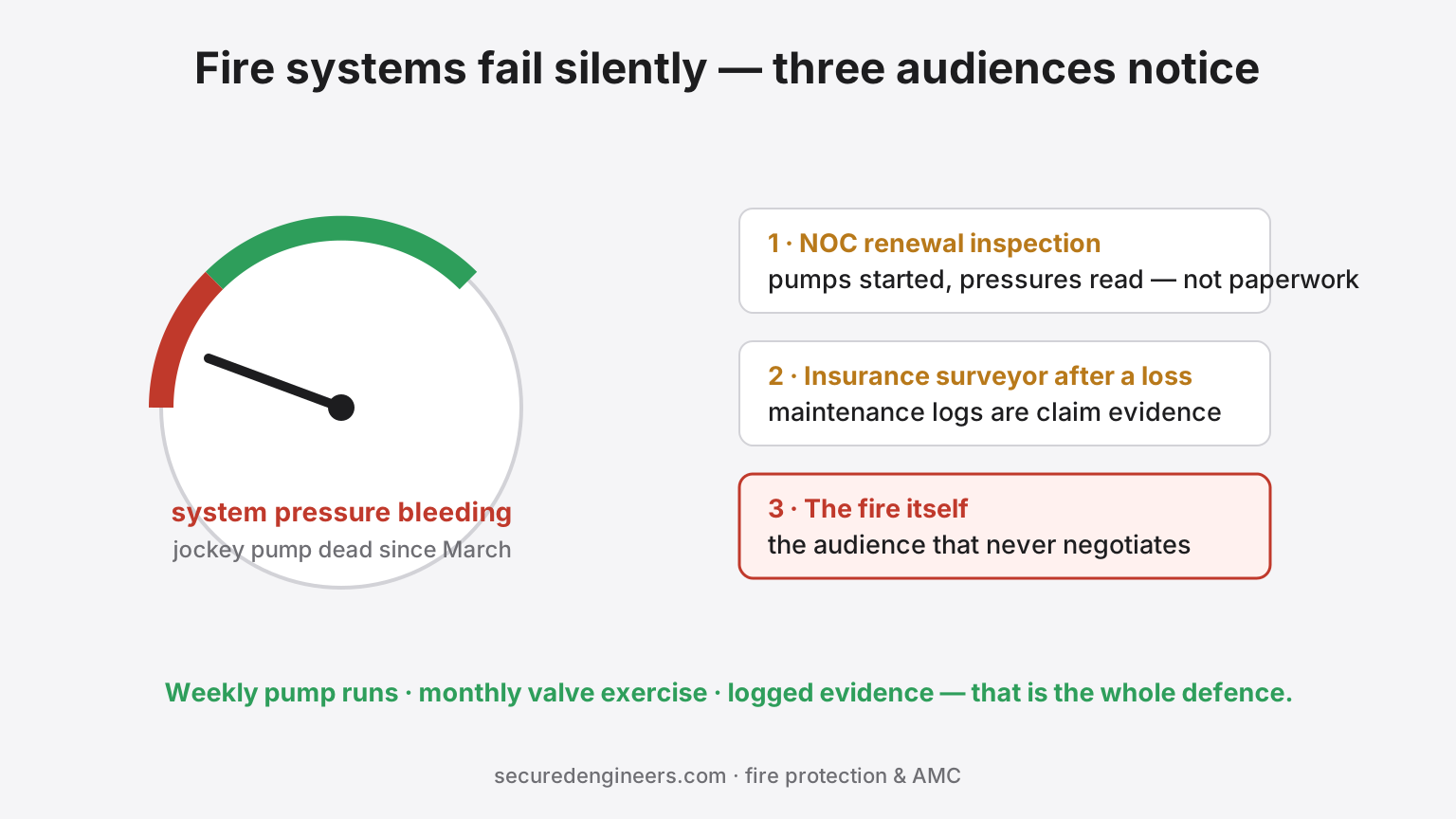
A fire system is the only installation in your plant that must work perfectly on a day nobody can predict, after years of doing nothing. That is a brutal engineering requirement — and it is why fire systems fail differently from every other system: silently, invisibly, and always earlier than anyone believes.
Production never notices a dead jockey pump. The three audiences that do notice are the ones you can least afford: the fire officer at renewal, the insurance surveyor after a loss, and the fire itself.
What actually dies first
| Component | Typical silent failure | Consequence on the day |
|---|---|---|
| Jockey pump | Trips or loses auto mode; system pressure quietly bleeds | Main pump dead-starts against empty mains — or nothing starts at all |
| Diesel pump battery | Sulphated after months without exercise | The one pump designed for power failure won't crank during one |
| Hydrant & valve stems | Seized, painted over, gland-leaking | Brigade arrives, connects, and the valve won't open |
| Panel zones | "Nuisance" zones bypassed and forgotten | Detection blind exactly where the nuisance was — usually the risk area |
| Sprinkler heads | Painted, corroded, blocked by new racking | Delayed or no release over the seat of fire |
| Static tank | Level dropped for "temporary" process use | Your 45-minute water reserve is 12 minutes |
The three reckonings
- NOC renewal. Fire NOCs are renewable certificates over a maintained system. Renewal inspections across Punjab, Haryana and UP increasingly test function — pumps started, pressure read, alarms sounded — not paperwork. A dead system converts a routine renewal into a compliance notice, and everything chained to the NOC (licence, occupancy, tenders) waits behind it.
- The insurance surveyor. Standard fire policies are priced on the protection you declared. After a loss, the surveyor's first questions are about the state of that protection — maintenance records, pump logs, last hydrotest. Demonstrable neglect of declared fire systems gives an insurer real grounds to contest or slash a claim precisely when the company is at its weakest. The maintenance register is not admin; it is claim evidence.
- The fire. The one audience that never negotiates.
What a real fire AMC looks like
Not a chowkidar-with-a-register. A functioning fire AMC runs a test calendar and leaves evidence:
- Weekly: jockey/main/diesel pump auto-start runs under pressure drop; panel healthy-check; pressures logged
- Monthly: hydrant valve exercise by rotation, hose/branch inspection, battery load test, tank level verification
- Quarterly: zone-wise detector testing, flow-switch and gong tests, extinguisher checks (right count and type per area)
- Annually: full functional drill with records fit to put before an inspector or surveyor — plus hydrant-main hydrotest where due
- Always: a log the fire officer can read in five minutes — dates, readings, signatures, corrective actions closed
For context on what the system itself must be, our NBC 2016 guide covers the design side; the AMC keeps that design true year after year.
The economics nobody runs
A proper fire AMC for a mid-size plant costs a few lakh a year. Weigh that against: a contested claim on a ₹30-crore loss, a stalled NOC renewal gating a customer audit, or re-commissioning a seized system before an inspection at panic rates. Fire AMC is the cheapest risk-transfer contract in the building — cheaper than the insurance it protects.
FAQs
Is fire system maintenance legally required?
State fire laws require installed life-safety systems to be kept in working order, and renewals verify it. Beyond statute, your fire policy's conditions effectively require it too — neglect exposes both the NOC and the claim.
How often should fire pumps be tested?
Weekly auto-start runs are the professional norm, with pressures logged. A pump that hasn't run in a month is a pump of unknown condition.
Our system was installed by another contractor — can you take over the AMC?
Yes — takeover begins with a condition audit (what works, what's dead, what's non-compliant), then a costed revival plan, then the test calendar. Fire & MEP AMC details here.
What records should we maintain for insurance?
Pump run logs with pressures, valve exercise records, panel test records, hydrotest certificates, extinguisher refill tags and closed corrective actions — dated and signed. If it isn't written down, on the worst day it didn't happen.
Related services
More insights
Fire Water Storage: Gross Volume vs Usable Capacity
A fire tank's gross volume is not the reserve the pumps can use. How to work from the approved demand and duration, subtract dead volume and freeboard, keep fire storage dedicated and compartmented, and avoid counting on refill you cannot rely on.
Fire SafetyFire Alarm System Expansion: Loop Capacity, Compatibility and Testing
Extending a fire alarm is a capacity and compatibility exercise before it is a wiring job — and the test that matters is the integrated one. The panel-and-loop checklist, the extend, network or replace decision, and how to prove the cause-and-effect before the building relies on it.
More on Fire Safety · all insights