
Your Server Room Is Cooled Like an Office. That Is Why It Keeps Failing.
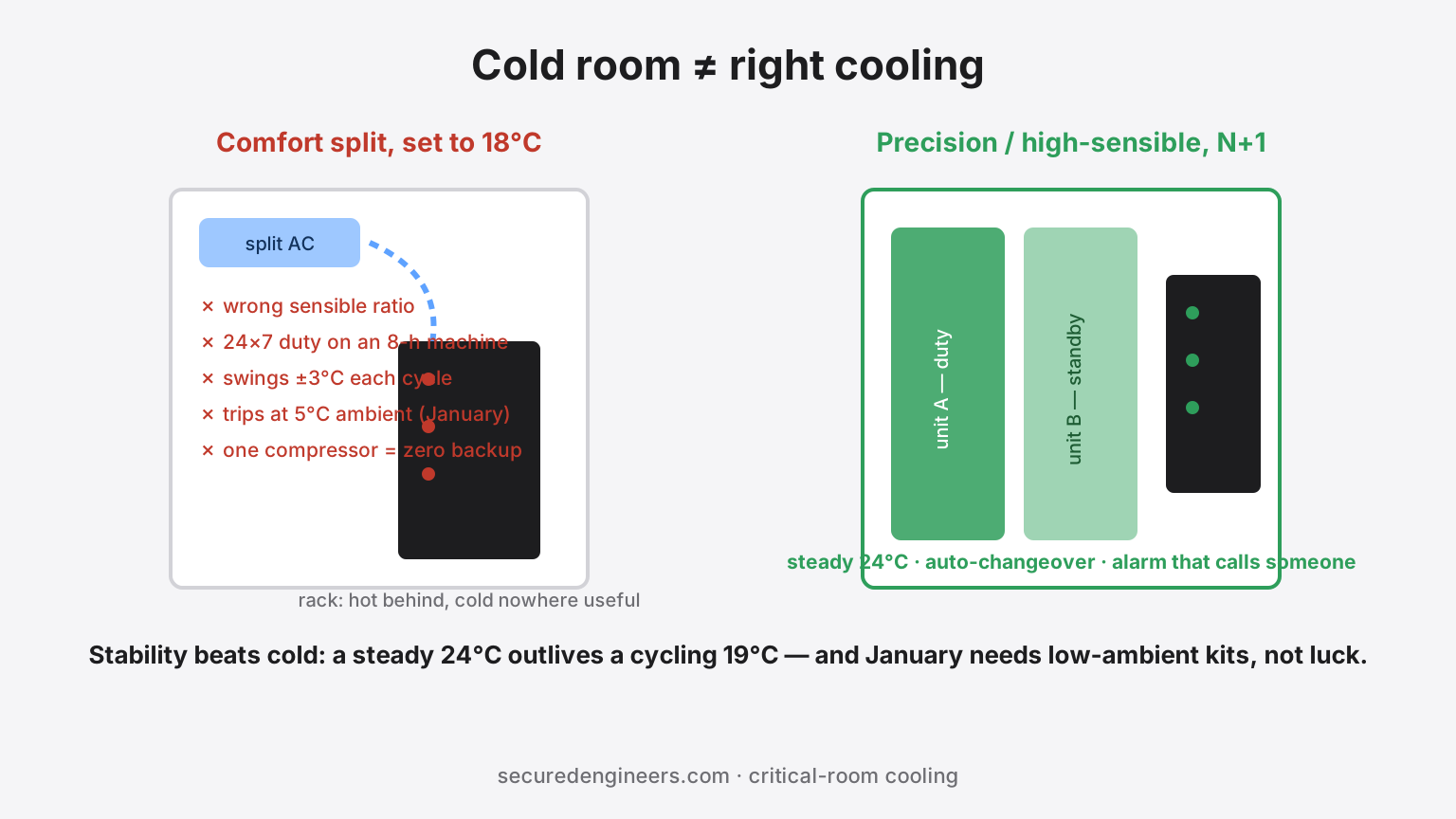
Walk into most factory server rooms, UPS rooms and control rooms across the NCR and Punjab industrial belts and you will find the same installation: one or two comfort split ACs, set to their coldest, blowing at a rack from across the room. It works — visibly. The room feels cold. And the equipment keeps failing anyway: drives at three years instead of five, UPS batteries swelling in summer, mystery trips on humid nights, and one bad weekend every winter.
The room is not under-cooled. It is wrongly cooled — because comfort machines and critical rooms disagree about physics.
Five ways a comfort AC is the wrong machine
| What the room needs | What a comfort split does |
|---|---|
| Sensible cooling — electronics make dry heat | Designed ~70:30 sensible:latent for sweating humans; wastes capacity wringing moisture that is not the problem — then over-dries or short-cycles |
| 24×7×365 duty | Designed for ~8–12 h/day comfort duty; run continuously, compressors and fans age at 2–3× the intended rate |
| Stable temperature & humidity band | On/off control swings the room several degrees each cycle — thermal cycling is precisely what kills electronics and batteries |
| Winter operation | The room needs cooling at 5°C ambient too; comfort condensers without low-ambient kits trip or slug on cold mornings — the classic North-India January failure |
| Failure tolerance | One split = zero redundancy; the room's availability equals one compressor's mood on a Sunday |
What a small critical room actually needs
- Honest heat load first: IT/UPS kW is the load — nameplate sums, diversity applied, plus lighting and envelope. A rack drawing 4 kW is a 4 kW heater, continuously. (First pass: tonnage calculator, then engineer it.)
- High-sensible machines: precision/close-control units — or at small scale, properly selected high-sensible inverter units with low-ambient kits — matched to dry heat, continuous duty and tight control bands
- N+1 by arithmetic, not sentiment: two units each able to carry the room alone, on an auto-changeover/duty-rotation controller, is the minimum honest configuration for anything the plant cannot run without
- Airflow with intent: cold air delivered to equipment intakes, hot air returned from behind — even a small room benefits from basic hot/cold discipline instead of an arctic gale across the ceiling
- Monitoring that calls someone: a ₹15,000 temperature/humidity alarm that messages the electrician beats a lakh of cooling that fails silently on Saturday night
- The power side done properly: dedicated circuits, DG-backed supply for the cooling (a UPS room that keeps servers alive while their cooling is off is a slow-motion shutdown), and clean earthing per the electrical-safety basics
The retrofit path (without a shutdown)
Most rooms can be corrected live: load survey and monitoring first (a week of data ends all arguments), then the second unit and changeover controller, then airflow correction, then replacing the weakest comfort unit with a high-sensible machine at its natural end. Sequenced this way, the room never loses cooling — and the failure pattern usually stops after step two. For anything bigger than a room — server halls, edge and enterprise data centres — the same physics scales up with containment, chilled water and serious redundancy math.
FAQs
What temperature should a server room be?
Modern IT equipment is comfortable well above the folk-wisdom 18°C — the widely used professional envelope centres around 18–27°C at controlled humidity. Stability matters more than cold: a steady 24°C beats a cycling 19°C.
Can I just add a second split AC?
As an interim redundancy step with a changeover controller — yes, it is the single best quick fix. It does not solve sensible-heat mismatch, control stability or winter operation; it buys time to do those properly.
Why does the room fail in winter when it is cold outside?
Comfort condensers are not designed to reject heat into near-zero ambients — refrigerant pressures fall out of range and units trip or damage themselves. Low-ambient kits or precision units solve this; open windows do not.
What does proper small-room precision cooling cost?
Indicatively, a redundant small-room setup (2 × high-sensible units + controller + monitoring) runs a few lakh installed — commonly less than one incident of UPS battery replacement plus downtime. Scope your room here.
Related services
More insights
VRF vs Chiller Plant for Commercial Buildings: How to Decide
There is no tonnage at which VRF stops and a chiller starts. The choice turns on how many zones run on different schedules, how much fresh air must be treated, what redundancy the building needs, and the running and maintenance cost over its life. A checklist and decision table to compare the two.
HVACRenovate or Replace an Ageing HVAC System?
Whether to retrofit or replace an ageing HVAC plant is decided by a measured baseline, the load the building has now, the staged options in between, and a lifecycle cost that states its uncertainty — not by the age of the machines alone.
More on HVAC & Mechanical · all insights