
Addressable Lighting Control Pays in Some Buildings and Not in Others.
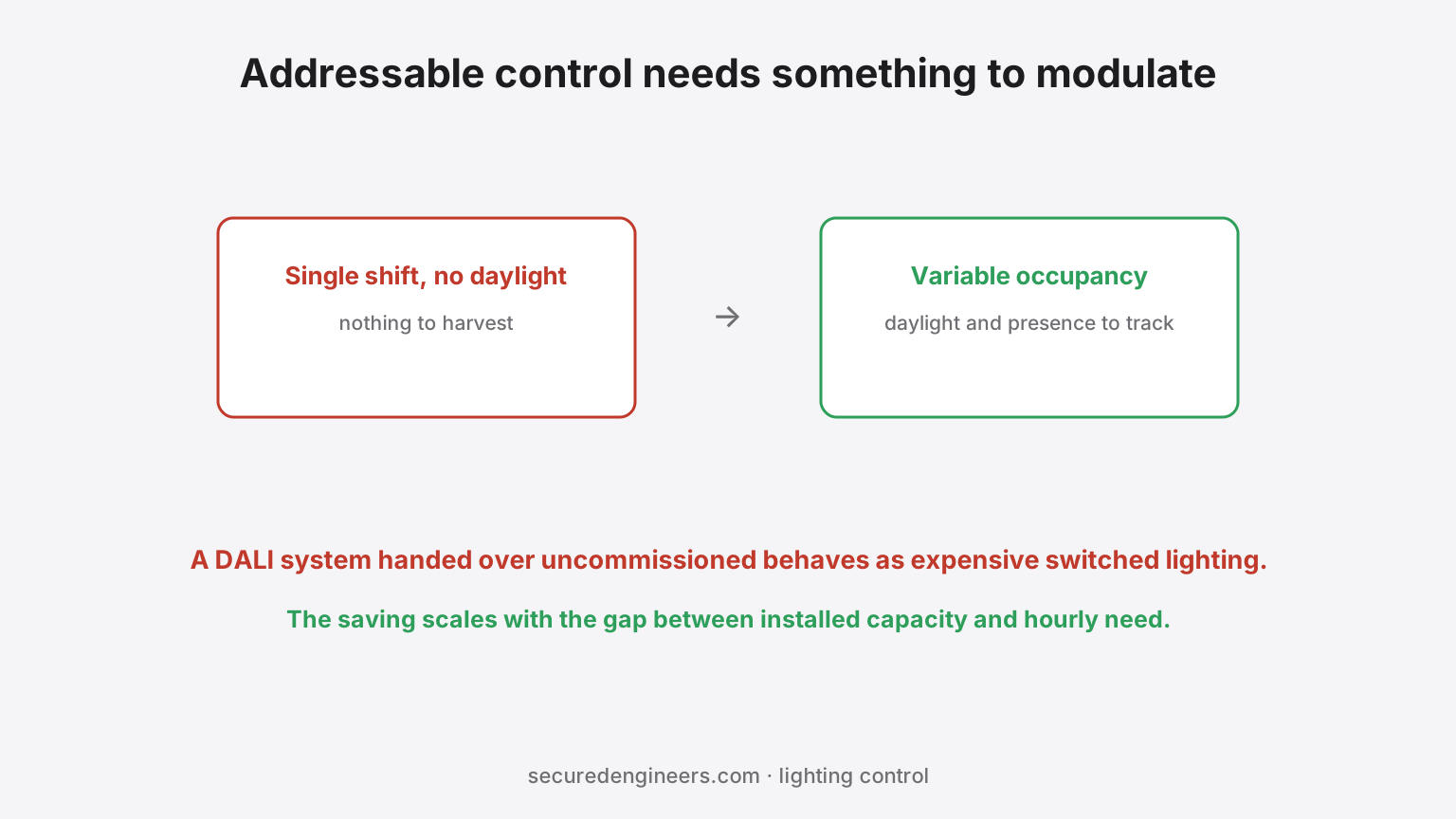
Addressable lighting control — DALI, KNX, or a proprietary equivalent — lets each fitting be commanded individually: dimmed, scheduled, grouped, and reported on. Compared with switching circuits from a distribution board it is a different category of control.
It is also a meaningful cost uplift, and the honest question is not whether it works but whether your building has the variability for it to save anything.
Where the saving comes from
- Daylight harvesting. Fittings near glazing dim as daylight rises. Real saving, proportional to how much perimeter glazing you have and how variable the daylight is.
- Occupancy response. Lighting follows presence rather than a wall switch someone forgot. Highest value in intermittently occupied spaces — meeting rooms, corridors, warehouse aisles, toilets.
- Task tuning. Output set to what the task needs rather than to design maximum. New installations are frequently over-lit against actual requirement.
- Scheduling. Areas that should be off outside shift hours actually going off, without depending on the last person out.
- Fault reporting. A failed fitting reports itself rather than being noticed. On a high-bay warehouse, that alone can justify the addressability.
Where it does not pay
| Space | Why the case is weak |
|---|---|
| Single-shift production hall, no daylight | Lighting runs at full output for a fixed period — nothing to modulate |
| Continuous process areas | Occupied around the clock; no off-hours to harvest |
| Small facilities | Commissioning and controller cost does not amortise across few fittings |
| Spaces where light level is a safety requirement | Dimming range is constrained by the requirement |
The pattern: the saving is proportional to the gap between installed capacity and what is actually needed, hour by hour. Where that gap is narrow, the control has nothing to work with — the same logic that governs demand-controlled ventilation.
The part that decides whether it survives
Commissioning. An addressable system is inert until someone assigns addresses, builds groups, sets scenes and configures schedules — and that work is skilled, time-consuming, and the first thing compressed when a programme slips. A DALI installation handed over uncommissioned behaves as expensive switched lighting.
The second is documentation. When a fitting is replaced in year three, someone has to know its address and group. Without an addressing schedule handed over, the system degrades fitting by fitting.
What we do differently
We specify addressable control where the occupancy and daylight profile justifies it and say plainly where it does not, and we treat commissioning and the addressing schedule as deliverables under ELV systems — because an uncommissioned control system is not a saving, it is a cost with a switch on it.
More insights
You Sized the DG. Nobody Sized the Safety Distance Its Diesel Tank Needs.
A DG set is easy to place; its diesel storage tank isn't. Safety-distance rules from the fire and PESO frameworks can push a tank — and everything around it — further from your building than the plot allows for. Decide tank type and location at layout stage, not after the DG is ordered.
ElectricalYour UPS Is Not for Power Cuts. It Is for the 200 Milliseconds Before the DG Wakes Up.
Factories buy UPS capacity the way they buy stabilizers — by habit and by kVA. Then a half-second voltage dip scraps a batch anyway. What a UPS is actually for, which topology earns its cost, and how to size the battery honestly.