
Retrofitting EV Charging Isn't an Electrician's Job. It's a Load Study.
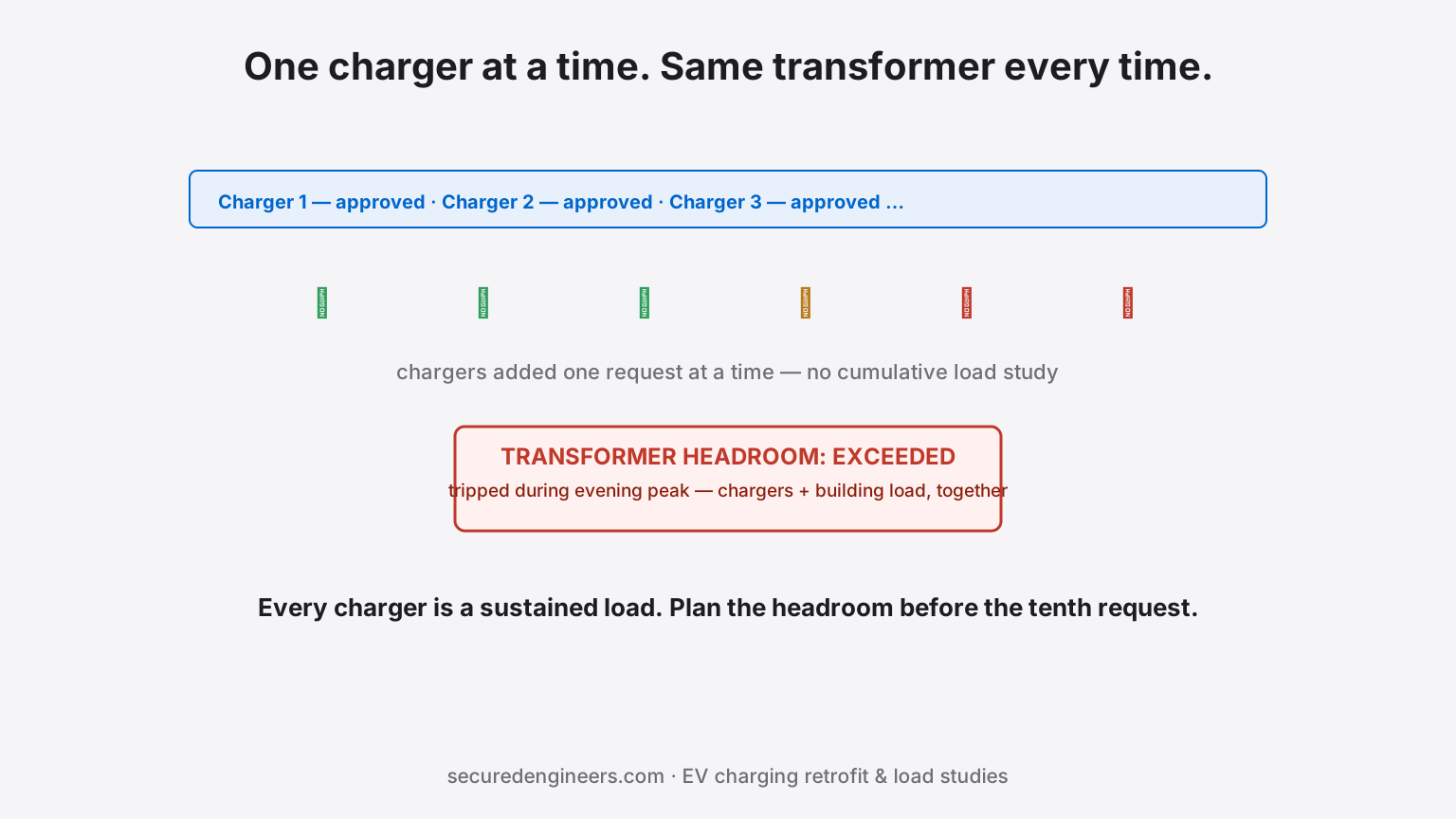
EV charger installation is being sold, correctly, as a simple product: a wall box, a cable, a socket. What's rarely mentioned at the point of sale is that every charger is also a new, sustained electrical load being added to a building whose transformer, panels and cabling were sized years ago for a building without EV charging in the plan at all.
One charger rarely causes a problem. The tenth, added the same way as the first — one request at a time, approved locally, with no cumulative load study — is where buildings start tripping breakers during evening peak, when parked cars are charging at the same hour the rest of the building is also drawing maximum load.
Why ad hoc charger additions overload existing infrastructure
- No cumulative load tracking — each charger request gets evaluated against "is there a spare circuit here," not against the building's total available headroom after the change
- Demand diversity gets ignored — EV charging load doesn't behave like general building load; multiple vehicles charging simultaneously in the evening can draw close to full rated capacity together, unlike lighting or general power loads that rarely peak in unison
- Transformer headroom was never verified, the same undersizing pattern covered in substation undersizing — a transformer sized tightly for the original building design has little or no spare capacity for a new load category
- Cable routing follows the path of least resistance, not the correct one — chargers get connected to the nearest convenient panel rather than a properly planned dedicated EV distribution board
What a proper EV retrofit load study covers
| Step | What it establishes |
|---|---|
| Existing load audit | Actual (not nameplate) building demand at peak hours, from utility billing data and panel-level metering |
| Available headroom | Real spare transformer and panel capacity after accounting for existing load and its own growth margin |
| Charging demand model | Realistic simultaneous-charging assumption for the building's parking count and expected EV adoption rate — not "assume everyone charges at once," which oversizes, or "assume nobody does," which undersizes |
| Distribution design | Dedicated EV panel(s) with correctly sized incoming feeder, not chargers daisy-chained onto whatever panel is nearest |
| Phasing plan | How many chargers can be added now versus what requires a transformer or panel upgrade first — so charger count 11 doesn't arrive as a surprise trip |
The parts that get missed even when capacity is planned correctly
- Fire safety in enclosed basement parking — EV charging in a basement changes the fire risk profile of that parking ventilation and fire zone; charger placement, ventilation and detection need to account for it specifically, not be treated as a generic electrical addition to an already-approved space
- Metering and billing model — in multi-tenant or CAM-charged buildings, unmetered or flat-rate EV charging creates the same allocation dispute risk covered in DG backup power allocation; sub-metering per charger avoids the argument before it starts
- Power factor impact — charger banks can affect the building's overall power factor at scale, with the same penalty exposure as any other reactive-load addition if not accounted for
- Solar/DG interaction — buildings with rooftop solar or DG backup need charger load included in those systems' capacity planning too, not treated as a parallel, unrelated addition
We run EV charging retrofits as a load-study-first exercise — establishing real headroom, designing dedicated distribution, and sequencing charger rollout against actual capacity, rather than approving requests one socket at a time until something trips. Our electrical infrastructure team can assess an existing building's real EV charging headroom before the next charger request comes in.
FAQs
How many EV chargers can an existing building's electrical system support?
There's no universal number — it depends on actual spare transformer and panel capacity, not nameplate ratings. A proper load study is the only reliable way to know, and that number changes as new chargers are added.
Do all EV chargers need to be on a dedicated panel?
Not strictly required for a single charger, but strongly recommended once a building plans for multiple chargers — a dedicated, correctly sized EV distribution board avoids overloading panels designed for other loads and simplifies future expansion.
Does EV charging in a basement need special fire safety measures?
It changes the risk profile of an enclosed parking area and should be assessed as part of that zone's fire and ventilation design, not approved as a standalone electrical fitting.
Can you assess our building's EV charging capacity before we add more chargers?
Yes — a load audit and phased retrofit plan, sized to actual headroom. Request an assessment.
More insights
The Building Isn't Open Yet. The EV Mandate Already Applies.
Delhi's draft EV Policy 2026 requires all new infrastructure projects to be EV-charging ready from day one — not retrofitted later, designed in from the start. Delhi has roughly 8,850 charging points against a stated need of over 36,000, and the policy is closing that gap by pushing the requirement upstream, onto every new building's electrical design. If you're breaking ground on a new project, this isn't an optional add-on anymore.
ElectricalWhat to check during electrical testing and commissioning
Energisation is earned by test records. The tests our electrical engineers run — and the values they record — before a factory's installation is offered to the Electrical Inspector and the DISCOM.