
You Cannot Air-Condition a Shop Floor the Way You Air-Condition an Office.
A factory decides the shop floor is unbearable in summer, gets quotes for air conditioning, and is quoted a number that stops the conversation. Sometimes the project dies there. Sometimes something undersized gets installed and does not work.
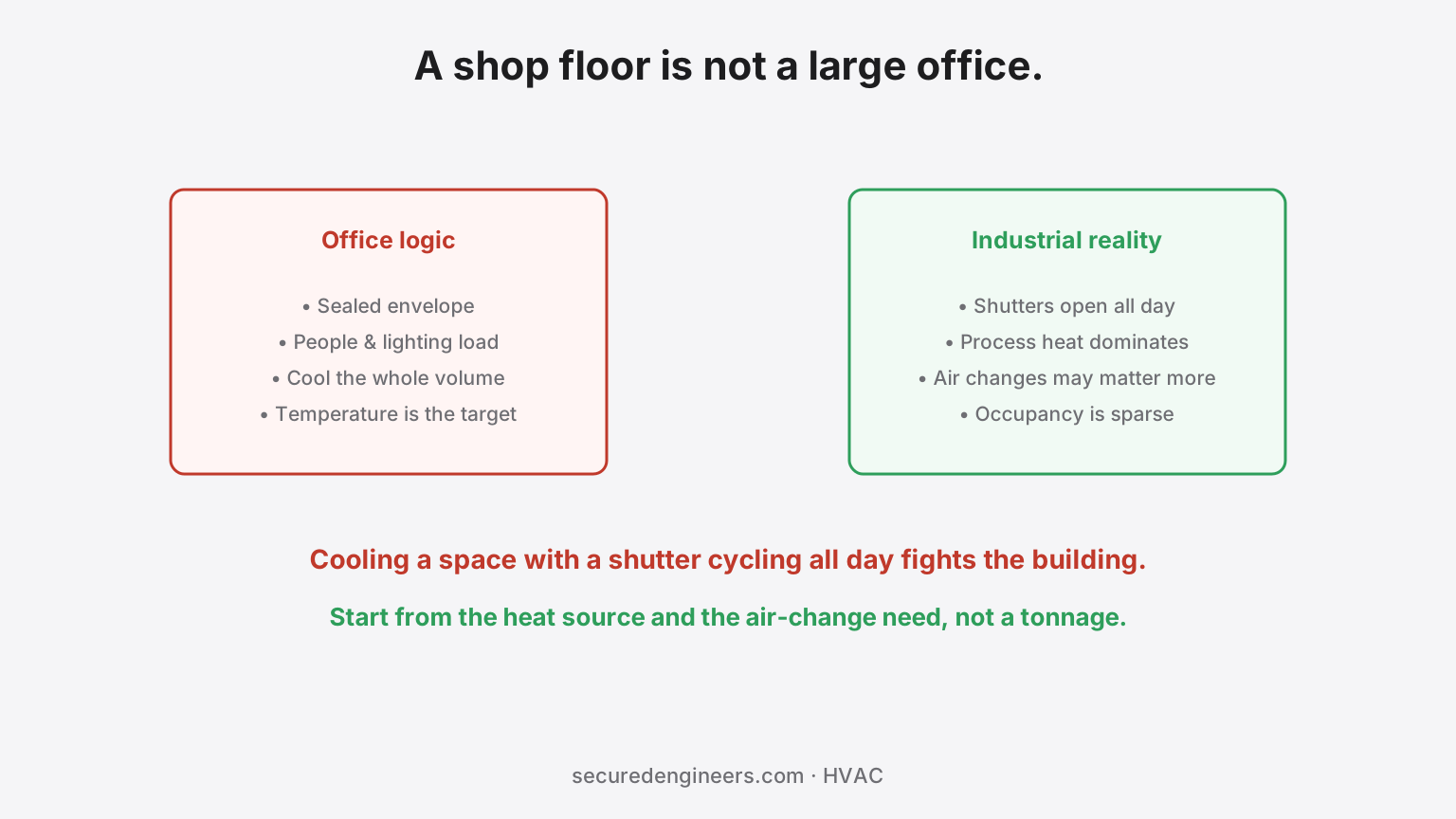
Both outcomes come from the same error: applying comfort-cooling logic to an industrial space. In an office you are removing heat from people, lights and solar gain in a sealed envelope. On a shop floor you are usually dealing with something else entirely.
What makes industrial different
- Process heat dominates. Ovens, furnaces, compressors, motors and machines can produce heat loads that dwarf anything in an office. Cooling that without addressing the source is expensive by design.
- The envelope is not sealed. Shutters open for material movement. Cooling a space with a large opening cycling through the day is fighting the building.
- Air changes may matter more than temperature. Where the issue is fumes, dust or humidity, ventilation solves the actual problem and cooling does not.
- Occupancy is sparse. Conditioning an entire high-bay volume to cool a handful of workstations is often the wrong target — spot cooling at the workstation can be dramatically cheaper.
- Some processes set the condition. In pharma, food and electronics, temperature and humidity are a process requirement, not comfort — a different design basis again.
Matching the solution to the actual problem
| The real complaint | Usually the right answer |
|---|---|
| "It is too hot near the furnace/oven" | Source capture and extraction, plus spot cooling — not whole-space AC |
| "The whole shed is stifling in summer" | Ventilation and air movement; evaporative cooling where humidity allows |
| "Fumes and smoke hang around" | Extraction at source with adequate make-up air |
| "Humidity is damaging product" | Dehumidification, which is a different machine from cooling |
| "The process needs a controlled condition" | Full HVAC to the process spec, correctly zoned |
| "Only the assembly line staff are affected" | Spot or zonal cooling at the workstations |
The mistake that wastes the most money
Extraction without make-up air. Fitting exhaust fans to pull fumes out, without providing a path for replacement air, puts the building under negative pressure — at which point the fans move far less than their rating, air is dragged in through every gap, and the problem is only partly solved while the electricity is fully paid for.
Ventilation is a balance of supply and extract. Treating it as only extract is the most common and most expensive industrial ventilation error.
Establish the load before pricing
Get the actual heat load and the required air changes established before comparing quotes — a heat-load study on an industrial space frequently shows that the answer is ventilation and source capture rather than tonnes of refrigeration, which is a different order of capital cost. Our ventilation calculator and AC tonnage calculator give indicative starting figures, and where the space is genuinely process-controlled, GMP and cleanroom basics covers that design basis.
What we do differently
Under Mechanical / HVAC we start from the heat source and the air-change requirement rather than from a tonnage, and say plainly when ventilation solves the problem that air conditioning was quoted for — because on a shop floor those are usually different problems.
More insights
VRF vs Chiller Plant: Which HVAC System Should You Choose in India?
A direct, India-specific comparison of VRF and chilled-water plants — by capacity, running cost, plant room, payback and the building types each one suits best.
HVACYour AC Contractor Built You a Cold Room. The Auditor Wanted a Clean One.
The plant is cold, the filters are new, and the GMP auditor still writes you up — because temperature was never the point. Pressure cascades, air changes, filtration classes and recovery times are what qualify a cleanroom. What pharma and food-plant owners need to know before the HVAC contract is signed.