
VRF vs Chiller Plant: Which HVAC System Should You Choose in India?
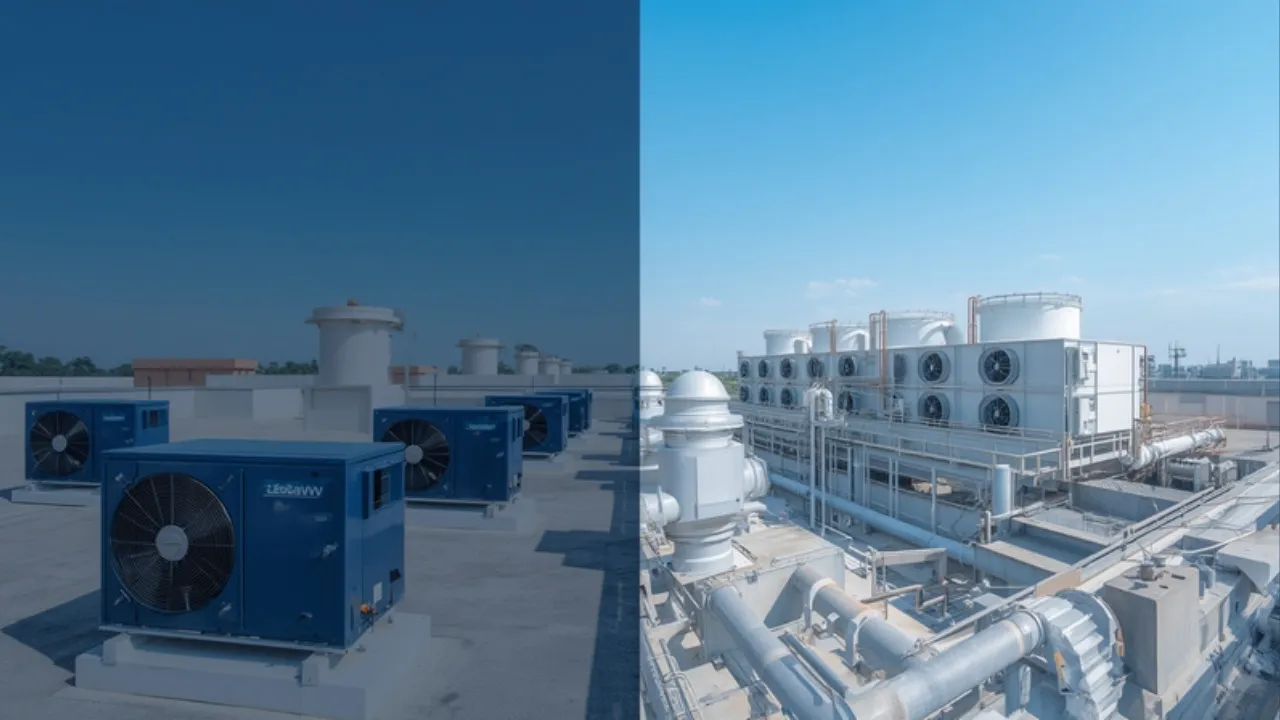
Short answer: choose VRF for zoned comfort up to ~50 TR where occupancy varies and you want no plant room — offices, showrooms, hotels and clinics. Choose a chilled-water (chiller) plant above ~50 TR of central cooling — malls, hospitals, hotels and factories — where a high-IPLV plant with VFD pumping gives the lowest running cost at scale. The right pick always comes from an actual heat-load study, but the rule of thumb below holds in most Indian projects.
VRF vs chiller — at a glance
| Factor | VRF / VRV | Chilled-water plant |
|---|---|---|
| Typical capacity | 2–60 HP per system (best up to ~50 TR) | 50–2,000+ TR |
| Plant room | None — outdoor units only | Dedicated plant room + cooling towers |
| Part-load efficiency | Excellent for varying zones | Excellent at scale with VFD pumping & high IPLV |
| Zoning / control | Independent control per zone | Zoned via AHUs/FCUs |
| Upfront cost | Lower for small–mid buildings | Higher, but cheaper per TR at large scale |
| Best for | Offices, showrooms, hotels, clinics | Malls, hospitals, large hotels, factories |
When VRF wins
VRF shines when loads vary by area and time — so you only cool what's in use. With no plant room, heat-recovery options and strong part-load efficiency, it's ideal for offices, showrooms, boutique hotels and clinics where each zone needs independent control.
When a chiller plant wins
Above roughly 50 TR of central cooling, a right-sized chilled-water plant with high IPLV and VFD pumping typically cuts running cost 20–30% versus alternatives, and holds temperature and humidity precisely — protecting comfort, process and product in malls, hospitals, large hotels and factories.
How to decide for your building
The deciding factors are total load, how that load varies across the day, available space for a plant room, and your running-cost horizon. We run a full heat-load study (ISHRAE/ASHRAE 62.1) accounting for area, occupancy, glazing, orientation and equipment heat, then recommend the system that pays back fastest. Get a quick figure from our AC tonnage calculator, then ask us for an engineered HVAC design with exact numbers for your site.
Building in North India specifically? Our deeper guide — VRF vs Chiller vs Ductable at 45°C — adds ductable/package units as a third option and covers the region-specific factors (design ambient, dust, winter heating, water availability) this quick comparison doesn't.
More insights
The Chiller Was Never the Problem. Nobody Balanced the Air After It Left the Plant.
A correctly sized chiller and correctly sized ducts can still deliver a badly performing building — because duct leakage at joints and flanges, combined with air that was never balanced after installation, means the cooling capacity that leaves the plant room isn't the capacity that reaches the room. Hot and cold spots get blamed on the equipment. The actual gap is in commissioning that never happened.
HVACThe Plant Met Spec in 2020. The Spec Assumed Summers North India No Longer Has.
45–50°C heat events now hit North India regularly, and air-cooled equipment catalogued at 35°C ambient derates hardest exactly when the load peaks. Climate-resilient HVAC design changes the ambient basis, condenser strategy, plant-room heat handling and the backup plan for heatwave grid stress.