
You Were Going to Build a Parking Shed Anyway. Put Solar on It Before the EV Chargers Go In.
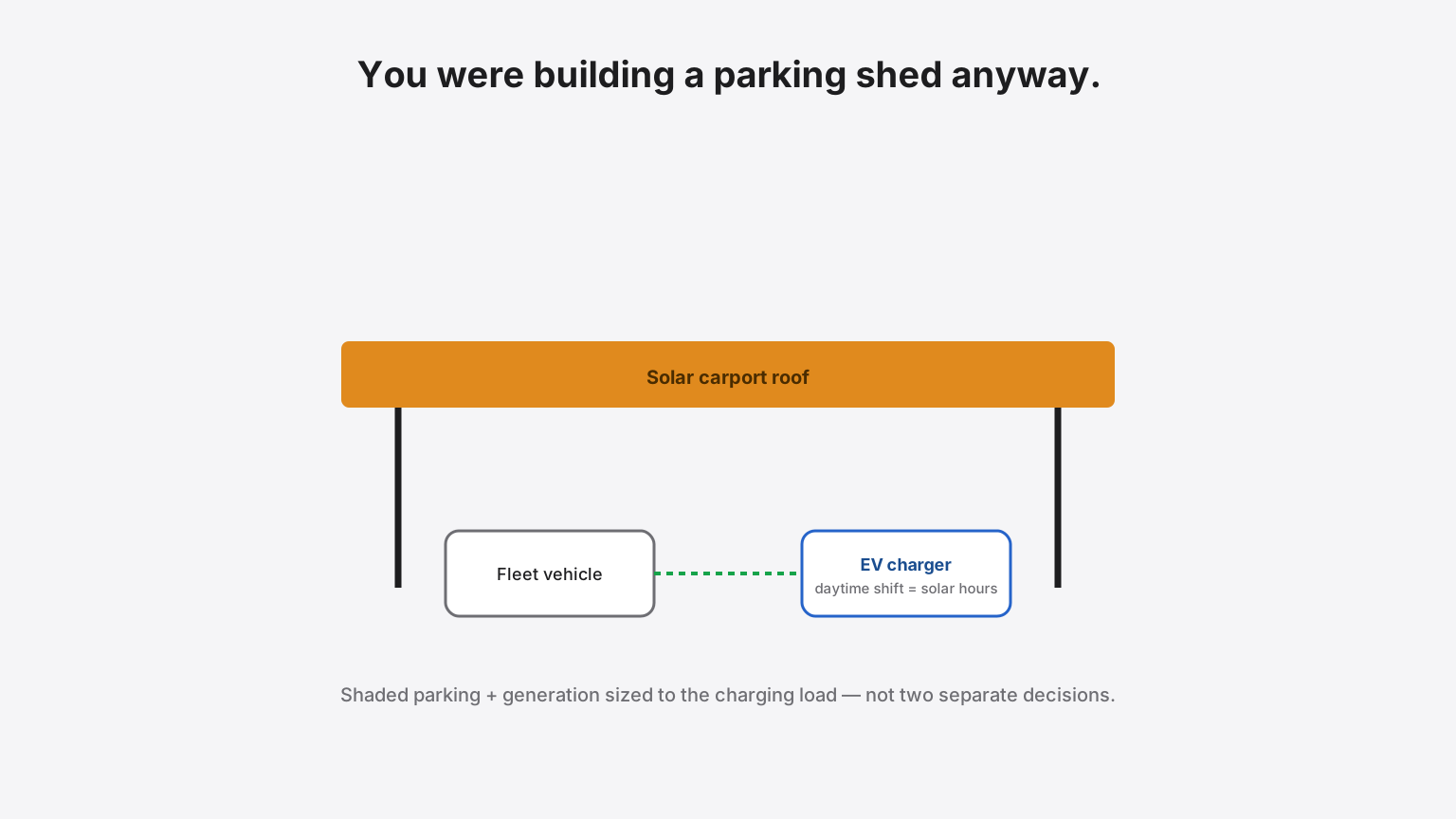
Our EV charging retrofit guide covers the electrical side of adding chargers to an existing building: transformer and panel headroom, demand diversity, metering. That guide treats the charging load as something the building's existing supply has to absorb. A solar carport is a different starting point — instead of asking "can our supply handle this new load," it asks "can we generate a meaningful share of it on-site, on structure we may be building anyway."
Where this genuinely applies
- Factories with EV logistics or delivery fleets — vehicles charging predictably during daylight shift hours line up well with solar generation, unlike opportunistic public charging.
- Hotels and hospitality adding guest EV charging to existing surface parking that has no shade structure at all — the carport's primary value (shaded parking) and its secondary value (generation) both land in the same capex.
- Corporate campuses installing employee charging where surface parking already exists and a shade structure is wanted regardless of the solar decision.
It applies less cleanly to basement or covered parking, where a carport structure has nothing to attach to — that scenario stays a straightforward electrical load-study problem, per our retrofit guide above.
What actually gets sized
| Question | Why it changes the design |
|---|---|
| What's the realistic daily charging load, once the fleet or guest count actually ramps up — not just the first few chargers installed? | Undersizing the carport against day-one demand is a common mistake; charging load grows as adoption grows, and structure is expensive to extend later. |
| Does charging happen mostly during solar hours, or into the evening? | A fleet charging on a daytime shift schedule gets direct offset from the carport array; guest or employee charging that peaks in the evening needs either battery storage or grid offset instead, changing the economics. |
| Is on-site generation meant to offset the load, or actually meet it in real time? | These are different design problems. Offsetting (net metering, annual balance) is simpler; real-time matching for a genuinely off-grid-style setup needs the storage sizing discussion in our dispatchable solar guide. |
The honest limits
Vehicle-to-grid (V2G) — using parked EV batteries to feed power back to the building or grid — gets discussed as the natural next step. For most Indian commercial sites today it isn't a real deployment option: the vehicle, charger and utility-side standards and commercial arrangements it depends on aren't yet in place at scale. Solar carports are worth building for shaded parking and daytime charging offset on their own merits; treat V2G as a possible future capability, not a reason to over-spec the installation now.
What we do differently
Our Solar EPC and electrical infrastructure teams size the carport array and the charging infrastructure together against your actual fleet or occupancy schedule, so the structure you build once accounts for where charging demand is headed, not just what's installed on day one.
More insights
A Plant Down 8% Looks Exactly Like a Plant Working Fine.
Solar underperformance is invisible from the ground and rarely obvious in the monitoring portal. Aerial thermography inspects every module in a fraction of the time a manual survey takes — and finds the specific failures that inverter data cannot localise.
Solar EnergyA Solar Array Cannot Be Switched Off From Below. Design for That.
While the sun shines, every string on your roof sits at hundreds of volts DC — breaker open or not. DC arcs don’t self-extinguish, mismatched connectors smoulder for months, and firefighters treat energised roofs differently. Solar fire safety is a design discipline, not an accessory.