
The Contract Said Turnkey. Four Things Were Still Your Problem.
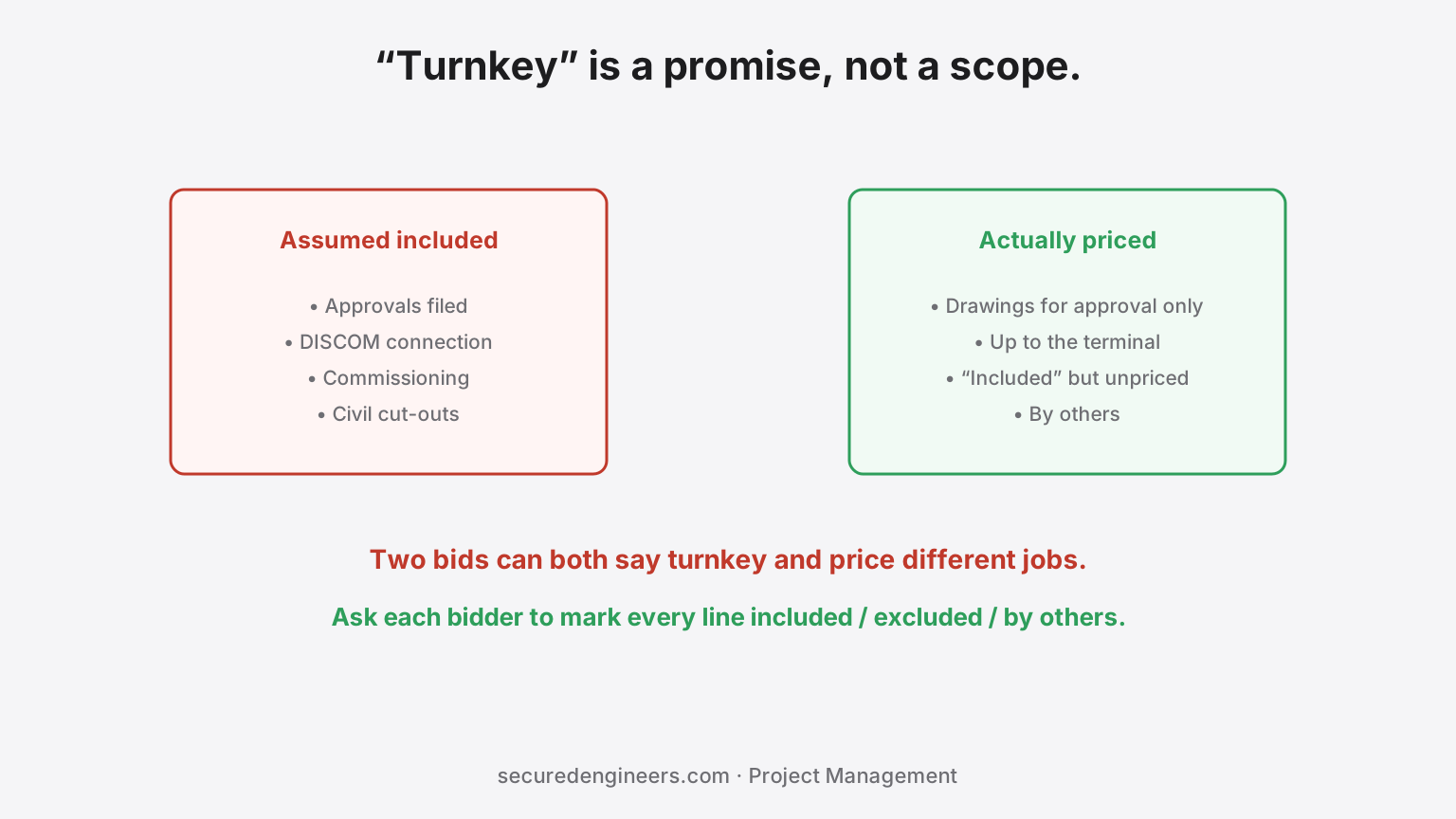
"Turnkey" is one of the most reassuring words in a construction contract and one of the least defined. It promises that you turn a key and the building works. What it does not do is state which activities are inside the scope — and because there is no standard definition, two contractors bidding "turnkey MEPF" can be pricing quite different jobs.
The client discovers the difference late, when something nobody priced turns out to be needed.
The four gaps that recur
- Statutory approvals. The single biggest one. Many "turnkey" quotes include preparing drawings for approval but not filing them, answering queries, or attending inspections. The distinction sounds procedural and is not: filing and query resolution is where months go.
- Utility-side works. The DISCOM connection, the metering arrangement, the sanctioned-load enhancement. Contractors frequently price up to their terminal and treat everything on the authority's side as the client's, which is defensible — but only if it was said.
- Testing, commissioning and documentation. Often assumed rather than priced, then compressed when the programme slips. A handover without measured performance data is not a commissioned building.
- Interfaces with other trades. Cut-outs and sleeves in civil work, the structural design for rooftop equipment, the base-build power supply a tenant fit-out relies on. Each sits between two contracts, and things between contracts are nobody's.
How to make bids actually comparable
| Ask explicitly | Why it changes the number |
|---|---|
| Do you file the approvals, or prepare drawings for us to file? | Filing and query rounds are labour-months, not a drawing fee |
| Where does your scope stop on the DISCOM side? | Decides who owns the connection timeline |
| Is commissioning a separate priced line? | If bundled, it is the first thing compressed when time runs out |
| Who provides civil cut-outs and sleeves? | Cheap if planned, structural work if retrofitted |
| Is O&M included, and for how long? | Turns a handover into a performance commitment |
Why the gaps are usually honest
It is tempting to read scope gaps as sharp practice. Mostly they are not. A contractor prices what they normally do, in the way they normally do it, and assumes the client's other vendors handle the rest — which was true on their last job. Nobody is lying; two reasonable assumptions simply fail to meet in the middle.
That is precisely why the fix is a written scope matrix rather than a stricter contract. Ambiguity, not bad faith, is what leaves work unowned.
The test worth applying
Take the list above and ask each bidder to mark every line "included / excluded / by others". The exercise takes an hour and does two useful things: it makes prices genuinely comparable, and it tells you something about the bidder. A contractor who can answer immediately has done this before. One who needs to check has not owned the full scope previously — which is worth knowing before you award, not after.
What we do differently
Our turnkey MEPF EPC scope is written as that matrix: design, every statutory approval filed by us, execution, and documented commissioning, with the boundaries stated rather than assumed. The approvals scope is owned in-house, which is the gap that most often lands back on the client.
More insights
Your BOQ Said 1,000 M. Site Said 1,470 M. Who Pays for the Missing 470 M?
Your BOQ says 1,000 metres of cable. The coordinated site route needs 1,470. Who pays for the missing 470? Why BOQ quantity mismatches surface during execution — and how route-based validation catches them first.
Project ManagementTurnkey EPC vs Multi-Vendor MEP — the Real Cost of Coordination
Five specialist quotes beat one turnkey number on paper. Then the interfaces start billing you. The honest comparison of how MEP is bought in India.