
Turnkey EPC vs Multi-Vendor MEP — the Real Cost of Coordination
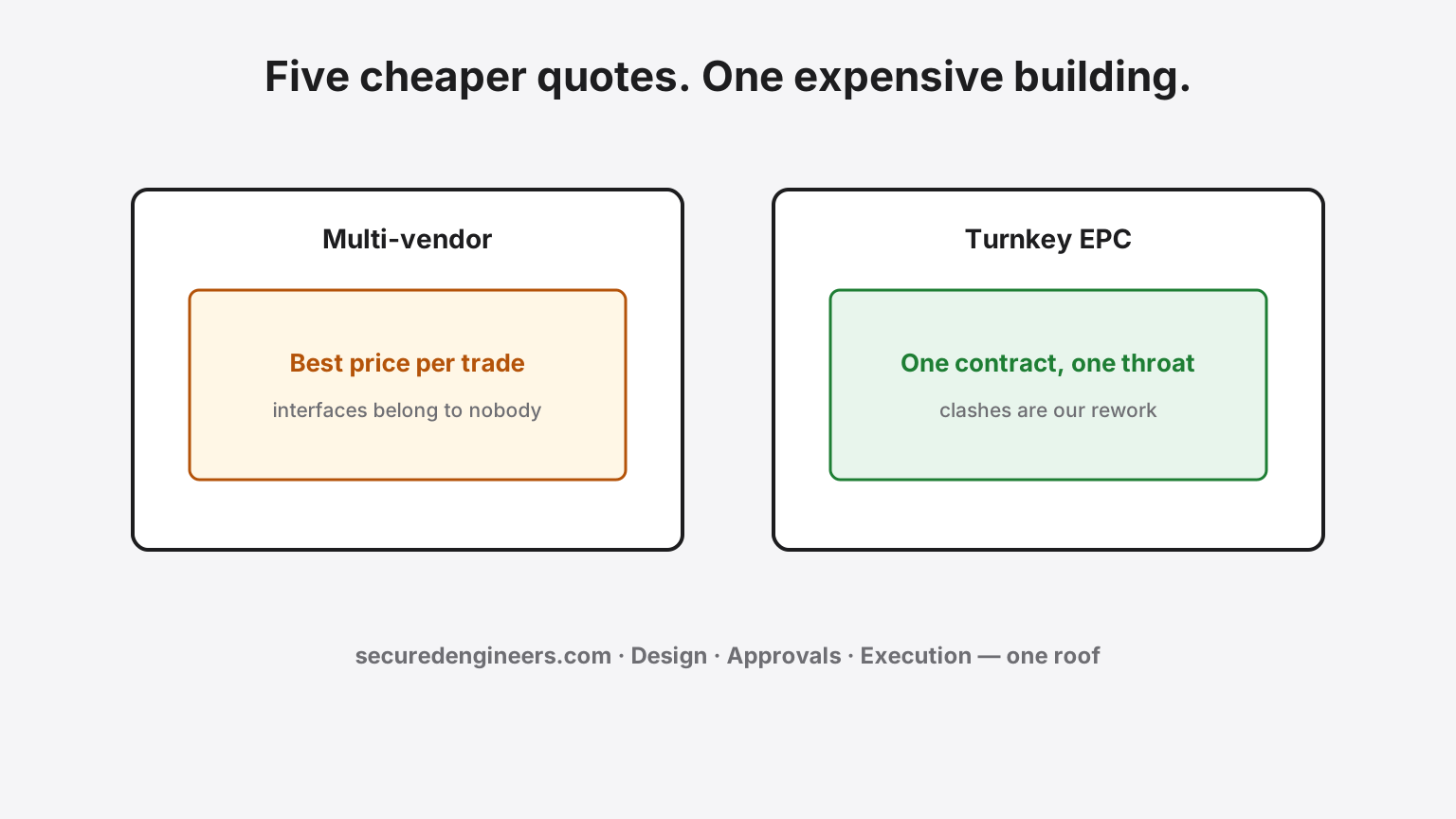
Take any factory or commercial project to market two ways. Ask five specialists to quote their own trades — HVAC, electrical, plumbing, fire, ELV — and ask one EPC to quote it all. Add up the five: they will beat the turnkey number, usually by a margin visible from across the room. Procurement logic says take the five.
Eighteen months later, on a large share of those projects, the ledger says otherwise. The difference was never in the quotes — it was in what the quotes didn't contain. We sell the turnkey model, so read what follows knowing that; we have also worked as one of the five often enough to describe the other side honestly.
The three ways MEP actually gets bought
| Model | Who coordinates | Strength | Structural weakness |
|---|---|---|---|
| Turnkey MEP EPC | The EPC — contractually | One accountable party, integrated design, one schedule | Weaker per-trade price discovery; you must vet one contractor deeply |
| Multi-vendor + PMC | A project-management consultant | Trade-level price discovery, specialist depth | PMC coordinates but rarely carries liability for interface failures |
| Owner-managed packages | Your team | Maximum control, no contractor margin on margin | You just became an MEP contractor with one project's experience |
Where the invisible costs live
The multi-vendor discount is real money at award. These are the accounts it quietly drains afterwards:
- Clashes built into ceilings. Separate contractors detail their own services against the same architecture; nobody owns the composite. Ducts meet cable trays at the same elevation, sprinkler mains thread through beam webs already claimed by drainage — and someone reroutes at site rates. Our piece on coordination failures prices this pattern.
- Interfaces nobody quoted. Who wires the fire pumps' starters? Whose scope is the plumbing shaft's fire-sealing? Five careful quotes can each exclude the same item — legitimately, by their own scope letters. The gap surfaces as a variation, at monopoly pricing, on the critical path. The pattern is dissected in the scope-gap contract trap.
- Sequencing arbitration. Every trade's programme is honest alone and incompatible together. When the electrical contractor's cable trays wait on the HVAC contractor's ducting, idle crews become prolongation claims — against you, because you hold both contracts.
- Commissioning with three explanations. The AHU underperforms: the HVAC vendor blames power quality, the electrical vendor blames the pump vendor's flow, the pump vendor blames the ducting. All three are contractually clean. The building still doesn't work.
The honest case for multi-vendor
The turnkey model is not a universal answer, and pretending otherwise would make this the disguised advertisement it must not be:
- A strong owner's engineering team changes everything. Industrial groups that build every two years, with MEP engineers on payroll and a coordination culture, capture the price-discovery benefit and manage the interfaces genuinely well.
- Some packages deserve a specialist. A GMP cleanroom, a data-centre white space, a specialised suppression system — niche leaders in these trades can out-engineer a generalist EPC inside their lane, and carving them out is rational.
- Turnkey concentrates counterparty risk. One weak EPC is worse than five average specialists. The model only works with a contractor whose balance sheet, engineering depth and track record survive scrutiny — vet accordingly.
- Price discovery is genuinely better per trade. If your programme has float and your team has depth, that discount can be kept, not surrendered to claims.
A decision framework that survives contact with procurement
| Your situation | Leans | Because |
|---|---|---|
| First major build, thin owner's team, hard deadline | Turnkey EPC | You are buying accountability and a schedule, not just systems |
| Repeat builder, in-house MEP engineers, standard facility | Multi-vendor | You can bank the price discovery and police the interfaces |
| Statutory-heavy scope (fire NOC, CEIG, net metering) | Turnkey EPC | Approvals fail at interfaces too — one filing owner keeps drawings and site telling one story |
| One genuinely specialist package inside a normal build | Hybrid | Turnkey the base building; carve out the specialist scope with its interfaces written, not assumed |
Whichever way you lean, budget from the same baseline: the MEPF cost calculator gives the per-sq.ft band for your building type, and the benchmark guide shows what sits inside it.
The interface matrix — the two pages that save the project
If you do go multi-vendor, one document does more for the outcome than any amount of meeting discipline: a written interface matrix, agreed before award and attached to every contract. Each row names an interface, who supplies, who installs, who connects, and who tests. A few of the rows that generate the most claims when left unwritten:
| Interface | The question nobody asked | Typical clean answer |
|---|---|---|
| Fire pump power | Who cables and terminates the fire pump starters? | Electrical supplies and terminates; fire contractor witnesses and tests |
| Shaft fire-sealing | Whose scope are the firestops where services cross floors? | Each trade seals its own penetrations to one specified system; fire contractor audits |
| AHU controls | Who wires sensors, actuators and the BMS points? | ELV/BMS wires and integrates; HVAC supplies mounted devices and commissions jointly |
| Plant-room drainage | Who drains condensate, pump glands and blow-downs? | Plumbing provides drains at stated points from the composite drawing |
| Earthing of other trades' equipment | Who bonds the ducts, pipes and trays? | Electrical owns the earthing system to every trade's terminal point |
Two pages, agreed while bidders still want the job, cost nothing. The same rows discovered at commissioning cost variations, delay and goodwill. A turnkey contract is, in effect, this matrix pre-signed under one name — which is the entire argument compressed into a sentence.
What we do differently
As a turnkey MEPF EPC, our contract puts design, all four trades, testing and the statutory file under one signature — so a clash is our rework, an interface is our scope, and commissioning has exactly one throat to choke. Where a project genuinely suits the multi-vendor route, we say so and bid our trades within it; an EPC that fears honest comparison isn't one.
The three takeaways
- Compare project costs, not tender totals — the multi-vendor discount competes against clashes, claims and interface variations that arrive later, unpriced.
- Coordination is a scope, not a hope — someone must own the composite drawing, the sequence and the interfaces; pay for it explicitly in whichever model you choose.
- Match the model to your bench — strong owner's teams can win with packages; everyone else is usually buying accountability, and should buy it whole.
Structuring the contracts for your next build? Book a Free Project Blueprint & Statutory Approvals Roadmap or call +91 70099 85817.
Frequently asked
What is the difference between turnkey EPC and multi-vendor MEP contracting?
Turnkey EPC places design, procurement, execution, testing and commissioning of all MEP services under one contract and one accountable party. Multi-vendor contracting splits the services — HVAC, electrical, plumbing, fire — into separate packages awarded to specialist contractors, coordinated by the owner, a PMC, or the civil contractor.
Is turnkey MEP more expensive than separate packages?
At tender stage, usually yes by a visible margin — a turnkey bidder prices the interfaces, coordination and single-point liability that split packages leave unpriced. Over the project, the comparison narrows or reverses through fewer clashes, no scope-gap claims, one commissioning owner, and a schedule that does not arbitrate between five contractors.
When does multi-vendor MEP make sense?
When the owner has a strong in-house engineering and coordination team, when a package is genuinely specialist (a cleanroom, a data-centre fit-out) and best bought from a niche leader, or when price discovery per trade matters more than schedule certainty. It is a legitimate model — it just needs the coordination role staffed and paid for, not assumed.
Where do the coordination costs actually appear on a multi-vendor project?
In services clashing in ceilings and shafts (rework), trades idling while waiting on each other (prolongation claims), scope holes at interfaces nobody priced (variations), and commissioning where every underperformance has three explanations. These arrive as claims and delays, not as a line item — which is why they get forgotten at comparison time.
Related services
More insights
Your MEP Contractor Left. So Did the Only People Who Understood the System.
Design drawings show what was intended. As-built drawings should show what was actually installed — but they routinely don't, because site changes during execution never get fed back into the drawing set. Combined with a generic O&M manual instead of one specific to the installed system, the facility team inherits a working building with no reliable record of why it works or how to fix it when it stops.
Project ManagementThe Most Dangerous Electrical Installation You Will Ever Own Is the Temporary One
Permanent installations get design, inspection and as-builts. The site supply that builds them gets a rented DG, a spider of cables through rebar and rainwater, and whoever was free that morning. Construction power deserves engineering — it kills more people than the permanent kind.
More on Project Delivery & Commercial · all insights