
Your Government Tender Was Rejected on Page 3. Nobody Opened the Price Envelope.
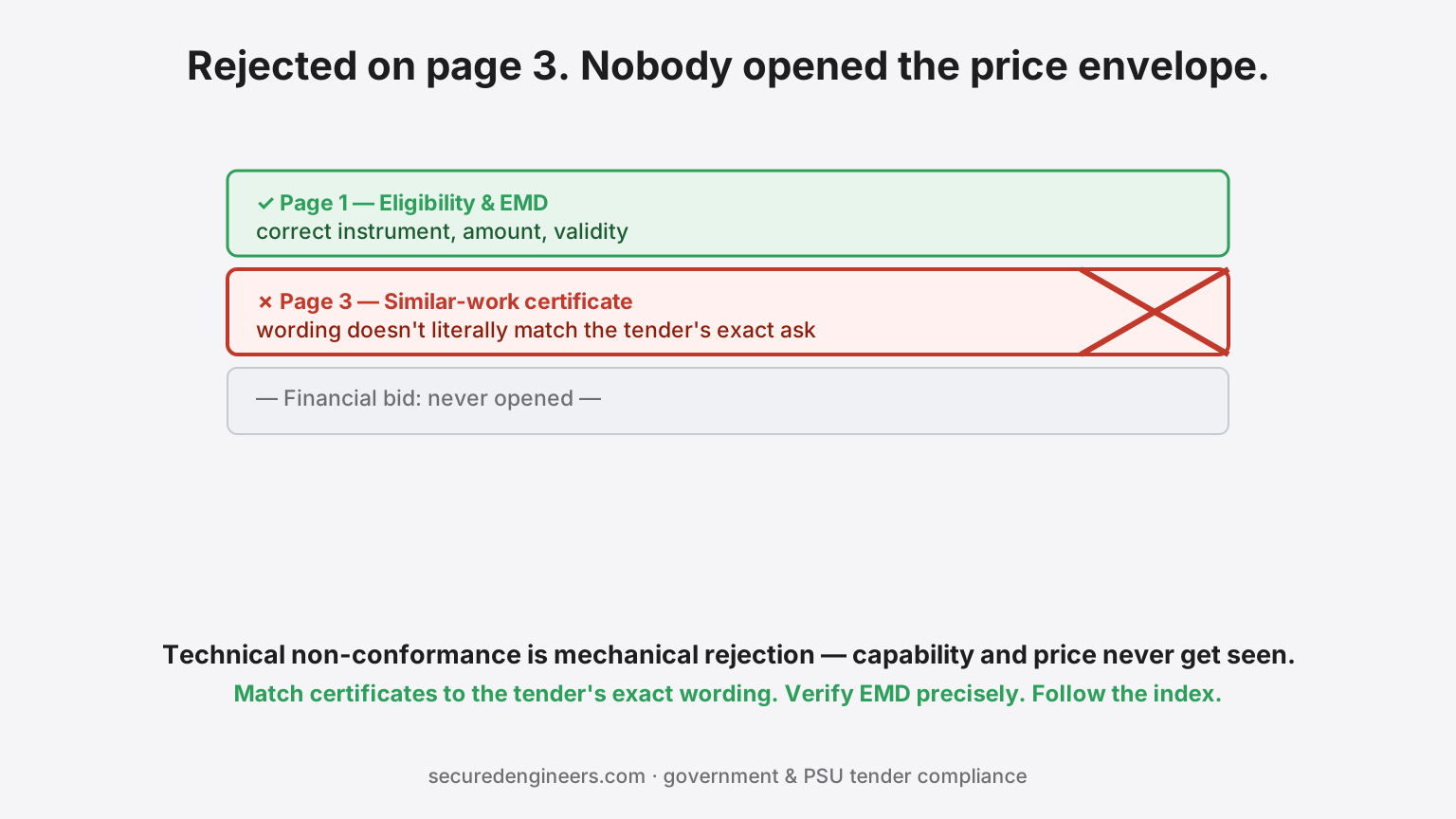
Private-sector tenders forgive a lot of documentation looseness because the buyer wants the best price and will call to clarify a gap. Government and PSU tenders operate on the opposite principle: the technical bid is evaluated strictly against the tender document, and non-conformance is grounds for rejection before the financial bid is ever opened. Contractors who are perfectly capable of the work, and would have priced competitively, lose these tenders on page 3 — an EMD in the wrong instrument type, an experience certificate that doesn't match the exact format demanded, a turnover figure calculated on the wrong financial-year basis.
This is not bureaucratic pedantry for its own sake — public procurement rules exist precisely to remove discretion from the evaluation, which means the flip side is genuinely mechanical rejection for genuinely mechanical non-conformance.
Where technical bids actually get disqualified
| Rejection cause | What actually goes wrong |
|---|---|
| EMD (Earnest Money Deposit) format | Wrong instrument type (DD vs bank guarantee vs online payment as specified), wrong validity period, wrong amount, or issued in the wrong entity's name |
| Turnover eligibility | Average annual turnover calculated over the wrong number of years, or using the wrong base (total company turnover vs. the specific work-category turnover the tender asks for) |
| Similar-work experience | Completion certificates that don't explicitly state the exact scope/value/period the tender requires — a genuinely comparable project, described in the wrong words, can fail a literal-match evaluation |
| Certificate validity & format | Expired registrations, certificates not on letterhead, missing notarisation or attestation where required, photocopies where originals or certified copies were specified |
| Document sequencing & indexing | Many tenders specify exact document order and an index — non-conformance here is a genuine, if frustrating, rejection ground in strict evaluations |
| Joint venture / consortium documentation | JV agreements not meeting the tender's specific power-sharing, liability or lead-partner requirements |
| Bid validity period | Financial bid or EMD validity that expires before the tender's stated evaluation timeline |
Why this happens even to genuinely qualified contractors
The pattern is consistent: a contractor with real MEPF capability, real completed projects, and a competitive cost structure treats the technical bid as a formality to be assembled quickly, while the real effort goes into pricing. But public-sector evaluation typically works the other way — the technical bid is scrutinised literally, by evaluators whose job is compliance verification, not capability judgment. A brilliant, underpriced bid that fails technical conformance never gets its price seen at all.
The pre-submission checklist
- Read the eligibility criteria as a literal checklist, not a general capability description — turnover threshold, years of experience, similar-work definition, all matched exactly against your documentation, not your judgment of "we clearly qualify"
- Match completion certificates to the tender's exact wording — if the tender asks for "similar work of value not less than X in the last Y years," your certificate should state a scope, value and date that visibly satisfies that sentence, not require the evaluator to infer it
- Verify EMD instrument, amount, validity and beneficiary name against the tender document precisely — this is the single most common purely mechanical rejection cause
- Check certificate currency — registration certificates, ISO certifications, PF/ESI registrations, GST — all need to be valid through the bid validity period, not just valid on submission day
- Follow the exact document sequence and indexing the tender specifies, even when it seems redundant with the content itself
- Submit early enough to catch and fix errors — a portal upload rejected for a file-format issue an hour before deadline has no recovery path
- For consortium bids, verify the JV documentation meets the tender's specific structural requirements — a valid JV agreement in general commercial terms can still fail a tender's particular format demands
The pattern that separates repeat winners from repeat rejects
Contractors who consistently clear technical evaluation treat tender-document compliance as its own discipline, separate from — and prerequisite to — competitive pricing. They maintain a standing library of current certificates, pre-formatted completion-certificate templates matched to common tender phrasing, and a document checklist reviewed against every new tender's specific requirements before a single price is calculated. The ones who lose repeatedly on technical grounds usually keep improving their pricing strategy while the actual failure point — documentation conformance — goes unaddressed.
Where this connects to the broader procurement picture
Government tender discipline is the mirror image of writing a gameproof tender from the buyer's side — the same precision that protects a private owner from ambiguous bids is what a government evaluator applies against your submission. Understanding both sides of that discipline is what makes a contractor genuinely tender-ready, on either side of the table.
FAQs
What is the most common reason MEP technical bids get rejected?
EMD format/validity errors and similar-work experience certificates that don't literally match the tender's required wording are the two most frequent purely mechanical rejection causes — both avoidable with careful pre-submission review.
Can a rejected technical bid be corrected and resubmitted?
Generally no, once the submission deadline has passed — which is exactly why pre-submission verification matters more than post-rejection appeals in most public procurement frameworks. Confirm the specific tender's clarification/appeal provisions, but don't rely on them as a safety net.
Does a lower price compensate for technical non-conformance?
No — in strict two-envelope evaluation, the financial bid is typically only opened for technically qualified bidders. A disqualified technical bid never has its price considered regardless of how competitive it was.
How should turnover eligibility be calculated?
Exactly as the tender specifies — average over the stated number of years, using the stated turnover category (often work-specific, not total company turnover). Confirm against your audited financials before submission, not after.
Can you help prepare a compliant technical bid for a government MEP tender?
Yes — eligibility-criteria mapping, documentation review and compliance checking against the specific tender document. Get in touch.
More insights
A Plan-Sanction Query Isn't a Delay. It's an Invoice — for Interest You're Already Paying.
A rejected MEP drawing reads as a paperwork problem. It's a financial one: every week a submission sits in a query-and-resubmission cycle is a week of construction-loan interest, idle site overhead and a possession date paid for by someone who assumed the file would move on schedule.
Costing & ProcurementSupplying a PSU? Your Invoice Now Has to Go on TReDS.
The 2026 amendment requires every central public sector enterprise to settle MSME invoices on the Trade Receivables Discounting System. For contractors on PSU work, that turns a receivable in a queue into a discountable instrument on a regulated exchange.