
A Plan-Sanction Query Isn't a Delay. It's an Invoice — for Interest You're Already Paying.
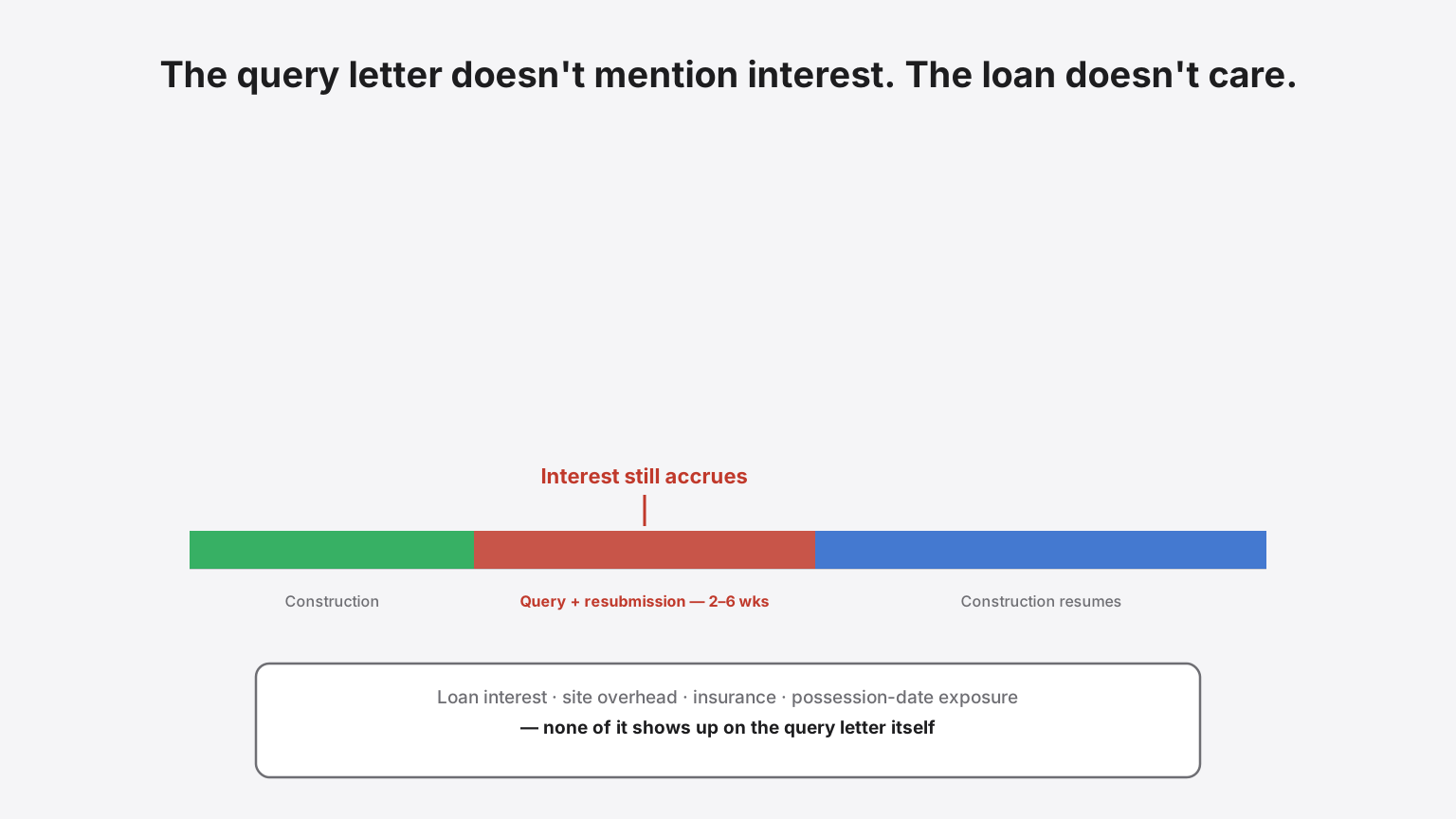
When a Fire NOC, CEIG or municipal building-plan submission comes back with a query, it gets treated as a scheduling problem — the project moves a milestone and continues. What that framing misses is that the weeks a submission spends in the query-and-resubmission cycle are not free. Construction finance keeps accruing interest whether or not steel is moving; site overhead — security, supervision, a skeleton crew — keeps running; and if the query lands late enough in the programme, it can push straight into a possession or lease-commencement date that was never contractually flexible.
Where the cost actually sits
| Cost category | Why a resubmission cycle triggers it |
|---|---|
| Construction loan interest | Drawn-down capital accrues interest on a calendar, not on progress — a stalled approval doesn't pause the interest clock. |
| Site overhead and idle mobilisation | Supervisory staff, security and any pre-mobilised trade crews are commonly retained through a hold, since demobilising and remobilising has its own cost and delay. |
| Insurance and statutory carrying costs | Project insurance and other calendar-based obligations continue regardless of approval status. |
| Downstream contractual exposure | Lease commencement, pre-sold possession dates or a tenant's own fit-out programme can carry penalty clauses that don't care why the approval slipped. |
None of this shows up on the query letter itself, which typically just states the technical objection. It shows up on the project's cash-flow statement three months later, as a line nobody budgeted because "approval delay" doesn't have its own cost code.
Why this argues for spending more at design stage, not less
The instinct on a tight budget is to compress design and coordination time to protect the schedule. It's the wrong lever. A design phase that costs a little more in coordination hours — cross-checked drawings, a pre-submittal internal review against the authority's actual checklist — is cheap against even one resubmission cycle's carrying cost. The maths rarely gets run explicitly, which is exactly why it keeps getting skipped.
Where this compounds
A commercial project chasing an occupancy certificate faces this same clock at the far end of the programme — our occupancy certificate delays guide covers how OC queries stall possession specifically. A submission that's clean the first time avoids paying this cost twice: once at plan-sanction stage, and again at OC stage if the same coordination gaps were never actually fixed.
What we do differently
Our Design & Approvals team runs submissions against the authority's actual checklist before filing, and because we're accountable for the approval outcome under a single-window scope, a clean first submission is our incentive as much as yours.
How long does a typical Fire NOC or plan-sanction resubmission add?
It varies by state and department workload, but 2-6 weeks per cycle is a reasonable planning assumption — and a submission can go through more than one cycle if the underlying coordination gap, not just the flagged item, isn't fixed.
More insights
The AC Failed in Month 11 of a 12-Month DLP. Is That a Defect, or Just... Life?
The defect liability period sounds simple: the contractor fixes anything that goes wrong for 12 months after handover. In practice, 'goes wrong' is exactly where owner and contractor start disagreeing — is a filter clog a defect or routine maintenance the owner skipped? Is a compressor failure a manufacturing fault or normal wear? The DLP works only when 'defect' is defined before it's argued about.
Costing & ProcurementSupplying a PSU? Your Invoice Now Has to Go on TReDS.
The 2026 amendment requires every central public sector enterprise to settle MSME invoices on the Trade Receivables Discounting System. For contractors on PSU work, that turns a receivable in a queue into a discountable instrument on a regulated exchange.