
Your STP Was Compliant Last Year. ZLD Is Reaching More Categories Every Year.
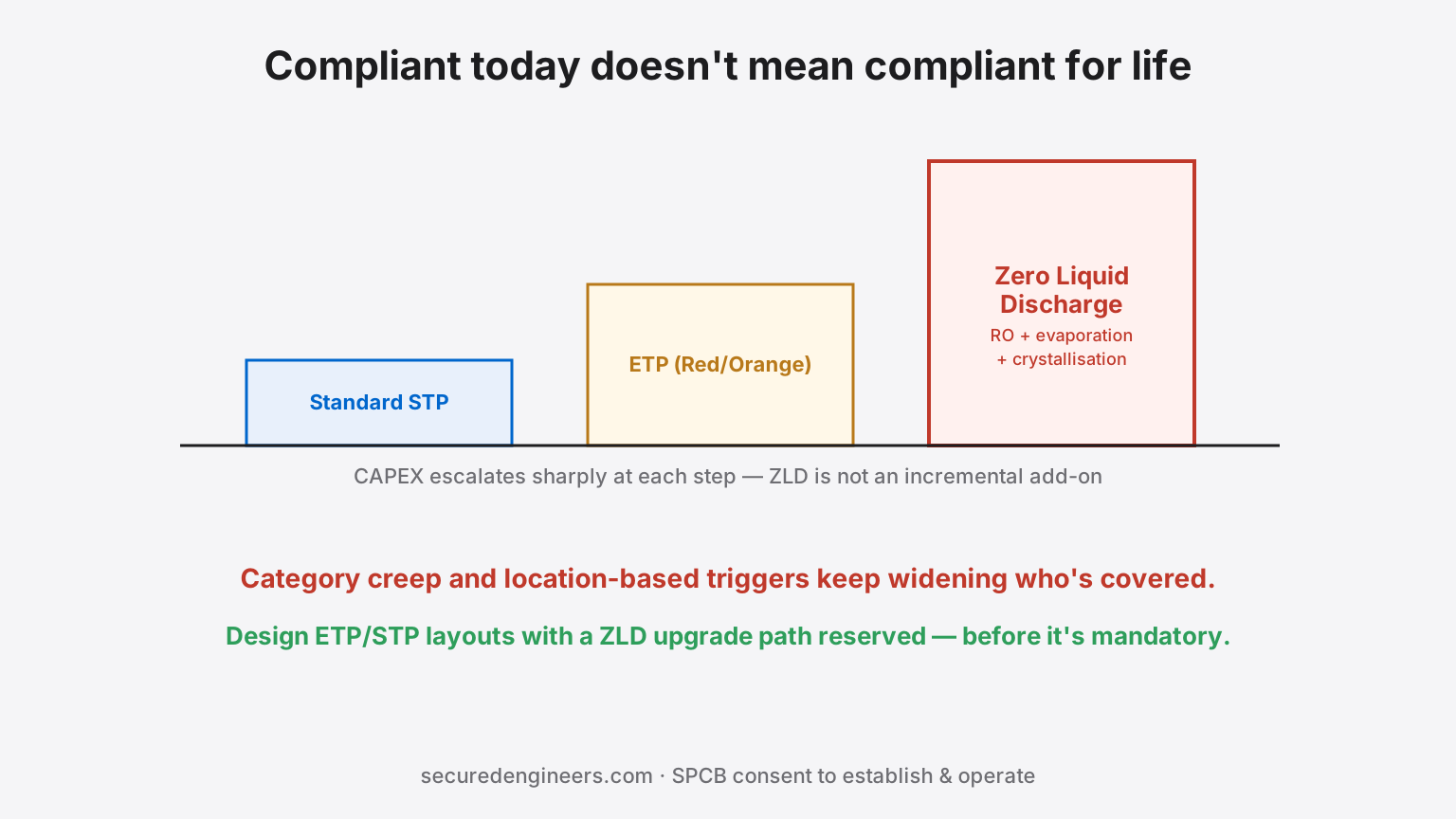
Zero Liquid Discharge — treating industrial effluent to a standard where none of it is discharged outside the plant boundary, with all water recovered and reused or the residual reduced to solid waste — began as a requirement aimed at the most heavily polluting sectors (textile dyeing, tanneries, certain chemical processes). The direction of travel across state pollution control boards has consistently been to widen ZLD's reach: more categories, more locations, tighter discharge norms even for units not formally under a ZLD mandate yet. A unit compliant today on a standard effluent treatment plant (ETP) or sewage treatment plant (STP) basis is not guaranteed to stay outside ZLD's scope for the life of the facility.
Why ZLD is a different order of CAPEX
| System | What it does | Relative CAPEX |
|---|---|---|
| Standard STP | Treats domestic/light industrial sewage to a dischargeable standard | Baseline |
| ETP (Red/Orange category) | Treats process effluent to CPCB/SPCB discharge norms before release | Meaningfully higher than STP |
| ZLD (RO + evaporation/crystallisation) | Recovers effluent to reusable water, concentrates and solidifies the remainder — nothing discharged | Substantially higher again, plus real ongoing energy cost to run it |
The jump from ETP to ZLD isn't incremental — it typically means adding reverse osmosis, multi-effect evaporation and often crystallisation stages on top of conventional treatment, each with its own capital cost, footprint, and continuous energy demand (evaporation in particular is energy-intensive, which is where solar or waste-heat integration becomes a genuine economic lever, not just an environmental one).
Where the risk actually sits
- Category creep — pollution board categorisation (Red/Orange/Green) and ZLD applicability both get revised periodically; a unit categorised Orange today can be re-categorised as the classification framework tightens.
- Location-based triggers — some ZLD requirements are geography-driven (proximity to water-stressed basins or specific industrial clusters) independent of the industry category itself.
- Expansion re-opening the question — the same "brownfield expansion reopens whole-site compliance" pattern covered in our factory expansion compliance guide applies directly here: adding capacity is exactly the moment a pollution board re-examines a unit's effluent treatment obligations.
Planning for it, not reacting to it
The practical response isn't building ZLD capacity nobody currently requires — it's designing the ETP/STP layout with a genuine ZLD upgrade path: enough plot area reserved, civil foundations that can carry the additional RO/evaporation train, and electrical capacity headroom for the load it adds. A facility built without that reserve faces a much harder, more expensive retrofit if or when ZLD applicability does arrive, on a compressed regulatory timeline rather than a planned one.
Our Design & Approvals scope and SPCB consent guide cover the compliance side; on the design side we plan ETP/STP layouts with upgrade headroom built in, so a future ZLD requirement is an addition, not a demolition-and-rebuild.
More insights
The IE Rules Are Gone. Here Is What You Are Personally on the Hook for Now.
Generations of Indian electrical practice ran on the Indian Electricity Rules, 1956. They have been replaced — the CEA's safety regulations now define an owner's duties: designated supervision, periodic testing, records, and accident reporting. Most facility owners have not read a line of them.
ComplianceDelhi NCR Is Not One Jurisdiction. Your MEP Approvals Prove It.
Noida, Greater Noida, Gurugram, Faridabad and Delhi sit within an hour of each other and answer to different authorities, different DISCOMs and different state fire services. A programme built for one does not transfer to the next.