
The IE Rules Are Gone. Here Is What You Are Personally on the Hook for Now.
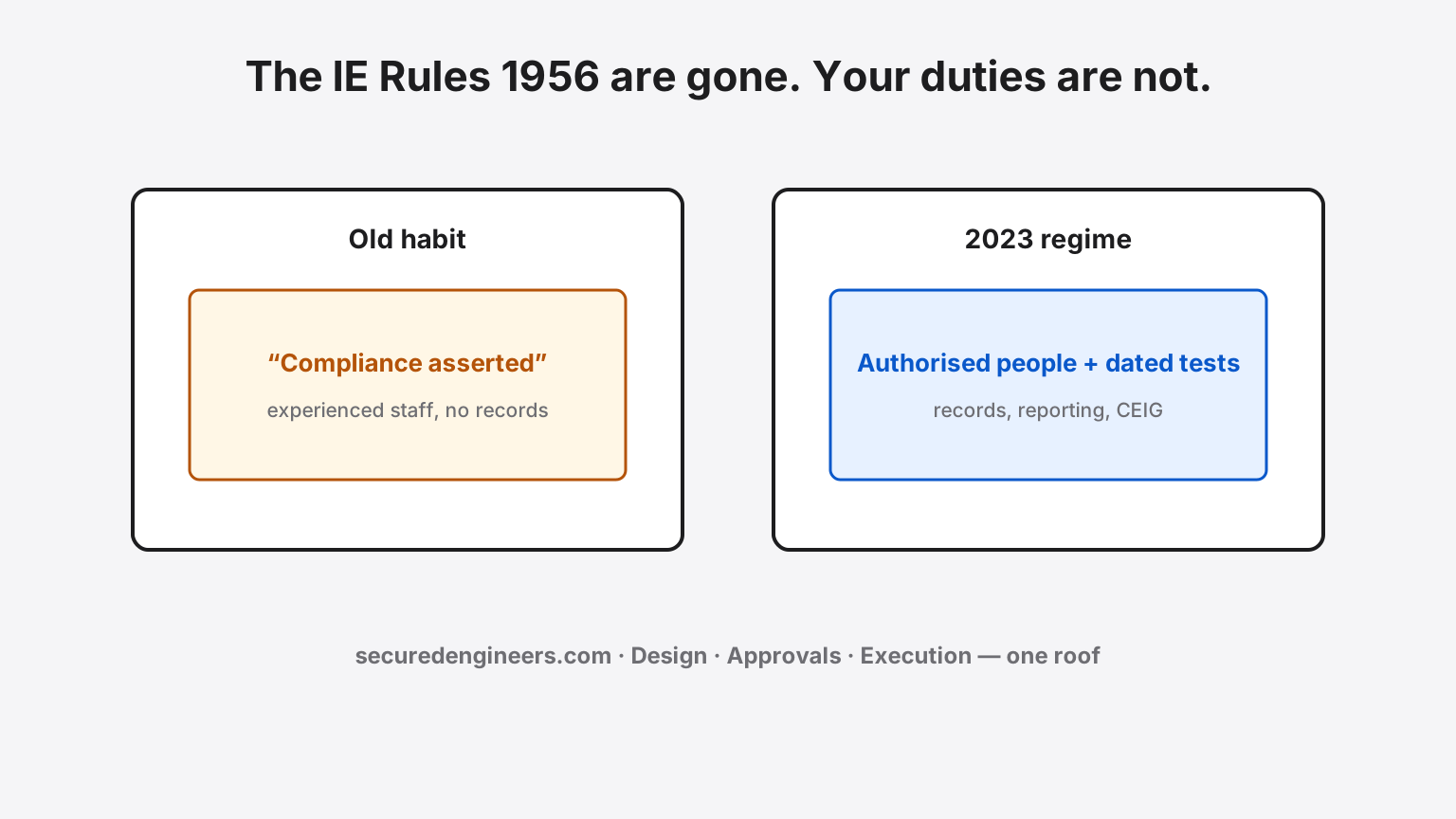
Ask an older electrical contractor which law governs installation safety and he will say "IE Rules" — the Indian Electricity Rules, 1956, the text an entire industry grew up quoting. Those rules are history. Under the Electricity Act, 2003, the Central Electricity Authority notified successor safety regulations — the CEA (Measures relating to Safety and Electric Supply) Regulations, updated most recently in 2023 — and it is this text, plus your State's Electrical Inspectorate practice, that now defines what a facility owner must do.
The regulations largely carry forward the old regime's architecture, which is exactly why they are dangerous to ignore: the duties are familiar in spirit but specific in letter, and after an incident, the letter is what gets read out. What follows is the owner's-eye summary first, then the same duties by regulation number from the gazette text — the CEA (Measures relating to Safety and Electric Supply) Regulations, 2023, notified on 8 June 2023 in supersession of the 2010 regulations.
The duties that attach to you as owner/occupier
- Competent supervision: installations must be operated and maintained under appropriately qualified/authorised persons. "The electrician we've always had" is an answer that must survive scrutiny of his authorisation, not his tenure.
- Safe condition, demonstrably: the installation must be maintained so as not to endanger life — which in practice means periodic inspection and testing (insulation resistance, earth resistance, protective-device health) with dated records. An untested installation is, in the regulator's eyes, an unmaintained one.
- Earthing that is measured, not assumed: earthing per the standards (the IS 3043 family of practice), maintained and periodically measured. The classic failure is a beautifully installed earth pit whose resistance nobody has measured since commissioning.
- Protection settings that match the system: fault protection must actually correspond to the installation as it exists today — every load added since commissioning has been quietly editing your fault levels and coordination.
- Statutory inspection interface: HT installations, generating sets and specified works engage the Electrical Inspectorate (CEIG) — pre-commissioning approval and the State's periodic-inspection regime. Operating ahead of, or in defiance of, that approval is the single most consequential shortcut in the field.
- Accident reporting: electrical accidents — fatal or otherwise as specified — must be reported to the Inspectorate within the prescribed timelines. Not reporting converts an accident into an offence.
- Display and documentation: shock-treatment/first-aid charts, danger notices at appropriate locations, single-line diagrams and test records available — the humble items every inspection begins with.
The same duties, by regulation number
Regulation 32(8) is the sentence the rest hangs off: it is the owner's responsibility to maintain and operate the installation in a condition free from danger, and as recommended by the manufacturer or by the relevant standards. It does not transfer to the contractor who built the installation, and it is not spent by the inspector who cleared it.
- An Electrical Safety Officer from 250 kW — regulation 5(3). A factory registered under the Factories Act, 1948 with more than 250 kW connected load must designate an Electrical Safety Officer. Regulation 5(2) sets the qualification: a degree in electrical engineering with at least five years in operation and maintenance, or a diploma with at least ten. The officer inspects at intervals not exceeding one year and records the result in the Schedule II form. 250 kW is a small plant, and this is the duty most often missed.
- Designated persons, and a register — regulations 3 and 4. Work on lines and apparatus is done by persons the owner has designated, and nobody may be designated unless they hold a certificate of competency or electrical work permit and their name is entered in a register the owner maintains. The inspector may call for that register. A competent electrician whose name was never written down does not satisfy it.
- Who inspects, and who self-certifies — regulation 32(1)–(3). The regime splits on a voltage notified for your state. Above it, periodic inspection is the Electrical Inspector's; at or below it, the owner inspects, tests and self-certifies on the Schedule II form, deemed received if not acknowledged within three working days. Periodicity is as the Appropriate Government directs, capped at five years by the proviso to 32(2). Regulation 32(4) puts installations covered by section 54 of the Act, and those of mines, oil-fields and railways, back with the Inspector regardless. Confirm your state's notified voltage and interval — both are the state's to set.
- A six-month shutdown re-opens it — regulation 45. An installation shut down for six months or more is inspected, tested and certified again before supply recommences: self-certified by the owner at or below the notified voltage (45(1)(a)), by the Electrical Inspector above it (45(3)). Seasonal plants and lines idled through a downturn get caught here, usually on the day they want to restart.
- What non-compliance costs — regulation 32(7). Defects the inspector records and the owner does not rectify in the time stated make the installation liable to disconnection after not less than forty-eight hours' notice, unless an appeal under section 162(2) of the Act has stayed it.
The approval side of the same regulations — drawings, inspection and energisation — is on our CEIG approval guide.
What changed in emphasis worth knowing
| Theme | Old-regime habit | Current-regime expectation |
|---|---|---|
| Evidence | Compliance asserted | Compliance recorded — test registers, authorisations, reports |
| People | "Experienced" staff | Authorised/qualified persons, identifiable by name |
| Periodicity | Inspection when something failed | Scheduled testing culture; the Inspectorate's periodic regime for covered installations |
| New technology | Silent | The 2023 framework speaks to present-day systems (renewables, storage, EV-era loads) — your solar plant and battery room are inside the regime, not beside it |
(State Electricity Regulatory practice and the State Inspectorate's circulars layer on top — the operational details of periodicity and formats are state-specific. Verify yours.)
A 30-day compliance reset for a typical factory
- Week 1 — People: list who operates and maintains what; verify authorisations; appoint and record the responsible person(s).
- Week 2 — Records: open (or resurrect) the test register — insulation resistance by circuit, earth resistance by pit/grid, relay/breaker test dates, SLD as-built.
- Week 3 — Measurements: run the actual tests with calibrated instruments; thermograph the boards while you are at it.
- Week 4 — Statutory: reconcile your CEIG approvals against reality — every HT change, DG addition and solar plant accounted for; file what is missing before an inspector finds it.
If your installation touches the Inspectorate — HT connection, transformers, gensets, larger solar — check your readiness in five minutes with our CEIG Readiness checker. It walks the same file an inspector will.
What we do differently
The regime points to a definite scope of work: the tests the regulations imply, the records an Inspectorate visit expects, and a defect list priced for fixing — followed, if you want, by our CEIG liaison team filing whatever the reconciliation surfaced. Remediation and approval under one roof means the findings do not die in a PDF.
The three takeaways
- The IE Rules 1956 are replaced — the CEA safety regulations (2023 edition) + your State Inspectorate now define owner duties.
- The regime runs on records: authorised people, dated tests, reconciled approvals, reported incidents.
- Solar, storage and new-era loads are inside the framework — compliance thinking must include them.
When did your installation last pass a real test — on paper? Book a Free Project Blueprint & Statutory Approvals Roadmap or call +91 70099 85817.
Frequently asked
Do the Indian Electricity Rules, 1956 still apply?
No. Under the Electricity Act, 2003 the Central Electricity Authority notified successor safety regulations — the CEA (Measures relating to Safety and Electric Supply) Regulations, most recently updated in 2023 — and it is that text, together with your State Electrical Inspectorate's practice, that now defines an owner's duties. An industry that grew up quoting the IE Rules is still quoting them, which is precisely the risk.
Does my factory need an Electrical Safety Officer?
If it is registered under the Factories Act, 1948 and its connected load is more than 250 kW, yes — regulation 5(3) of the CEA (Measures relating to Safety and Electric Supply) Regulations, 2023 requires one to be designated. Regulation 5(2) sets the qualification (a degree in electrical engineering plus five years in operation and maintenance, or a diploma plus ten), and the officer inspects the installation at intervals not exceeding one year, recorded on the Schedule II form.
Does a factory need re-inspection after a long shutdown?
Yes, if the shutdown lasted six months or more. Under regulation 45 the installation is inspected, tested and certified again before supply recommences — self-certified by the owner at or below the state's notified voltage, and by the Electrical Inspector above it.
What does a facility owner actually have to do under the CEA safety regulations?
Four things, in the owner's-eye summary: keep the installation under appropriately qualified and authorised supervision; maintain it in demonstrably safe condition through periodic inspection and testing with dated records; maintain and periodically measure earthing rather than assume it; and keep fault protection matched to the installation as it exists today, not as commissioned. For the binding wording, read the current notified text.
Is the electrician we have always used a competent person?
That depends on his authorisation, not his tenure. The requirement is that installations are operated and maintained under appropriately qualified or authorised persons, and after an incident that is assessed on paper. "He has been with us for twenty years" is an answer that has to survive scrutiny of his authorisation.
What records would be asked for after an electrical incident?
Dated test records are the ones that matter — insulation resistance, earth resistance, protective-device health — along with evidence of who supervised the installation and what the protection settings were. An untested installation is, in the regulator's eyes, an unmaintained one, and the letter of the regulation is what gets read out afterwards.
Related services
More insights
The Thresholds Moved. Your Factory May Have Changed Category Without Doing Anything.
MSME classification is set by investment in plant and machinery and by turnover. When the notified limits rise, enterprises change category without any change in their own operations — and both the benefits and the obligations move with them.
ComplianceThe Drugs Controller, the Pollution Board and the Fire Department All Have an Opinion on Your Cleanroom.
Our GMP HVAC and WHO-GMP guides cover how to design a cleanroom that passes its audit. A separate problem sits alongside the engineering: a pharma or food manufacturing facility answers to several regulatory bodies at once, and their requirements don't always agree with each other.
More on Statutory & Approvals · all insights