
The Escalator Stopped Mid-Step. The Inquiry Wants to Know Who Last Serviced It.
Most building systems fail privately — an AC unit that stops cooling inconveniences the people in that room. A lift or escalator failure in a mall, office lobby or metro-adjacent commercial building fails in public, in front of witnesses, often with someone on it. That distinction changes everything about how the maintenance record needs to be kept — and most commercial building owners discover this only after an incident, when the record they actually have turns out to be inadequate for the scrutiny that follows.
Why lifts and escalators sit in a different liability category
- Statutory licensing: unlike most MEP systems, lifts and escalators require a state Lifts Act (or equivalent) licence, periodic statutory inspection, and a licensed operator/maintenance framework — not a generic AMC arrangement
- Public exposure: the population at risk from a failure is the general public, not a controlled workforce — which changes the regulatory and insurance posture entirely
- Personal accountability: in a serious incident, inquiries look for a named responsible person — the building owner's nominated safety officer, the AMC contractor's signing engineer — not an abstract "the company"
- Insurance scrutiny: public-liability policies for commercial buildings routinely condition coverage on documented, competent maintenance — the same principle we covered for fire systems, with a lower tolerance for gaps
What a defensible maintenance record actually contains
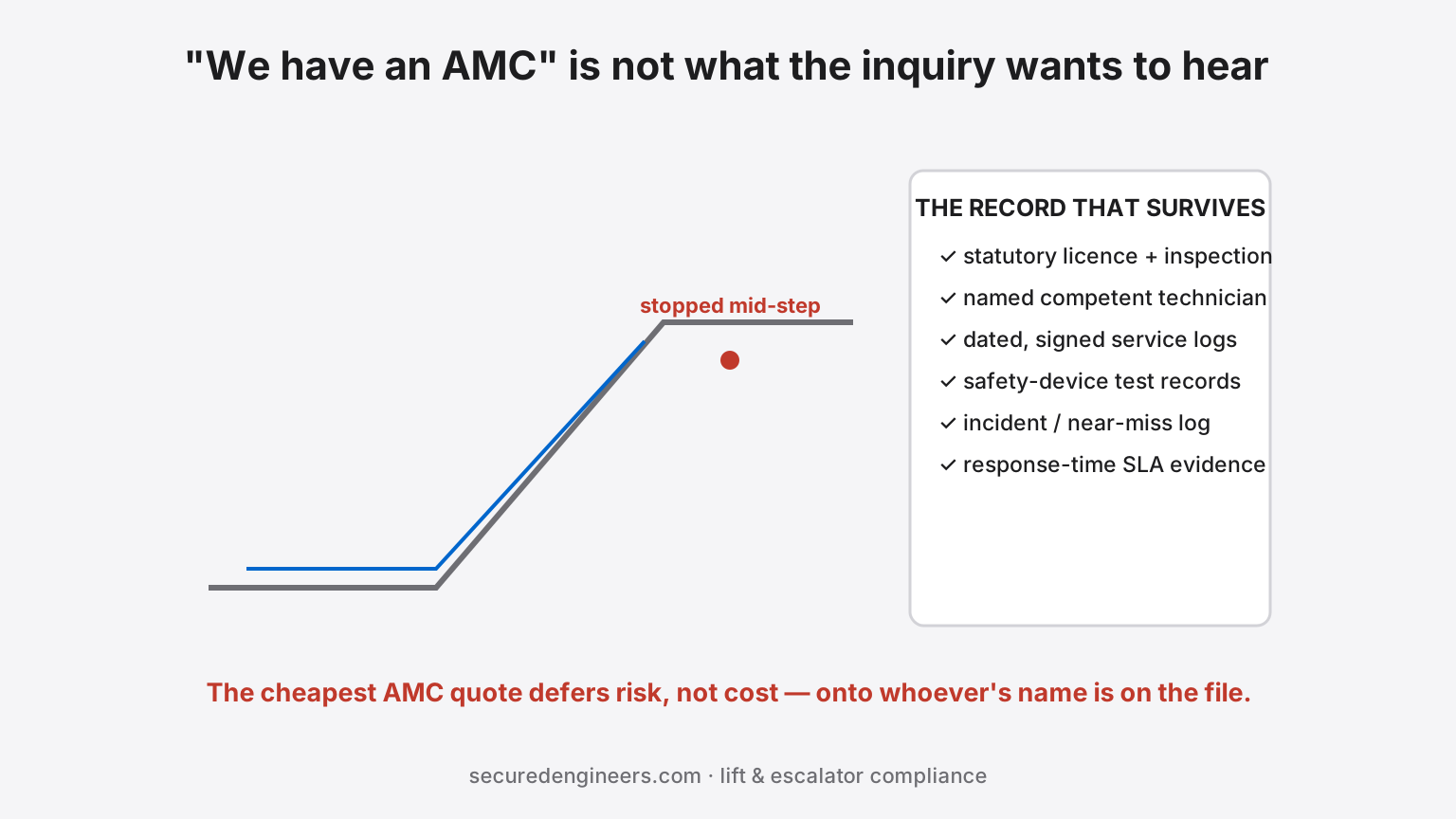
"We have an AMC" is not an answer an inquiry accepts. The record that survives scrutiny includes:
| Element | Why it matters |
|---|---|
| Statutory licence & periodic inspection certificates | Proves the installation is legally certified to operate — the baseline, not the whole answer |
| Named, competent maintenance personnel | Regulations typically require servicing by qualified technicians, not "whoever the AMC vendor sent" |
| Scheduled maintenance logs with signatures | Dated, specific records of what was checked, not a generic "serviced" stamp |
| Safety device test records | Overload sensors, door interlocks, emergency brakes, comb-plate switches — each tested and logged individually |
| Incident and near-miss log | A documented history of faults and their resolution — its absence looks worse in an inquiry than any individual fault would |
| Spare-parts and response-time SLA | Evidence the AMC contractor could actually respond adequately, not just that a contract existed on paper |
Why the cheapest AMC quote is the riskiest one here
Lift and escalator AMC pricing varies enormously between vendors, and the gap is almost never about margin — it's about visit frequency, technician competence, and genuine parts availability. The same L1 logic that backfires on MEP procurement generally applies here with sharper consequences: a discount AMC that skips scheduled visits or defers a genuine part replacement is not saving money, it's deferring risk onto whoever's name ends up on the inquiry file when something eventually fails in public.
Questions worth asking any lift/escalator AMC bidder before price: How many technicians do they have per unit under contract? What is their actual (not contracted) average response time on past jobs? Do they hold genuine OEM-approved parts stock or source generically after a fault is found? Can they produce three years of maintenance logs from an existing client for reference?
Building owner obligations, practically
- Nominate a responsible safety officer by name, formally, with the authority and budget to act on maintenance findings — not a title that exists only on an org chart
- Verify the AMC contractor's licence and insurance independently, not just take their word for it — this is a document check that takes an afternoon and prevents a catastrophic gap
- Keep the maintenance log physically or digitally accessible on-site, not solely in the AMC vendor's system — if their office is unreachable during an inquiry, the building owner still needs the record
- Run periodic independent audits, separate from the AMC vendor's own reporting — a third-party spot-check every year or two catches what a self-reporting system won't flag
- Treat every reported fault, however minor, as loggable — a jerky stop or unusual noise reported and dismissed without documentation is the exact gap an inquiry will find
FAQs
Is a standard AMC contract legally sufficient for lift/escalator compliance?
An AMC alone isn't the full picture — statutory licensing, periodic inspection certificates, and named competent-person maintenance are separate obligations under the applicable state Lifts Act. Verify all three exist, not just the AMC.
Who is personally liable if a lift incident occurs?
Liability findings depend on the specific facts and jurisdiction, but inquiries typically examine the building owner's nominated responsible person and the maintenance contractor's signing engineer — which is exactly why both roles need to be named and documented, not informal.
How often should escalators be inspected beyond routine AMC visits?
Beyond scheduled AMC service intervals, periodic statutory inspection is typically required under state regulations — confirm the current interval and certifying-authority requirement for your state.
Can you take over maintenance of our building's MEP systems?
Yes — preventive and comprehensive AMC with defined SLAs, statutory test certification and compliance reporting. See AMC scope.
More insights
The New Shed Is Easy. It's Your 1998 Building That Fails the Inspection.
You add one line, one shed, one mezzanine — and suddenly the fire officer is asking about hydrants your 1998 building never had. Why brownfield expansions in Ludhiana, Faridabad and the NCR belt trigger whole-site compliance, and how to expand without opening a Pandora's box.
ComplianceThe IE Rules Are Gone. Here Is What You Are Personally on the Hook for Now.
Generations of Indian electrical practice ran on the Indian Electricity Rules, 1956. They have been replaced — the CEA's safety regulations now define an owner's duties: designated supervision, periodic testing, records, and accident reporting. Most facility owners have not read a line of them.