
The AC Failed in Month 11 of a 12-Month DLP. Is That a Defect, or Just... Life?
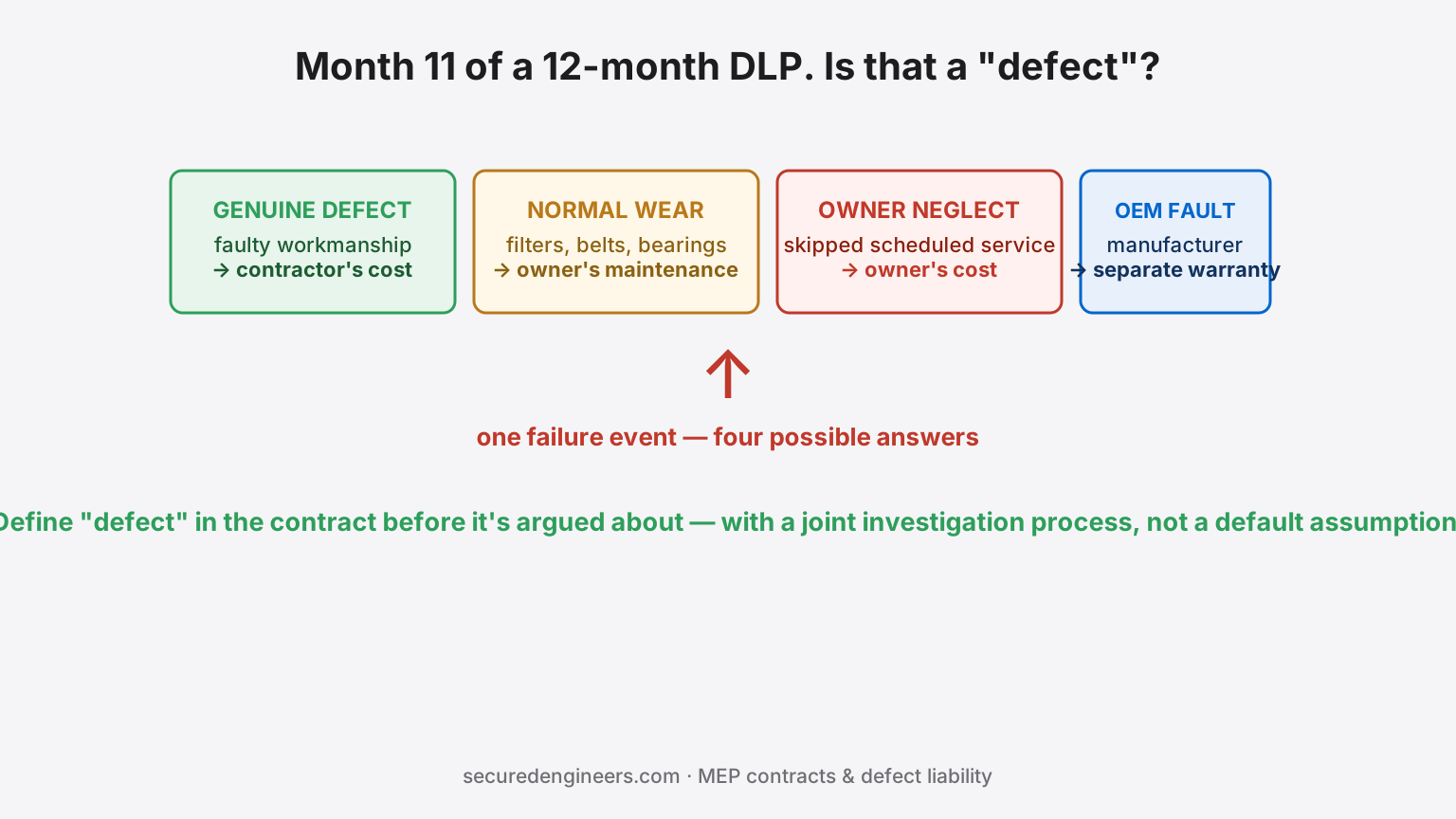
Every MEP contract includes a defect liability period — typically 12 months after handover, during which the contractor is obligated to fix defects at no additional cost. Every contract also, almost universally, fails to define the one word the entire clause depends on: what actually counts as a defect.
This gap doesn't matter when nothing breaks. It matters intensely the day an AC unit fails in month 11, a pump seizes in month 6, or a panel trips repeatedly starting in month 3 — because "defect" and "normal wear, owner-side neglect, or expected consumable replacement" describe very different obligations, and the contract that never distinguished them leaves both parties arguing from first principles under time pressure.
The four categories that get conflated as one word
| Category | What it actually is | Whose responsibility |
|---|---|---|
| Genuine defect | Faulty workmanship, incorrect installation, or a manufacturing fault present at handover that manifests later | Contractor, under DLP |
| Normal wear and consumable replacement | Filters, belts, bearings and similar wear items reaching their expected service life | Owner — routine maintenance, not a defect, regardless of DLP timing |
| Owner-side maintenance neglect | A failure caused by skipped scheduled maintenance the owner was responsible for (per the lifecycle-AMC obligation) rather than a fault in the original work | Owner — the DLP doesn't retroactively cover consequences of the owner's own maintenance gaps |
| Genuine product/equipment failure (not workmanship) | An OEM manufacturing defect in purchased equipment, distinct from installation quality | Often the equipment manufacturer's warranty, which may run on a different timeline than the MEP contractor's DLP — a frequently missed distinction |
A single failure event — say, a chiller compressor stopping in month 8 — could genuinely be any of these four, and the honest answer requires investigation, not assumption from either side.
Why the argument gets bitter instead of technical
Without a defined process, a failure event triggers a positional argument: the owner assumes it's a defect because "it broke during the DLP," the contractor assumes it's wear or neglect because "the DLP doesn't mean immortality." Neither position is technical — both are defaults chosen because the contract gave neither party a process to establish the actual cause. The dispute then consumes weeks of correspondence that could have been a site visit and a technical finding.
The contract provisions that prevent this
- An explicit exclusions list naming consumable items and their expected replacement intervals — filters, belts, lamps — so these are never ambiguous "defect" candidates in the first place
- A joint investigation process for any failure claimed as a defect — both parties' representatives (or an agreed independent party) inspect and document findings before liability is assigned, not after positions have hardened
- A maintenance-compliance condition — DLP defect coverage explicitly conditioned on the owner having performed the maintenance obligations specified in the O&M manual; a documented maintenance log becomes the owner's evidence of compliance, and its absence becomes relevant evidence too
- Separate handling for OEM equipment warranties — the contract should clarify that equipment manufacturer warranties run independently, with the MEP contractor's obligation being to facilitate the warranty claim, not personally cover an OEM manufacturing fault
- A defined response-time and resolution process for genuine defects, so "is it covered" and "how fast will it be fixed" aren't both left equally undefined
What this means practically, on both sides
- Owners: maintain the O&M-specified maintenance schedule and keep records — the DLP is not a substitute for maintenance, and skipping it weakens your own position when something later fails
- Contractors: hand over a clear O&M manual with explicit maintenance schedules and consumable-replacement intervals at handover — an owner who was never told the filter needed changing every three months has a fair complaint when its absence gets blamed on them
- Both: document the handover condition thoroughly — commissioning reports, test certificates, photographs — because "was this present at handover" is often the actual technical question a defect investigation needs to answer
FAQs
What is a defect liability period?
A contractually defined period, commonly 12 months after handover, during which the contractor is obligated to remedy genuine defects in their work at no additional cost — distinct from normal wear, consumables, or the owner's own maintenance obligations.
Is a filter replacement covered under DLP?
Consumable items with a defined service life are normal maintenance, not defects, regardless of DLP timing — which is exactly why the contract should explicitly list consumables and their expected intervals.
Who is responsible if a failure resulted from skipped owner maintenance?
Generally the owner — DLP coverage for genuine defects is typically conditioned on the owner having performed their maintenance obligations; a documented maintenance log (or its absence) becomes relevant evidence.
Does DLP cover equipment manufacturer defects the same way as installation defects?
Not necessarily — OEM equipment often carries its own separate warranty timeline; the contract should clarify whether the MEP contractor's DLP obligation extends to facilitating that claim or personally covering it.
Can you help draft clearer DLP and defect-definition contract language?
Yes — contract clause review as part of project scoping, before disputes have a chance to start. Get in touch.
Related services
Guides that reference this page
- The MEP Snag List at Handover: How to Run It So Defects Actually Close
- MEP Works Defects Liability: Period, Scope and How to Enforce It
- Checking an MEP Contractor's References: The Questions That Reveal the Real Track Record
- Documents your EPC contractor should deliver — design basis, test records, asset register and as-builts
- The Site Is Insured. The Chiller That Failed on Test Is Probably Not.
- You Vetted the Company. Did Anyone Vet the Hands Actually Doing the Work?
Related on this site
- termPPA (Power Purchase Agreement)
- termMEPF
- termOpen Access (Solar)
- serviceAccess Control & Boom Barriers (Low Voltage / ELV)
- servicePublic Address & Voice Evacuation (Low Voltage / ELV)
- calculatorCctv Storage Calculator
- calculatorSolar Open Access Savings Calculator
- buyer's guideHow to Select an MEP Contractor
- guideCLU for industrial land
- guidePESO licence for diesel storage
More on Project Delivery & Commercial · all insights