
Year 1 Was Free. Year 2 Was Cheap. Year 3 Is Eating Your Budget. Here Is the Curve.
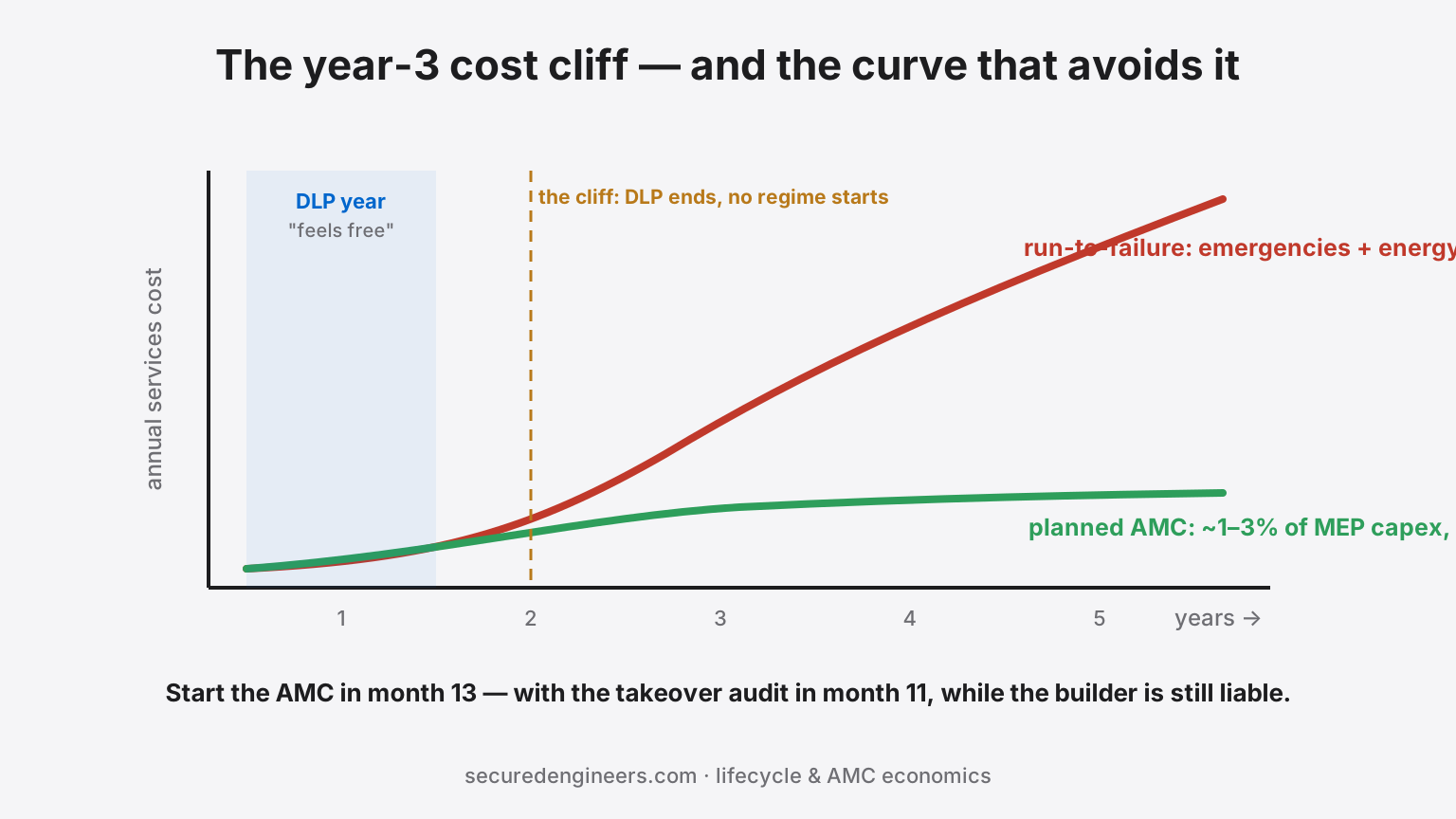
New buildings flatter their owners. In year one, the contractor fixes everything under the defect-liability period (DLP) — maintenance feels free. In year two, the systems are young enough to forgive neglect. Somewhere in year three, the story turns: a compressor here, a pump seal there, energy bills drifting upward, and suddenly the facility line item is growing 20% a year while everything feels like an emergency.
Nothing broke the building. The owner simply inherited a portfolio of engineering assets and managed them like a plumbing complaint line.
The three curves that write the year-3 bill
- The DLP cliff. When the defect-liability year ends, the builder's incentive to fix things ends with it — and buildings that never set up their own maintenance regime discover that "handover" also handed over every future failure. The O&M manuals, test records and as-builts you insisted on at completion are the difference between managing assets and rediscovering them.
- Energy drift. Unserviced systems do not usually stop — they get quietly expensive. Fouled condensers and clogged filters push HVAC consumption up double digits; slipping power factor re-invites penalties; leaking compressed air and unmaintained DG sets burn money invisibly. Energy drift is the largest maintenance cost most owners never book as one.
- The emergency premium. Run-to-failure means every repair happens at the worst time, at panic prices, with downtime attached. The industry's rough arithmetic is stable across decades: planned work costs a fraction of the same work done as an emergency — and secondary damage (the burnt motor that takes the panel with it) rides only on the emergency side.
What sane lifecycle economics look like
| Practice | The economics |
|---|---|
| A real AMC from month 13 — scheduled service, consumables, test calendar, log books | Typically ~1–3% of MEP capex per year; buys back energy drift alone in most buildings |
| Comprehensive vs non-comprehensive chosen consciously | Comprehensive (parts included) converts volatility into a fixed line; non-comp is cheaper until the first compressor — decide by your risk appetite, not by the lower quote (the L1 reflex applies here too) |
| Condition monitoring on the big five — chillers, transformers, pumps, DG, lifts | Oil/vibration/thermography readings a few times a year catch the ₹15-lakh failure while it is a ₹40k intervention |
| A capital-replacement calendar | Every asset has a service life; pretending otherwise just schedules the surprise. A 15-year chiller plan funded annually is boring — which is the point |
| Compliance folded into maintenance | The fire test calendar, electrical audits, water hygiene — the same visits that protect uptime protect the licences |
The number that settles the argument
Take a building with ₹10 crore of MEP capex. A serious AMC regime costs perhaps ₹15–25 lakh a year. Against it: energy drift on unmaintained plant (routinely 10–20% of a ₹1.5–3 crore annual utility spend), one avoided major failure every couple of years, longer asset lives before replacement, and zero compliance surprises. The AMC is not a cost centre competing with repairs — it is the cheapest supplier of uptime, energy and asset life the building will ever have. Owners who see it that way run buildings that get cheaper with age relative to their neighbours — the gap compounds exactly like the neglect does.
FAQs
What should an AMC cost?
Indicatively 1–3% of MEP capital value per year depending on scope, comprehensiveness and building type — hospitals and cleanrooms higher, warehouses lower. Judge quotes on the test calendar and records they commit to, not the headline.
Comprehensive or non-comprehensive AMC?
Comprehensive if you value budget certainty and the contractor's incentive to prevent failures (they pay for them); non-comprehensive if you have strong internal engineering and prefer paying actuals. The wrong answer is choosing by lowest price without reading what is excluded.
When should the AMC start?
Month 13 — the day the DLP ends — with the takeover audit done in month 11 while the builder is still liable for what it finds. The gap year between DLP and first AMC is where buildings quietly rot.
Can you take over a neglected building?
Yes — condition audit, revival plan (prioritised by risk), then the standing calendar. The first year of a takeover AMC is mostly repaying deferred maintenance; it gets cheap after that. Details here.
Related services
Guides that reference this page
- MEP AMC for a Factory: Scope Tiers, Coverage and What Drives the Annual Cost
- In-House vs Outsourced MEP Maintenance for a Factory: A Decision Guide
- Comprehensive vs Non-Comprehensive MEP AMC: Which Suits Which Plant
- When should an industrial facility consider an AMC?
- MEP AMC scope after an expansion or renovation — the asset register, tasks, exclusions and records to update
- The Chiller Gave Three Weeks of Warning Before It Failed. Nobody Was Listening.
Related on this site
- termGross Metering
- termDLP (Defect Liability Period)
- termEPC
- serviceInverters (String / Central) (Solar EPC)
- serviceMounting Structures & BOS (Solar EPC)
- calculatorWater Reuse Savings Calculator
- calculatorProject Estimator
- buyer's guideHow to Select an MEP Contractor
- guideCTE/CTO pollution consent
- guideEnvironmental clearance (EIA 2006)
More on Project Delivery & Commercial · all insights