
You Vetted the Company. Did Anyone Vet the Hands Actually Doing the Work?
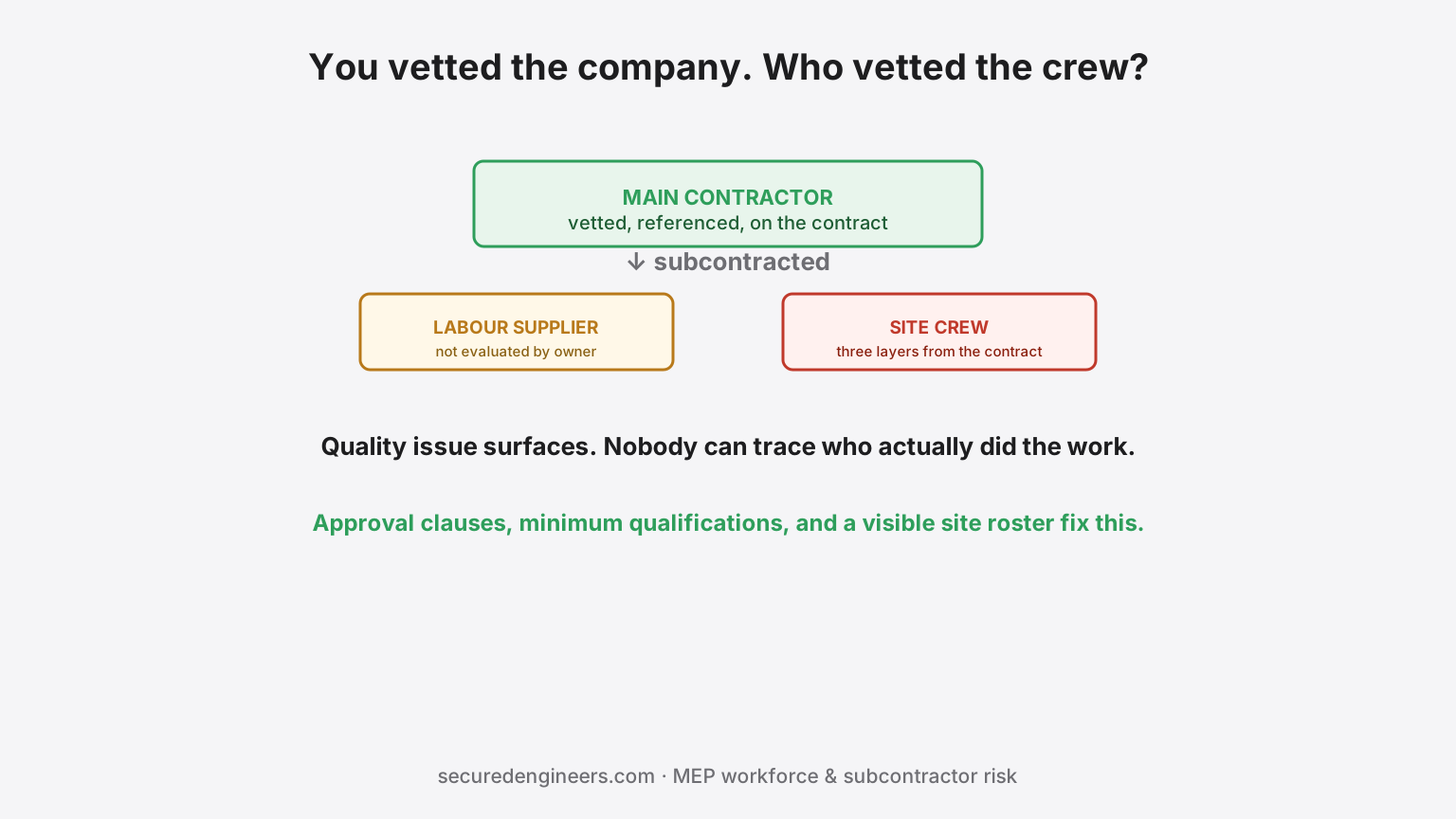
Owners run due diligence on the MEP contractor bidding for their project — financial standing, past project references, technical capability, safety record. What that due diligence usually doesn't reach is the layer beneath the contract: the skilled electricians, HVAC technicians, welders and fire-system installers who actually execute the work, a significant share of whom may be subcontracted labour the main contractor brought in to cover a genuine, industry-wide shortage of skilled MEP manpower.
This isn't automatically a problem — subcontracting is a normal part of how MEP execution works at scale. It becomes a problem when it's invisible: when the owner has no visibility into who's actually on site, no approval process for which subcontractors are used, and no way to trace accountability when a quality or safety issue surfaces from a crew several layers removed from the name on the contract.
Why the shortage makes this worse, not better
- Genuine skilled-labour shortage in trades like industrial electrical work, precision HVAC commissioning, and certified welding means demand regularly outpaces the supply of properly trained, experienced crews
- Contractors under schedule pressure — the same compression covered in realistic project timelines — bring in whichever subcontracted crew is available, not necessarily the most qualified one, to hit a date
- Layered subcontracting dilutes accountability — a main contractor who subcontracts to a labour supplier who further sources individual workers means the actual worker on site may be three commercial relationships removed from the entity that signed your contract
- Low-price bids — the same L1 backfire pattern — often win partly by planning to execute through cheaper, less-vetted subcontracted labour rather than the contractor's own trained workforce
Where this actually shows up as a problem
| Risk area | How unvetted subcontracting creates it |
|---|---|
| Workmanship quality | A crew without the specific experience the work requires produces defects that surface later — exactly the ambiguity that fuels DLP disputes when nobody can trace who actually did the work |
| Site safety | Inconsistent safety training and site-induction standards across layered subcontractors raise incident risk in ways a single, directly-managed workforce doesn't |
| Statutory compliance | Labour law and welfare compliance (registrations, insurance, wages) becomes harder to verify the more layers of subcontracting separate the worker from the main contract |
| Schedule reliability | Subcontracted crews sourced last-minute for a labour gap are less predictable than a planned, committed workforce, undermining the project's own timeline |
What contractual and site controls actually address this
- A subcontractor approval clause requiring the main contractor to disclose and get approval for any subcontracted scope beyond a defined threshold — not a blanket right to subcontract freely
- Minimum qualification requirements for key trades — certified welders, licensed electricians, trained HVAC commissioning technicians — that apply regardless of which entity employs them
- Site-level workforce visibility — a requirement to maintain and share a current roster of who's actually on site, tied to the subcontractor approvals given
- Statutory compliance verification for subcontracted labour — registrations, insurance and wage compliance checked as part of the approval, not assumed because the main contractor is compliant
- Accountability retained at the main contract level, regardless of execution layer — the main contractor remains responsible for subcontracted work's quality and safety, contractually and in practice
This is exactly the kind of gap a structured tender and BOQ process should surface before award — asking not just who's bidding, but who will actually execute, and how much of the workforce is the contractor's own versus subcontracted. It's also a central consideration in choosing between execution models covered in EPC, PMC and in-house delivery — each model distributes this workforce-visibility risk differently. Our turnkey execution teams maintain direct oversight of key trades rather than defaulting to opaque subcontracting layers.
FAQs
Is subcontracting on an MEP project a red flag by itself?
No — it's normal industry practice, especially given genuine skilled-labour shortages. The risk is invisible or unapproved subcontracting, not subcontracting itself.
How can an owner get visibility into who's actually executing the work?
Through a contractual subcontractor approval clause and a requirement for a current site workforce roster — visibility has to be built into the contract, not assumed to exist by default.
Does subcontracted labour affect who's liable for defects?
Contractually, the main contractor typically remains responsible regardless of execution layer — but tracing the root cause and preventing repeat issues is much harder without workforce visibility.
Can you review our contract's subcontracting terms and site workforce controls?
Yes — as part of tender document review or an existing-contract audit. Get in touch.
More insights
Your Government Tender Was Rejected on Page 3. Nobody Opened the Price Envelope.
Government and PSU MEP tenders reject more bids on technical eligibility than on price — a missing certificate, an EMD in the wrong format, a turnover figure one lakh short of the threshold. The financial bid never gets opened. What actually disqualifies technical bids, and the pre-submission checklist that prevents it.
Costing & ProcurementYear 1 Was Free. Year 2 Was Cheap. Year 3 Is Eating Your Budget. Here Is the Curve.
Every new building lives the same cost story: the defect-liability year feels free, year two runs on youth, and from year three the breakdowns, energy drift and emergency repairs compound — because maintenance was treated as a cost to minimise instead of an asset to manage. The lifecycle economics, honestly.