
You Need MEP Done. Nobody Told You There Are Three Completely Different Ways to Buy It.
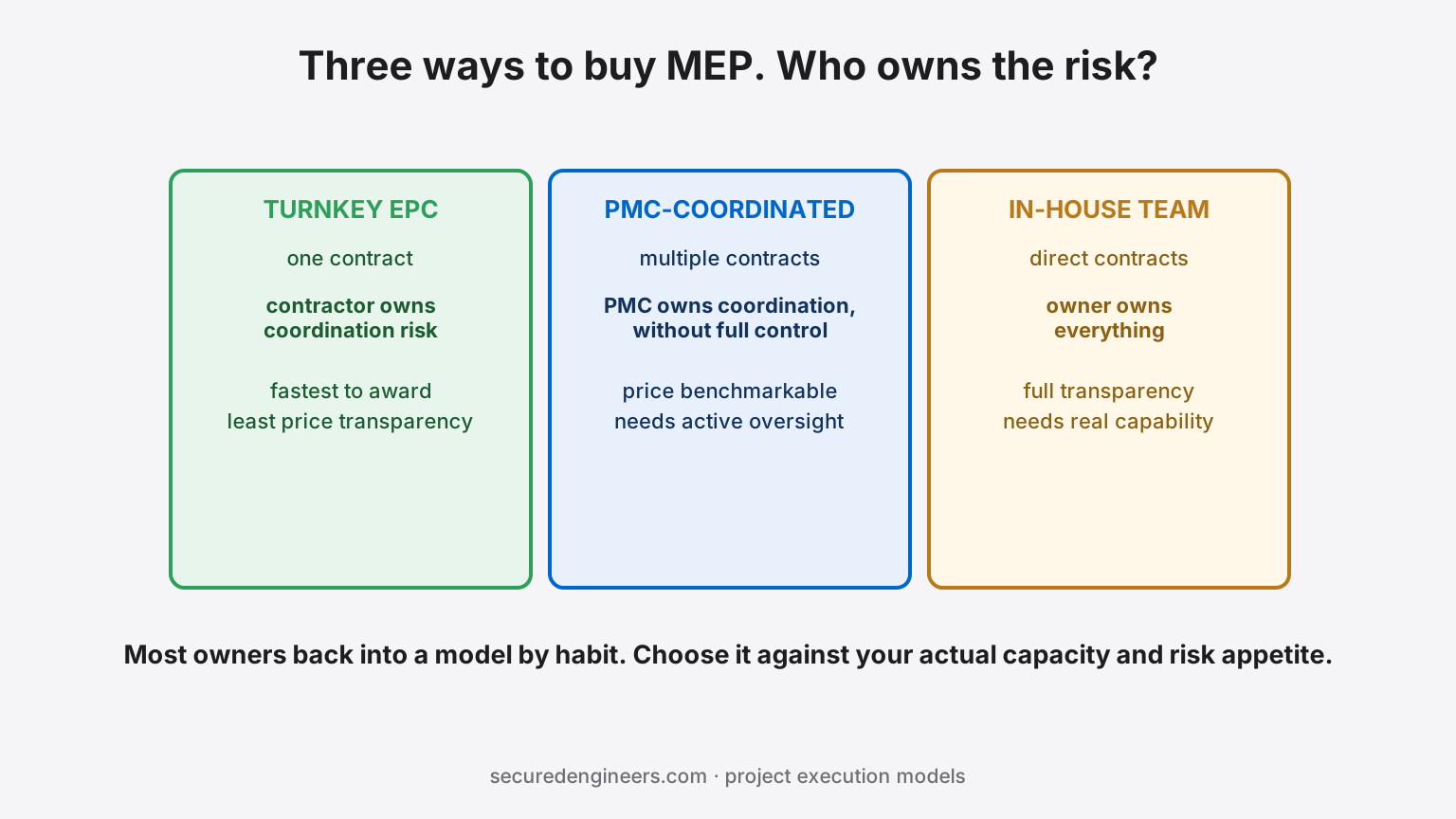
Most project owners back into their execution model rather than choosing it. The previous project used a PMC, so this one does too. A relative recommended a turnkey contractor. The internal team has "always managed projects directly." None of these are wrong reasons on their own — but the execution model is one of the highest-leverage decisions in the entire project, because it determines who owns the risk when things go wrong, and most owners never see that decision laid out explicitly.
The three models, honestly compared
| Turnkey EPC | PMC-coordinated multi-contractor | In-house team, direct contracts | |
|---|---|---|---|
| Who owns coordination risk | The EPC contractor — contractually, completely | The PMC, but without direct control over each contractor's commercial incentives | The owner's own team, with all the coordination burden that implies |
| Who owns cost-overrun risk | Largely the EPC contractor, within the contracted scope | Split across multiple contracts — overrun on one package doesn't automatically transfer risk to others | Entirely the owner |
| Price transparency | Lower — a lump-sum or design-build price bundles design, materials and execution margin together | Higher — each trade package is separately priced and can be benchmarked | Highest — the owner sees every cost directly |
| Speed to award | Fastest — one contract, one negotiation | Slower — multiple tenders, multiple contracts, PMC selection itself | Slowest — the owner runs every procurement personally |
| Owner's internal capability needed | Lowest — one point of accountability to manage | Moderate — needs to manage the PMC relationship and understand enough to hold them accountable | Highest — needs genuine in-house engineering and project-management capability |
| Where it fails | If the EPC's margin pressure erodes quality/spec on items the owner can't easily verify | If the PMC lacks either the authority or the incentive to genuinely enforce coordination — see the ceiling war | If internal capability is overestimated — coordination risk doesn't disappear just because there's no PMC named to hold it |
When each model genuinely fits
- Turnkey EPC fits when the owner wants one accountable relationship, values schedule certainty and coordination guarantee over maximum price transparency, and doesn't have (or doesn't want to build) internal engineering-management capability. It particularly suits owners running their core business, not a construction department — a factory owner, a hotel operator, a hospital administrator.
- PMC-coordinated multi-contractor fits when the owner has genuine in-house capacity to manage the PMC relationship actively (not just sign off on their reports), values trade-by-trade price transparency and benchmarking, and is willing to accept more coordination risk in exchange for cost visibility. It suits sophisticated repeat developers with dedicated project teams.
- In-house direct management fits almost exclusively for organisations with genuine, proven internal engineering and project-management depth — typically large industrial groups or institutional owners with a standing capital-projects function, not a one-off project team assembled for this build.
The mistake pattern in each direction
- Choosing EPC without verifying the contractor's actual coordination discipline — the model transfers risk contractually, but only to a contractor who genuinely executes coordinated design; an EPC contractor who subcontracts each trade separately and doesn't coordinate them internally has recreated the multi-contractor coordination problem while charging turnkey margin for having "solved" it
- Choosing a PMC without genuine internal capacity to hold them accountable — a PMC relationship still needs an engaged owner's team asking hard questions; an owner who selects a PMC specifically to avoid needing internal capability often ends up with neither the PMC's full attention nor real oversight
- Choosing in-house management by default, without honestly assessing capability — this is the highest-risk default, because unlike the other two models, there's no contractual party whose job it is to own coordination risk if the internal team turns out to be under-resourced
Questions that should decide the model, not habit
- Does the organisation have genuine, currently-available internal engineering and project-management capacity, or would building it mean hiring for a one-off project?
- Is schedule certainty or price transparency the higher priority for this specific project?
- How much organisational bandwidth exists to actively manage a PMC or in-house team relationship — not sign off on reports, but genuinely engage?
- What's the actual track record of the shortlisted EPC contractor's internal coordination discipline, verified through reference site visits, not just their sales presentation?
We deliver primarily as turnkey EPC because it's the model that matches most of our clients' situation — but the honest answer for any specific project depends on the questions above, not on which model a contractor happens to sell.
FAQs
Is turnkey EPC always more expensive than a PMC-coordinated approach?
Not necessarily on a total-project basis — EPC's bundled margin is often offset by avoided coordination rework and schedule slippage that multi-contractor projects frequently incur. Compare total delivered cost, not just headline contract price.
Can a PMC model work without strong in-house capability?
It's higher-risk — the PMC needs genuine engaged oversight to be effective, and an owner without capacity to provide that oversight often gets the coordination-risk exposure of multi-contractor without the price-transparency benefit that was the reason to choose it.
How do I evaluate an EPC contractor's actual coordination capability, not just their pitch?
Ask for reference sites, specifically to see combined services drawings and speak with facility teams about post-handover experience — not just completed-project photos.
Can you help decide which execution model fits our specific project?
Yes — we walk through this decision honestly, even when the answer isn't turnkey EPC. Start the conversation.
More insights
The Retrofit Quote Was Cheaper. The Shutdown It Required Cost Ten Times More.
Brownfield MEP work is priced like greenfield work — by material and labour — but its real cost is production downtime. A retrofit plan that ignores how the plant keeps running is not cheaper; it has simply moved the largest cost line off the quotation and onto the operations budget.
Project ManagementThe Building Stays Open. The Chiller Still Has to Come Out.
Renovating MEP infrastructure in an occupied, operating building — a hospital, hotel, running factory or leased commercial building — is a fundamentally different problem from new construction, because the systems being replaced can't simply be switched off while work happens. Phasing, temporary systems and sequencing decide whether the renovation succeeds quietly or becomes the outage the client remembers for years.