
The Retrofit Quote Was Cheaper. The Shutdown It Required Cost Ten Times More.
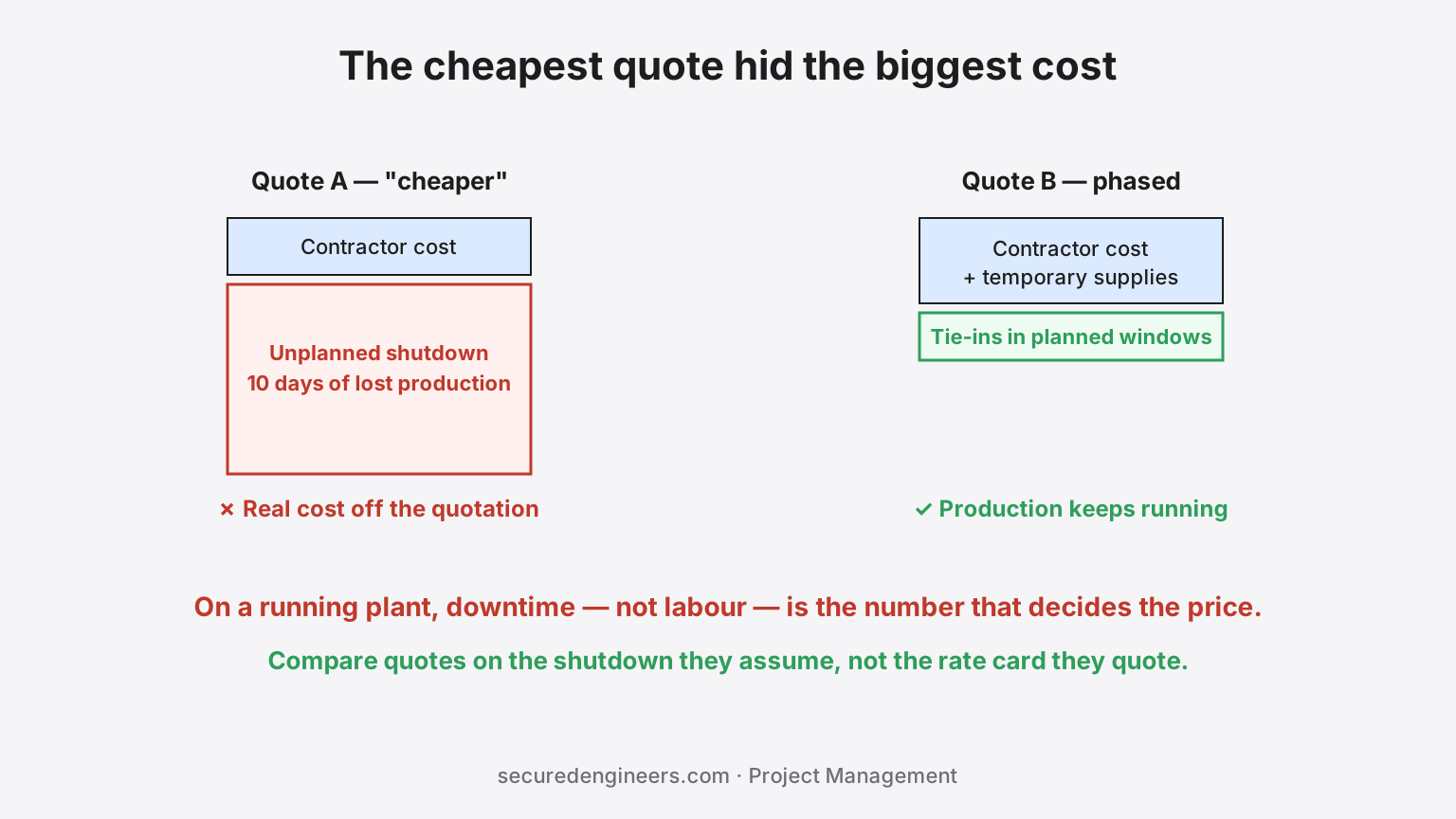
A retrofit quotation looks like a new-build quotation. Same trades, same materials, same rate cards — often a smaller number, because the building already exists. That comparison is what makes brownfield MEP work so consistently underestimated, because it prices the visible scope and ignores the one that dominates: what it costs the plant to stop while the work happens.
On a running factory, an hour of unplanned downtime is frequently worth more than a day of contractor labour. Any retrofit plan that does not start from that ratio is optimising the wrong number.
The costs that never appear on the quotation
- Production stoppage during tie-ins — the moment a new distribution board, chilled-water main or hydrant loop connects to the existing system, something has to be off. How long, and whether it lands in a planned shutdown window, is the single biggest cost variable.
- Temporary supplies — keeping a line running while its permanent supply is rebuilt means temporary cabling, temporary cooling or a hired genset. Real money, rarely in the base quote.
- Working around occupied space — restricted hours, hot-work permits, barricading, and productivity loss from working in a live plant rather than an empty shell.
- Unknowns behind the wall — as-built drawings for older Indian industrial buildings are frequently absent or wrong. What is actually buried in that trench is discovered by digging.
Phasing is the whole design
| Approach | Consequence |
|---|---|
| Single large shutdown | Cheapest contractor cost, highest production cost — viable only if it fits an existing annual maintenance shutdown |
| Phased changeover with temporary supplies | Higher contractor cost, far lower production cost; usually the right answer for continuous-process plants |
| Parallel new system, single cutover | Highest capital cost, shortest downtime — used where stopping is effectively impossible |
| Unplanned, discovered-as-you-go | The default when nobody phased it deliberately, and the most expensive of the four |
The survey that pays for itself
Before pricing a brownfield job at all, the existing condition needs establishing rather than assuming: what the actual connected load is versus the sanctioned load, where services genuinely run, what spare capacity exists in the existing panels and risers, and what condition the equipment being retained is really in. A retrofit designed on the assumption that the old system matches its drawings is a retrofit that will meet surprises during the shutdown window — the worst possible moment to discover anything.
This is also where a cheap quote and an expensive one usually differ. The cheap one has not surveyed; it has assumed. The difference does not disappear, it just arrives later as a variation.
How to buy retrofit work
Ask for the phasing plan before comparing prices, and make required downtime an explicit, priced line in the tender rather than a contractor assumption. Two quotes are not comparable unless they assume the same shutdown. Where an upgrade is being driven by capacity limits rather than age, establishing what the existing system can actually carry is usually the cheaper first step — it sometimes removes the need for the retrofit altogether.
What we do differently
We plan brownfield work under our turnkey EPC scope around the plant's production calendar, with tie-ins scheduled into shutdown windows and temporary supplies priced in from the start — because on a running factory the contractor's cost is rarely the number that decides whether a retrofit was worth doing.
More insights
The Site Is Insured. The Chiller That Failed on Test Is Probably Not.
Erection all-risk and contractors all-risk policies cover the works during construction. The exclusions are where MEP claims die — testing and commissioning, defective design, and the gap between practical completion and the operational policy starting.
Project ManagementYour BOQ Said 1,000 M. Site Said 1,470 M. Who Pays for the Missing 470 M?
Your BOQ says 1,000 metres of cable. The coordinated site route needs 1,470. Who pays for the missing 470? Why BOQ quantity mismatches surface during execution — and how route-based validation catches them first.