
The Building Stays Open. The Chiller Still Has to Come Out.
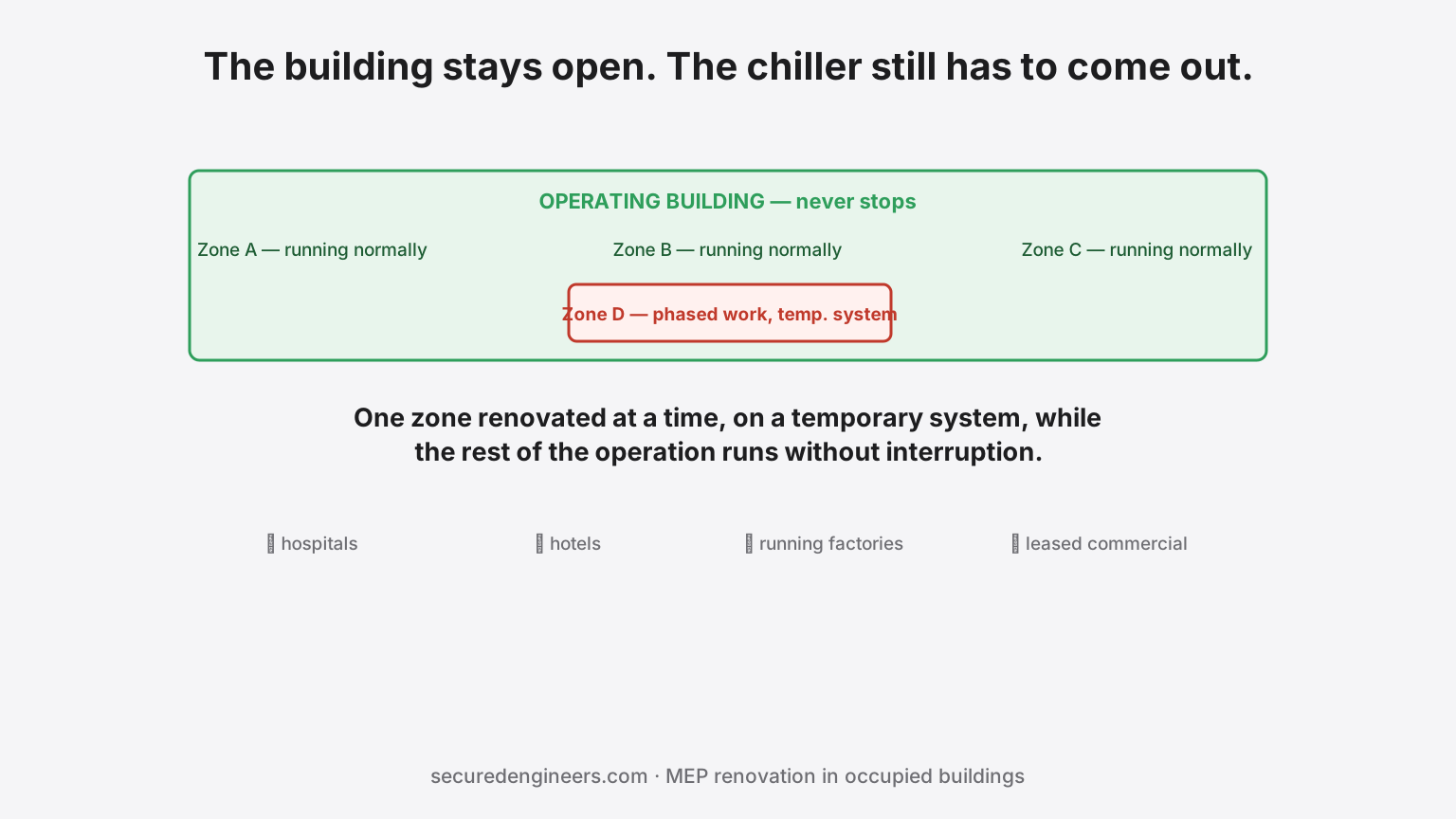
New-building MEP work has one enormous advantage: nothing is running yet, so nothing needs to keep running while the work happens. Renovation in an occupied building has none of that luxury. A hospital cannot suspend patient care while its chiller plant is replaced. A hotel cannot close floors indefinitely while electrical risers are upgraded. A running factory cannot halt production for the weeks a new fire system installation would normally take in a greenfield project. The work still has to happen — but around operations that cannot stop, not instead of them.
This is a genuinely different discipline from new-build execution, and treating it with new-build sequencing logic is where occupied-building renovations go wrong.
Why occupied-building renovation fails when planned like new construction
- New-build sequencing assumes full access, all the time — an occupied building offers access in windows, around operating hours, patient schedules, or production shifts, not continuously
- Systems being replaced are often the only ones available — there's frequently no redundant path to fall back on while the primary system is down for replacement, unlike a new installation with nothing yet depending on it
- Noise, dust and disruption tolerances are near zero in active clinical, hospitality or production environments, in ways a construction site simply doesn't need to consider
- An unplanned outage during works has consequences a new-build delay doesn't — a chiller offline mid-renovation in an occupied hospital is a patient-safety event, not a schedule slip
What phased renovation planning actually requires
| Planning element | What it establishes |
|---|---|
| Criticality mapping | Which zones and systems absolutely cannot lose service, and for how long, before consequences become serious |
| Temporary system provision | Interim cooling, power or fire coverage — rented chillers, temporary generators, temporary hydrant feeds — bridging the gap while permanent systems are replaced |
| Work-window sequencing | Which activities can only happen during specific hours or shutdown windows, coordinated against the operation's own schedule, not the contractor's preferred pace |
| Zone-by-zone phasing | Breaking the renovation into sections small enough that each phase's risk and disruption is contained and manageable |
| Rollback plan | What happens if a phase overruns or a temporary system fails — a documented fallback, not an improvised one |
Where this shows up hardest, by building type
- Hospitals — MEP renovation around live patient care needs the same rigor as NABH fire and MEP compliance generally, with the added constraint that critical systems (medical gas, isolated power, HVAC in operating theatres) cannot have even brief unplanned interruptions
- Hotels — floor-by-floor phasing keeps guest rooms sellable while risers, HVAC or fire systems are upgraded elsewhere in the building; getting the phasing wrong closes revenue-generating rooms unnecessarily
- Running factories — the same due-diligence discipline covered in factory MEP due diligence applies in reverse during renovation: production-critical services need identified fallback capacity before the primary system comes down
- Occupied commercial buildings — tenant coordination becomes a project workstream in its own right, closely related to the allocation questions in landlord-tenant MEP responsibility
The realistic timeline logic that applies to new construction applies even more strictly here — an occupied-building renovation schedule compressed to hit an arbitrary date is exactly where a temporary system gets skipped and an operation loses service it was never supposed to lose. Our turnkey execution and maintenance teams plan brownfield renovation around the client's operating constraints from day one, not as an afterthought to the construction schedule.
FAQs
Can MEP systems be renovated without shutting a building down?
Generally yes, with proper phasing and temporary system provision — but it requires planning specifically for continuous operation, not a compressed version of new-construction sequencing.
What is a temporary system in a renovation context?
An interim arrangement — a rented chiller, temporary generator, or temporary fire water feed — that maintains service while the permanent system is being replaced, avoiding an operational gap.
Why is renovating a hospital's MEP systems harder than a hotel's?
Both require careful phasing, but hospitals have life-safety-critical systems (medical gas, isolated power, operating theatre HVAC) with essentially zero tolerance for unplanned interruption, raising the stakes of any sequencing error.
Can you plan and execute an MEP renovation in our operating facility?
Yes — criticality mapping, temporary system planning and phased execution around your operational constraints. Request a plan.
More insights
Your Civil Contractor Says Eight Months. Nobody Asked the Transformer.
Project timelines are set by civil logic — pour, cure, build — while the items that actually decide your move-in date sit in MEP: transformer deliveries, chiller lead times, approval clocks, testing sequences. The honest duration table, and why the last 10% takes 25% of the time.
Project ManagementFive Contractors, One Ceiling: Why Your Duct, Cable Tray and Sprinkler All Want the Same Spot
The HVAC contractor blames the electrical contractor. The electrical contractor blames the fire contractor. Everyone blames the drawings. Why multi-contractor MEP projects clash — and what coordination actually costs when nobody owns the ceiling.