
You Are Treating Water to Drinking Standard and Flushing With It.
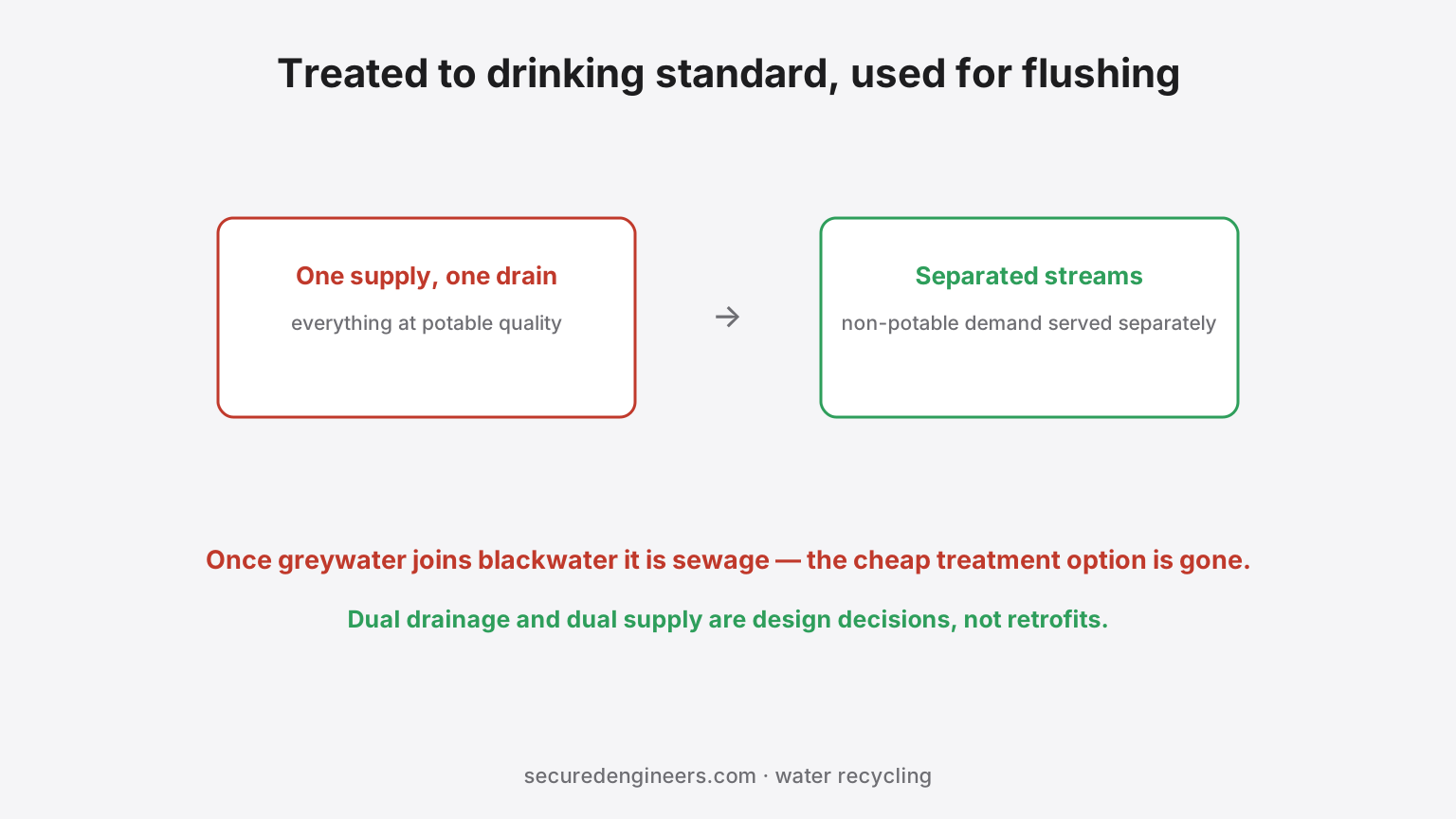
A factory typically has one water source and one drain. Everything arrives at the same quality and leaves as effluent, regardless of what it was used for. Yet a substantial share of industrial water demand — flushing, landscape irrigation, floor washing, cooling tower make-up — does not need potable quality at all.
Greywater recycling separates those streams. Increasingly it is also a condition attached to consent or building approval rather than a voluntary green measure.
What counts as greywater, and what does not
- Greywater — wash basins, showers, canteen handwash, and similar low-contamination domestic streams. Treatable to non-potable reuse standard with comparatively simple plant.
- Blackwater — toilet waste. Requires full sewage treatment, which is the STP conversation, not this one.
- Process effluent — a different problem entirely, governed by what the process contributes, and handled by an ETP.
Mixing these is the most common design error. Once greywater joins blackwater, you no longer have greywater — you have sewage, and the cheap treatment option is gone.
The decision that has to be made early
Recycling requires two drainage systems and two supply systems: one collecting greywater separately, one distributing treated non-potable water to the fixtures that will use it. Both are plumbing infrastructure buried in walls, floors and shafts.
| Decided at design | Retrofitted later |
|---|---|
| Separate greywater drainage designed in | Re-plumbing occupied buildings |
| Dual supply risers in the shaft | New riser route, or surface-run pipework |
| Plant space allocated | Treatment plant sited wherever there is room left |
| Marginal cost on a package being installed anyway | A standalone capital project |
What the treated water can and cannot do
Treated greywater is suitable for flushing, landscape irrigation, floor and vehicle washing, and often cooling tower make-up. It must be unambiguously separated from potable supply — distinct pipe identification, no cross-connection, and outlets marked non-potable. That separation is a health requirement and is what an inspector will look for.
Cooling tower make-up deserves specific thought: water chemistry drives scaling and corrosion in the tower and the chiller condenser, so treated quality has to suit the equipment, not merely be clean.
The economics
Strongest where water is expensive, scarce, or restricted — which describes a growing share of Indian industrial locations — and where the facility has meaningful non-potable demand. Weakest in small facilities with low flushing load, where plant and monitoring cost dominates. Where a consent condition requires it, the calculation is moot and the only question is whether it was designed in or bolted on.
What we do differently
Under Plumbing & Public Health we design the dual system at the outset where recycling is intended or likely to be required, and coordinate the treated-water quality with the HVAC equipment that will actually receive it.
More insights
Moving the Machines Is the Easy Half of Moving a Factory
Riggers can shift a press in a weekend. What stretches into months is everything around it: power sanction and CEIG at the new premises, fire NOC from scratch, compressed air and utilities re-laid, and approvals that do not transfer with the trucks. A relocation is an MEP project wearing a logistics costume.
IndustrialTwo Rooms in Your Factory Are Quietly Manufacturing an Explosive Atmosphere
The forklift charging bay makes hydrogen. The paint booth makes solvent vapour. Both are ordinary rooms right up until ventilation fails — then they are ignition events waiting for a spark. The engineering that keeps them ordinary is specific and mostly invisible.