
Factory Relocation: A Utility Cutover Checklist
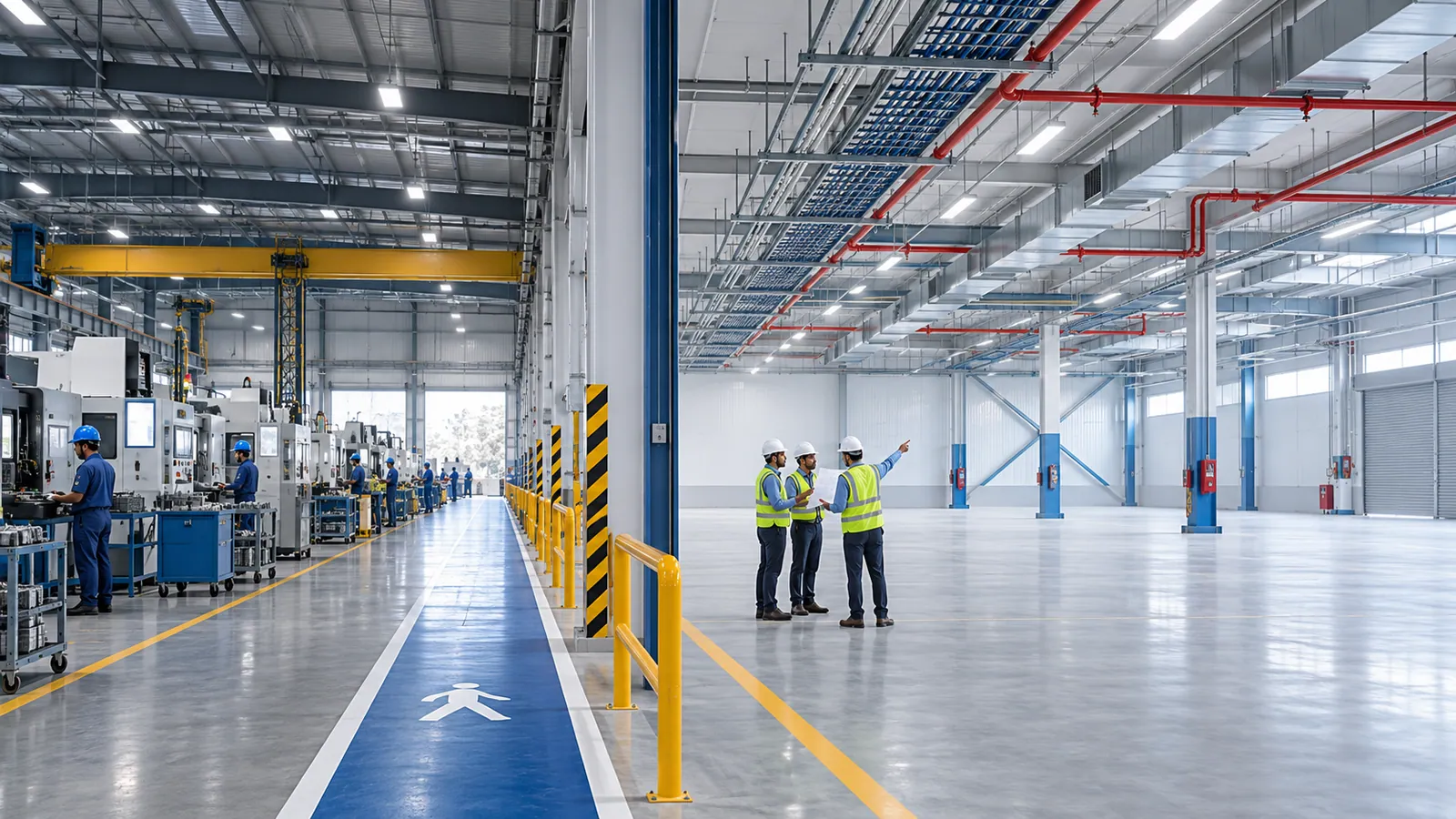
Every relocation plan starts with the machines: crating, cranes, low-beds and riggers. The machines are the visible part. Production restarts only when power, compressed air, water, drainage, fire protection and the statutory approvals at the new site are ready, and several of those depend on authorities whose timing you do not control. A factory move is a utility cutover: production stops on one set of connections and restarts on another.
This checklist covers the four parts of that cutover: destination readiness, the disconnection and move sequence, temporary parallel running, and recommissioning with the authorities involved.
Start with a utility register of the plant you are moving
Before any dates are promised, record what the plant actually draws. A one-line utility card per machine (electrical rating in kW or kVA with voltage and starter type, air flow and pressure, water, drainage, exhaust, fuel and foundation details) is the document the whole project runs on. Add the plant's measured maximum demand in kVA and its energy use in kWh from the bills or meter data, not the sanctioned load from memory. The register becomes the new site's connection application, the transformer and panel sizing (the transformer sizing calculator gives a first figure) and the sequence of the move.
It also answers what is worth moving. An old compressor, a corroded air main or an overloaded panel can cost more to dismantle, move and recommission than to replace, and the relocation is the one time the downtime is already planned.
1. Destination readiness
The target is simple to state: machines arrive at live, tested connections. Use this checklist to agree what "ready" means for each utility and what evidence must exist before the trucks leave.
| Item at the new site | Ready means | Evidence to hold before the move |
|---|---|---|
| Power connection | Load sanctioned and the connection energised at the required capacity, with metering installed | DISCOM sanction and energisation records |
| Electrical installation | Inspected by the Electrical Inspector, or self-certified where the installation is at or below the state-notified voltage, before supply starts | Inspector's approval or the acknowledged self-certification report |
| Transformer, HT and LT panels, earthing | Installed, tested and protection settings applied | Test reports, earth-resistance records, relay settings |
| DG set and any solar plant | Generating units above the capacity the state has notified inspected before commissioning; solar connection approved by the DISCOM | Inspector's approval; DISCOM approval for the solar connection |
| Machine power points | A tested, labelled feeder or busbar tap-off at every machine position | Circuit schedule matched to the machine layout |
| Compressed air | Compressor, dryer, receiver and ring main installed and pressure-tested | Pressure-test record; air quality at the use points |
| Water and drainage | Process and cooling water, treatment and the drainage or effluent route ready | Flow test; the pollution-board consent conditions met |
| Fire protection | Hydrants, sprinklers, detection and fire water storage installed and tested for the new building | The fire approval for the new building, or the authority's correspondence |
| Ventilation and process exhaust | Ready for the processes that will move in | Commissioning airflow readings |
| Foundations, floors and rigging routes | Foundations cured, anchor positions checked, door and route sizes confirmed | Civil handover; a structural engineer's confirmation of floor and route loads |
| Operating approvals | Consent to operate for the new site and the factory licence or registration where it applies | Consent and licence documents |
Two items on that list need the most lead time and the least optimism. The power connection depends on what the DISCOM network can supply at the new location; a new transformer or HT line is a project in itself, as our guide to HT connection delays explains. And the fire protection must be built for the new building and its occupancy, not copied from the old one, with fire water stored separately from domestic and process water.
2. Disconnect and movement sequence
- Move in production-line order, not crate order. The sequence that restores saleable output soonest wins. List the lines by how long the business can live without each, then plan the move around the shortest of those windows.
- Isolate formally at the old site. Lock-out and tag-out, a permit to work for each disconnection, cable ends and pipe ends labelled to match the utility cards, and the card travelling with the machine.
- Drain and purge before lifting. Coolants, hydraulic oil, compressed air and process chemicals are removed and disposed of through authorised routes, not left in the machine for the riggers to find.
- Close the old site properly. Settle the DISCOM connection (disconnection or load reduction, final bill, security deposit) and surrender or amend approvals the old site no longer needs. Under the CEA safety regulations, an installation that has been disconnected for six months or more must be inspected or self-certified again before supply recommences, which matters if the old building will be re-let.
3. Temporary parallel running
Running both sites for a period protects customer supply, but it duplicates fixed costs for that period: two sets of demand charges, staff split across two locations, and often temporary or DG power at the new site while its connection is completed. The DG running cost calculator puts a figure on the DG option for your own load and fuel price; construction-stage supply is covered in our guide to temporary construction power. Choose the cutover strategy deliberately:
| Cutover strategy | When it fits | Utility implications | Watch-outs |
|---|---|---|---|
| Single shutdown: move everything at once | Small plants, few lines, a stock buffer that covers the whole shutdown | The new site must be fully ready, approvals included, before day one | No fallback if one utility is late; every snag lands in the same week |
| Phased: line by line | Several independent lines; customers who cannot wait for a full shutdown | Both sites live for the duration; the new site's supply must carry the phases already moved | Shared utilities such as air and cooling water have to be split or duplicated |
| Parallel running: duplicate a critical line first | One line carries most of the revenue or a contract penalty | Temporary or DG power if the new connection is not ready; two sets of fixed charges | Cost of duplication; quality approvals that must be repeated at the new site |
| Build new, then switch | Moving into a new building with a long lead time | Receiving infrastructure finished and tested long before the first machine arrives | Specifications drift if the machine list changes; freeze it early |
4. Recommissioning and authority interfaces
Recommission each machine like a new installation: insulation resistance, earthing continuity, phase rotation, protection settings, interlocks and emergency stops, then the utilities proven at the machine connection (voltage, air pressure and flow, water flow) before production. At plant level, check power quality and power factor under the first full-load runs, and record the as-built drawings from day one; a relocation is a rare chance to start with drawings that match the plant.
The authority interfaces run in parallel and none of them can be promised a date:
- Electrical Inspector. Under the Central Electricity Authority (Measures relating to Safety and Electric Supply) Regulations, 2023, installations above the voltage the state has notified are inspected by the Electrical Inspector before supply starts, and those at or below it are self-certified; generating units above the state-notified capacity are inspected before commissioning. Our CEIG approval guide and CEIG readiness checker help prepare the file.
- DISCOM. The new connection or load, metering, and any solar or net-metering connection, which has to be applied for at the new premises.
- State fire service. The fire approval for the new building, under the state's own rules.
- State Pollution Control Board. Consents are site-specific, and a process change in the move can widen the review; see our CTE and CTO guide.
- Labour and factories department. Plan permission and the factory licence or registration now sit under the Occupational Safety, Health and Working Conditions Code, 2020, in force since 21 November 2025, and the state's rules. Confirm the current procedure with the state department.
- Groundwater authority, if the new site will draw from borewells.
The project phase and timeline estimator helps lay these streams against the construction programme. Relocations are where a turnkey EPC scope pays off: one team designs the receiving infrastructure, prepares the approval drawings and installs and tests the utilities, so the move date rests on one programme rather than several separate ones. To plan yours, share existing and proposed loads, the layout and your production constraints through a scope request; more planning guides are in Insights.
Sources and how to verify
- Department for Promotion of Industry and Internal Trade, National Single Window System: the Know Your Approvals questionnaire lists the central and state approvals a business needs.
- Central Electricity Authority, Measures relating to Safety and Electric Supply Regulations, 2023 (notified 8 June 2023): regulation 45 on approval by the Electrical Inspector and self-certification, regulation 34 on generating units, regulation 33 on testing a consumer's installation before supply.
- Press Information Bureau, Ministry of Labour and Employment, the four Labour Codes made effective from 21 November 2025, including the Occupational Safety, Health and Working Conditions Code, 2020.
Confirm locally: the voltage and generating-unit capacity your state has notified for inspection, your DISCOM's connection procedure, the state fire rules for the new building, the pollution board's consent route, and the state rules under the OSH Code.
Frequently asked
What should I measure at the old plant before planning a relocation?
A utility card for every machine: electrical rating in kW or kVA with voltage and starter type, compressed-air flow and pressure, process and cooling water, drainage or effluent, exhaust, fuel or gas, and foundation details. Add the measured maximum demand in kVA and monthly consumption in kWh from your bills or meter data, the production lines that cannot stop, the stock buffer you can build, and every approval the plant holds with its conditions. That register becomes the new site's load application, panel schedule and move sequence.
Which conditions at the new site can change the relocation scope or budget?
The supply voltage and spare capacity the DISCOM network can offer (a new transformer or HT line changes everything), the distance to that network, floor and foundation capacity for heavy machines, roof height for cranes, water availability and quality, the effluent route, space for fire water storage and a pump room, and whether the building was designed for your occupancy. Each one can add civil, electrical or approval work that the move itself does not show.
What should I send an engineer to plan the utility cutover?
The machine list with utility data, the existing single-line diagram and recent electricity bills, the new site layout and building drawings, the proposed machine layout, your production constraints and target shutdown window, and the approvals held at the old site with their conditions. From those an engineer can scope the receiving infrastructure and propose a cutover sequence.
Do approvals from the old site transfer to the new premises?
Plan as if they do not. Under the CEA safety regulations of 2023, a new electrical installation is inspected by the Electrical Inspector, or self-certified where it is at or below the voltage the state has notified, before supply starts. Pollution-board consents and fire approvals are granted for a specific site and building. Confirm the route with each authority; the National Single Window System can list which approvals apply to the new unit.
Related services
More insights
Two Rooms in Your Factory Are Quietly Manufacturing an Explosive Atmosphere
The forklift charging bay makes hydrogen. The paint booth makes solvent vapour. Both are ordinary rooms right up until ventilation fails — then they are ignition events waiting for a spark. The engineering that keeps them ordinary is specific and mostly invisible.
Industrial72.5 Million Square Feet Leased This Year. How Many Passed a Real Fire Audit?
India's industrial and warehousing sector transacted 72.5 million square feet in H1 2026 alone, up 29% year-on-year, with Grade A vacancy tightening fast. That pace is exactly what pushes fire and MEP compliance into the background — developers building to lease as fast as possible, operators moving in on a deadline, and full compliance audits treated as a formality to close rather than a genuine safety check.
More on Project Delivery & Commercial · all insights