
The Building Has Been Running for a Year. Your Retention Money Hasn't Moved.
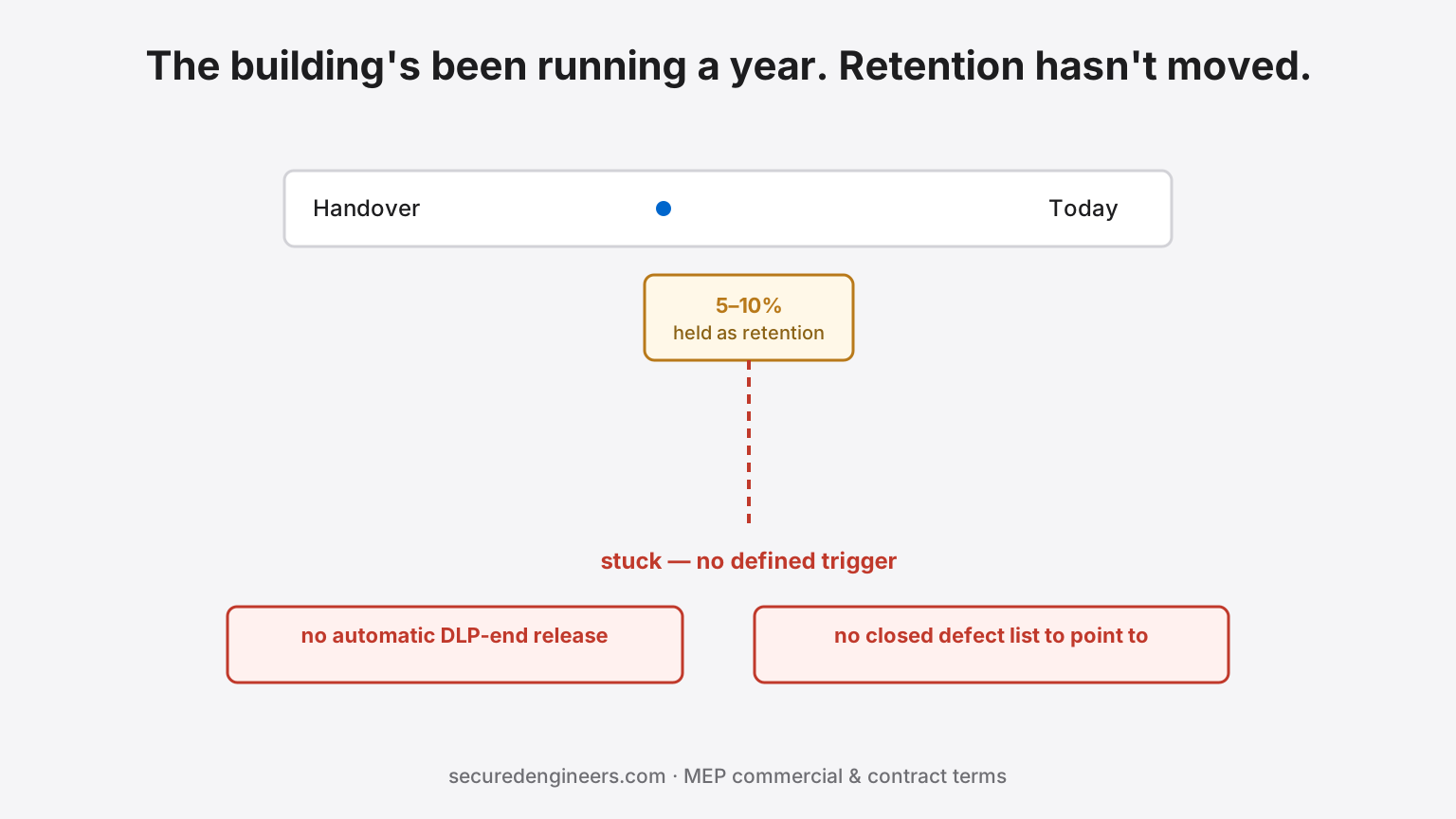
Retention money is a reasonable idea: the owner holds back 5–10% of the contract value at handover, to be released after the defect liability period confirms the work is genuinely sound. In practice, across a large share of MEP contracts, that reasonable idea becomes an indefinite hold — the building has been operating for a year, the contractor has moved on to three other projects, and the retention sits in the client's accounts with no active process moving it toward release.
This is rarely deliberate bad faith. It is what happens when a contract defines that retention will be released, without defining how or when — leaving the release entirely dependent on someone remembering to act.
Why retention gets stuck
- No defined DLP end-date trigger. Many contracts state a defect liability period (commonly 12 months) without specifying what happens automatically at its end — release requires someone to initiate it, and if nobody does, nothing happens
- No closed defect list. If defects were noted during the DLP but never formally closed out with sign-off, the retention has an open-ended justification for continued hold — even for defects long since fixed
- Final measurement/reconciliation disputes. Retention release is often bundled with final bill settlement — and if the final measured quantities are disputed (echoing the BOQ mismatch problem), the whole package stalls together
- Organisational memory loss. The facility manager who inherited the building a year after handover has no institutional knowledge of the original contract's retention terms — and no incentive to chase a release that isn't their money
- Passive retention as informal leverage. Some owners, consciously or not, treat unreleased retention as ongoing leverage to ensure the contractor remains responsive to post-handover issues — which may be understandable in spirit but isn't what the contract actually authorised
The contract language that prevents this
| Clause element | What it should specify |
|---|---|
| DLP start and end dates | Tied to a specific, documented event (handover/taking-over certificate date) — not a vague "after completion" |
| Automatic release trigger | Retention releases automatically at DLP end unless a specific, documented defect notice is outstanding — shifting the burden to the owner to actively object, not the contractor to actively chase |
| Defect notification and closure process | A defined format for raising defects during DLP, with a corresponding sign-off process for closing each one — so "defects were noted" doesn't become permanent ambiguity |
| Partial release provisions | For larger contracts, releasing a portion of retention early (e.g., 50% at DLP midpoint) with the balance at full DLP close, reducing the amount stuck to any single dispute |
| Interest on delayed release | A modest interest provision on retention held beyond the contractually defined release date — creates a real incentive for the owner's side to actually process the release |
| Separation from final bill disputes | Retention release explicitly decoupled from unrelated final-measurement disputes, so one disagreement doesn't freeze an entirely separate payment |
What contractors can do proactively
- Calendar the DLP end date at handover, not as an afterthought — and initiate the release conversation before it lapses into "forgotten"
- Get every defect closure formally signed off, in writing, at the time it's fixed — not left as a verbal "yes it's done" that has no paper trail a year later
- Request a formal DLP-end inspection from the owner, in writing, creating a documented event that the release can be tied to
- Keep the retention conversation separate from any final-bill quantity disputes, explicitly, in correspondence — don't let an unrelated argument become the reason retention never gets discussed
- Escalate in writing, with the contract clause cited, once the DLP has genuinely closed with no outstanding defects — a documented, specific request is harder to indefinitely defer than an informal follow-up call
What owners should do to avoid becoming the reason it's stuck
A facility team that inherits post-handover responsibility should receive the original contract's retention terms as part of handover documentation — not rediscover them when a contractor eventually calls asking. Building the DLP-end inspection and retention review into the facility management calendar, the same way planned maintenance gets calendared, closes the loop deliberately instead of by accident.
FAQs
How long can retention money legally be withheld?
Retention terms are governed by the specific contract, not a universal statutory period — which is exactly why the contract needs to define a clear release trigger rather than leaving it open-ended. Review your specific agreement's DLP and retention clauses.
What happens if defects are found right at the end of the DLP?
A properly drafted contract distinguishes genuinely outstanding, documented defects (which can justify a proportionate hold) from an open-ended "we might find something" — retention shouldn't be held against defects that don't exist and haven't been raised.
Can retention be partially released before the DLP ends?
Yes, if the contract provides for it — staged release reduces how much value is exposed to any single late-stage dispute, and is worth negotiating into future contracts even if the current one doesn't have it.
Should retention release be tied to the final bill settlement?
Better practice separates them explicitly — bundling means an unrelated measurement dispute can freeze a payment that has nothing to do with it.
Can you help review or negotiate retention terms on a contract?
Yes — contract clause review and commercial-dispute resolution support as part of our project delivery scope. Get in touch.
More insights
What should an HVAC contractor include in a BOQ — the lines that make a mechanical package priceable
An HVAC BOQ that stops at "chiller, 200 TR" cannot be priced, compared or held to. Here is the line structure a mechanical package needs — plant, air side, water side, controls, commissioning and the interfaces — and the items that go missing most often.
Costing & ProcurementMEP / MEPF Cost per Sq Ft in India — Factory, Warehouse, Hospital, Hotel
What MEPF really costs per square foot in India, benchmarked by building type — and what legitimately moves a project inside (or outside) its band.