
Your MEP Contractor Is an MSME. Your Payment Terms Say 90 Days.
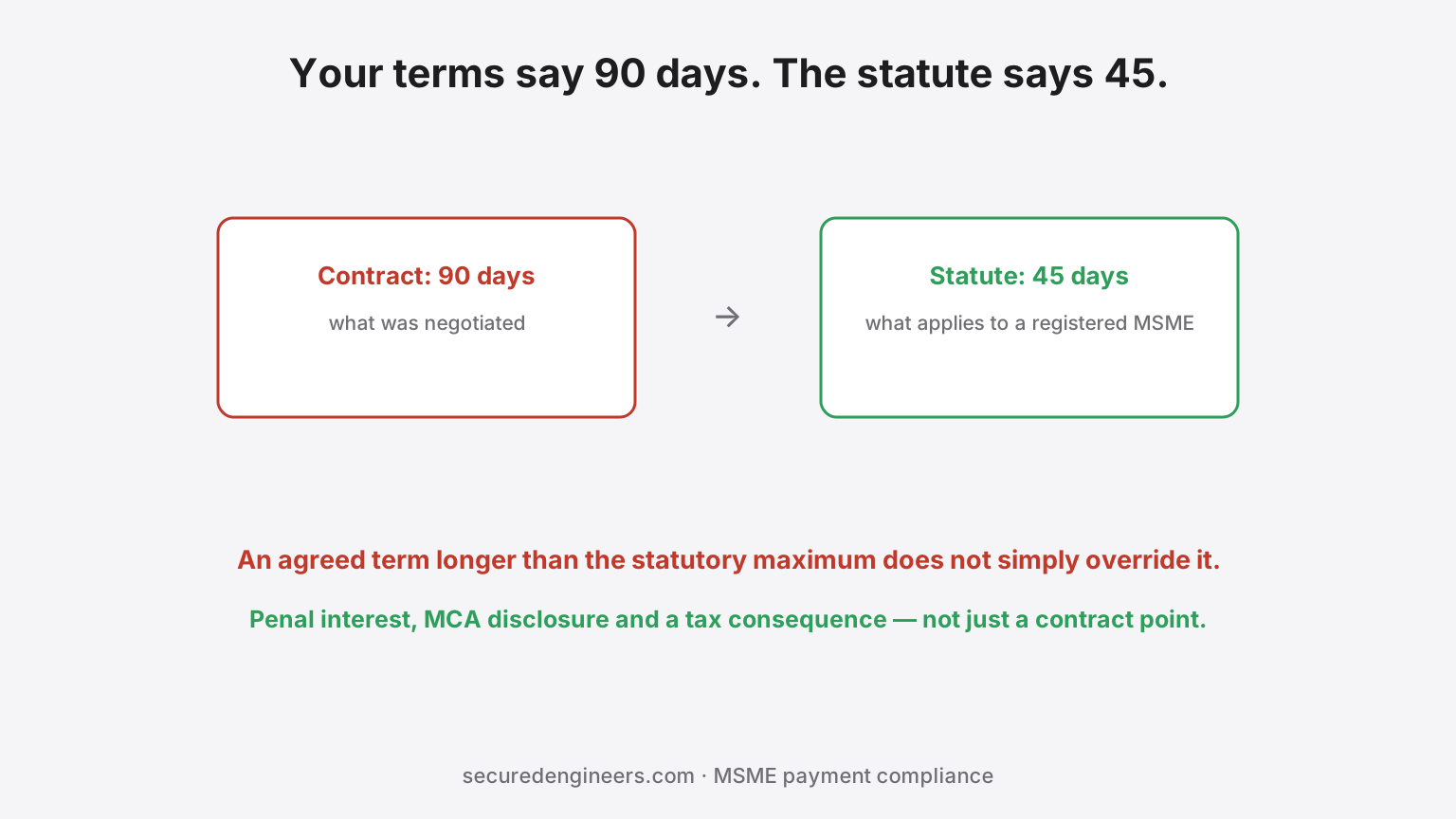
Construction payment terms get negotiated hard: 60 days, 90 days, sometimes "on receipt of funds from the client". Both sides treat this as freely contractable. Where the supplier is a registered MSME, it is not entirely free.
The MSME Development Act sets a maximum period for payment to a registered micro or small enterprise — commonly understood as 45 days, and shorter where no period is agreed. An agreed term longer than the statutory maximum does not simply override it.
What follows from getting this wrong
- Interest at a penal rate. The Act provides for compound interest on delayed payment at a multiple of the RBI bank rate — materially above commercial borrowing cost. It accrues whether or not the supplier asks.
- A disclosure obligation. Companies are required to disclose amounts outstanding to MSME suppliers in their financial statements, and periodic returns to the Ministry of Corporate Affairs cover dues beyond 45 days. The exposure becomes visible to auditors and lenders.
- A tax consequence. Deductibility of expenditure to micro and small enterprises has been tied to actual payment within the statutory period. Paying late can move the deduction to a later year — which is a cash cost, not a paperwork one.
- A faster dispute route. The 2026 amendment puts hard clocks on mediation and arbitration, and requires part-payment where court proceedings run past six months.
Where construction makes this messy
| Practice | Problem against a statutory clock |
|---|---|
| "Pay when paid" / back-to-back terms | Your client's delay does not pause your obligation to an MSME sub-vendor |
| Retention held for 12–24 months | Retention is deferred payment — the treatment needs deciding deliberately, not assumed |
| Certification disputes | Argument over quantum does not necessarily stop the clock on undisputed amounts |
| Invoices "not received" by accounts | The clock runs from acceptance of goods/services, not from when the paperwork surfaces |
| Long defect-liability holdbacks | Same question as retention, over a longer period |
The practical position
Two things worth doing before the next dispute rather than during it. Establish and record MSME status for every vendor in your chain — it is a declaration and a registration number, and it takes minutes. Then look at your standard terms honestly: if they specify 90 days to a class of supplier that is statutorily entitled to 45, you have an exposure sitting in your template.
The reverse is worth checking too. If your own enterprise qualifies, your receivables carry protections you may not be using.
What we do differently
Payment terms are stated plainly in our budgetary proposals rather than buried, and we do not run back-to-back terms down to sub-vendors who are statutorily entitled to be paid sooner. Related: retention money and final-bill disputes and why the cheapest bid backfires.
General information, not legal or tax advice. Confirm the current position with your advisor.
More insights
A Fixed Price for 14 Months of Copper. Someone Is Carrying That Risk.
MEP is unusually exposed to metal prices — copper in cable and motors, steel in pipe, tray and structure. A fixed lump sum over a long programme does not remove that risk. It just decides who holds it, and prices it in.
Costing & ProcurementEvery Ambiguity in Your Tender Is a Variation Claim With a Delivery Date
Contractors do not game tenders out of malice — they price what is written and claim what is not. Every undefined make, unmeasured item and vague exclusion in your tender is a future claim, already scheduled. The anatomy of a gameproof MEP tender, clause by clause.