
The MSME Act Just Changed. Here Is What It Means for a Factory Owner.
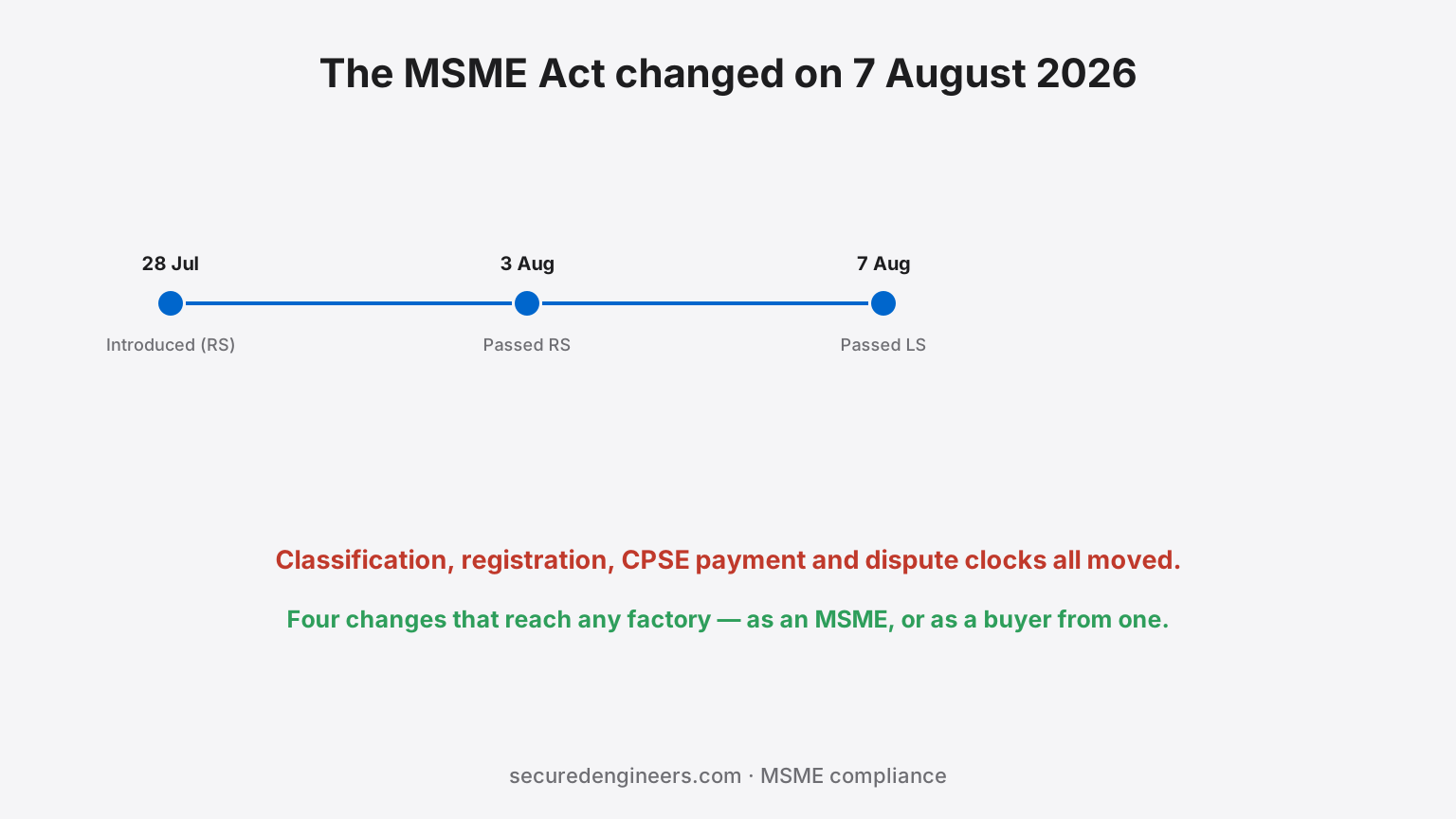
The Micro, Small and Medium Enterprises Development (Amendment) Bill, 2026 was introduced in the Rajya Sabha on 28 July 2026, passed there on 3 August, and cleared the Lok Sabha on 7 August 2026. For anyone running a factory — as an MSME, or as a buyer from MSMEs — four changes matter.
1. Classification moves out of the Act
Previously the investment and turnover thresholds that define micro, small and medium were written into the statute, so changing them meant amending the law. The amendment instead empowers the central government to notify the criteria, based on investment in plant and machinery or equipment and on turnover.
Practically: the thresholds can now be revised by notification rather than by Parliament. The direction of travel has been upward — more enterprises falling inside the MSME definition, not fewer. Check the current notified figures rather than any number you remember, including any quoted in guides like this one.
2. Registration becomes voluntary
Filing the memorandum is now voluntary for all MSMEs. It had been mandatory for medium manufacturing enterprises. The government is to provide digital platforms for the filing.
Voluntary is not the same as pointless. Registration is what evidences MSME status, and MSME status is what gives you the delayed-payment protections below. An unregistered enterprise that is entitled to those protections still has to prove it is one.
3. CPSE payments go onto TReDS
Every central public sector enterprise must settle invoices for goods or services procured from MSMEs on the Trade Receivables Discounting System. If you supply to a CPSE, your invoice becomes a discountable instrument on a regulated platform rather than a line in somebody's payables queue.
4. Hard clocks on delayed-payment disputes
This is the substantive one. The amendment puts defined time limits on a process that previously had none that bit:
| Stage | Time limit |
|---|---|
| Mediation | Complete within 90 days from the date fixed for first appearance |
| Referral to arbitration | Within 30 days of mediation being terminated |
| Arbitral award | Within 90 days from completion of pleadings |
| Court proceedings beyond six months | At least 50% of the awarded amount must be paid to the supplier |
That last row changes the economics of stalling. Appealing an award used to defer payment indefinitely; now protracted litigation triggers a part-payment obligation.
Why this matters on a construction project
An industrial project sits in the middle of this in both directions. Your MEP contractor may be an MSME, which puts you on the 45-day clock. Your contractor's sub-vendors — panel builders, cable suppliers, fabricators — very often are, which puts your contractor on it. And if your own enterprise is an MSME supplying a CPSE, the TReDS provision changes when you get paid.
The practical step is unglamorous: establish the MSME status of every party you pay and every party who pays you, in writing, and file it. Almost nobody does this until a dispute makes it urgent.
What we do differently
We state our own status and our sub-vendors' in the contract documents rather than leaving it to be discovered later, and our budgetary proposals set out payment terms explicitly. The related contract mechanics are covered in retention money and final-bill disputes.
General information, not legal or tax advice. Confirm the current notified thresholds and the commencement position with your advisor.
More insights
The Fire NOC Query Wasn't About Fire Safety. It Was About a Duct Nobody Coordinated.
Our BIM clash-detection guide covers what an uncoordinated design costs on site. A different cost shows up earlier: the query-and-resubmission cycle at Fire NOC and building-plan sanction, where an inconsistency between drawings — not a genuine safety gap — is what actually stalls the file.
ComplianceThe Drugs Controller, the Pollution Board and the Fire Department All Have an Opinion on Your Cleanroom.
Our GMP HVAC and WHO-GMP guides cover how to design a cleanroom that passes its audit. A separate problem sits alongside the engineering: a pharma or food manufacturing facility answers to several regulatory bodies at once, and their requirements don't always agree with each other.