
What we check in a Punjab factory electricity bill before sizing solar
Most solar proposals a Punjab factory receives start from the roof: so many square feet, so many kilowatts, here is a price. It is the wrong starting point, and it is why so many of those proposals stall at the DISCOM counter or deliver savings that never arrive.
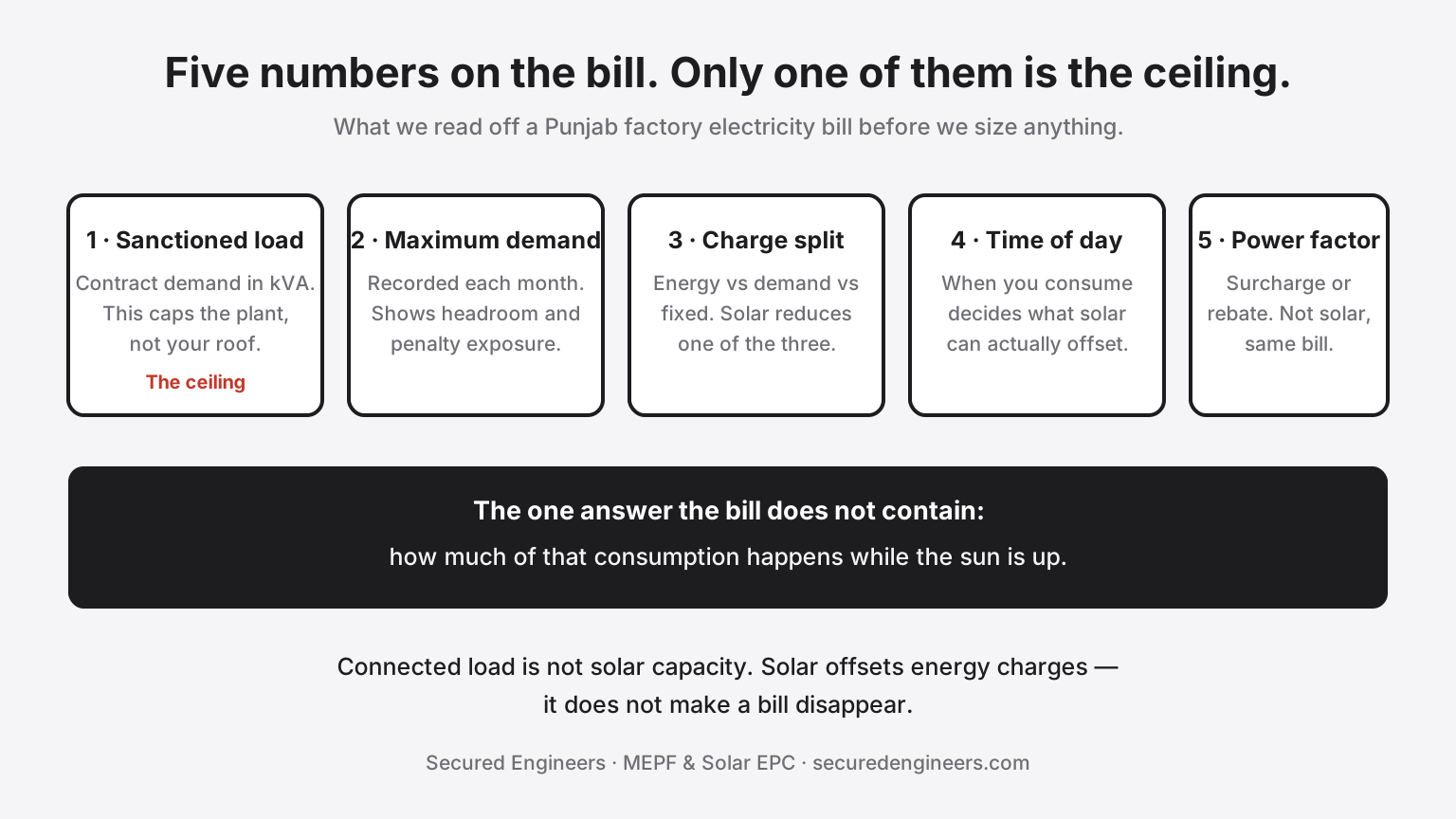
The constraint is almost never the roof. It is the electricity bill — specifically five figures on it, only one of which most buyers are asked for. This is the order we read them in, and what each one governs.
1. Sanctioned load or contract demand — the ceiling
This is the figure the DISCOM has agreed to supply you, expressed in kW or in kVA. It is not your connected load, which is the arithmetic sum of everything you could switch on at once. The two can differ by a factor of two in a factory that has grown one machine at a time.
It matters because net-metering regulations set permissible plant capacity against the sanctioned figure. A 500 kW plant designed against a 600 kW connected load, on a 350 kW sanction, is not a tight design — it is an application that will not be approved. We have been called in to look at plants where the modules were already on site when this surfaced.
If your bill states contract demand in kVA, it converts to kW at the normative power factor your tariff specifies; the conversion is on the bill, not an assumption we make for you.
2. Maximum demand — headroom, and what you are already paying for
Your bill records the maximum demand actually registered in each billing period. Compare twelve months of it against the sanctioned figure and two things become visible: how much headroom exists, and whether you are already paying demand penalties for exceeding sanction.
That second one changes the conversation. If a factory is routinely overshooting its sanction, the question stops being "how much solar" and becomes "should the sanction be revised first" — because revising it changes both the penalty exposure and the capacity the solar plant is permitted to be. Sequencing those two applications in the right order saves a round of paperwork.
3. The charge split — solar only touches one part of it
An industrial bill is not one number. It is energy charges for the units consumed, demand or fixed charges driven by your peak draw, plus electricity duty, surcharges and any power-factor adjustment.
Solar reduces the energy component, for the units it displaces. It does not reliably reduce demand charges, because those follow your peak, and a rooftop plant only shaves the peak if the peak happens to fall in daylight on a clear day. Fixed charges continue regardless.
So before anyone models a saving, we work out what share of your bill is actually addressable. On some factory bills that is most of it. On others — a plant with heavy demand charges and a night shift — it is a good deal less, and the honest advice is a smaller plant than the roof would carry.
4. Time of day — when you consume decides what solar is worth
Where the tariff carries time-of-day slabs, the bill shows consumption split across them. That split is the single best proxy available on paper for the question that governs the whole economic case: how much of your load runs while the sun is up?
A single-shift unit running 9 to 6 and a three-shift unit with the same monthly consumption are completely different solar propositions. The first can self-consume nearly everything it generates. The second exports a large share at whatever the applicable settlement rate is — which is lower than the tariff it avoids, so the same plant earns materially less.
5. Power factor — not solar, but it is on the same bill
The power-factor line shows whether you are paying a surcharge or earning a rebate. It is not a solar question, but it appears on the same page, it is often cheaper to fix than to generate around, and an inverter's reactive-power capability interacts with it. We flag it because a buyer comparing "solar versus doing nothing" is sometimes better served by capacitor bank work first. We would rather say that than sell a bigger array.
The capacity cap — and why the internet gives you three different numbers
Search for the permissible rooftop capacity in Punjab and you will find figures that do not agree:
- A PSPCL public notice dated 10 December 2024 states that rooftop capacity shall not exceed 70% of sanctioned load or contract demand for non-domestic consumers.
- Several older documents still in circulation — PSERC material from 2015, and PDFs hosted by local development authorities — state 80%.
- Various blog summaries state further figures again, including absolute ceilings that we could not reproduce on the issuing agency's own website when we checked on 2 October 2026.
We are not going to resolve that disagreement in an article, and you should be wary of any contractor who does so casually. Regulations are amended, notices supersede one another, and the figure that binds your project is the one current for your connection category on the day your application is filed.
What we do instead: read your bill, establish your sanctioned figure, and verify the capacity rule then in force against your connection before we propose a number. That check costs us an hour. Getting it wrong costs a redesign.
A worked example — illustrative, not a quotation
The figures below are constructed for this article. They are not a customer's bill and not a price we are offering. They exist to show the sequence.
- Sanctioned/contract demand: 300 kVA
- Maximum demand, twelve-month peak: 268 kVA
- Monthly consumption: ~95,000 units
- Shift pattern: single shift, roughly 9 am to 6 pm, six days
Reading in order: the sanction sets the ceiling, so permissible capacity is a percentage of 300 kVA converted to kW — and which percentage applies is the check described above, not an assumption. The demand record shows real headroom, so no sanction revision is needed first. The shift pattern says most generation will be self-consumed rather than exported, which is the favourable case. Monthly consumption gives the energy-charge share that is addressable at all.
That lands on a capacity range, and at our published C&I band of ₹24,000–32,000 per kW, exclusive of GST, an order-of-magnitude investment range. It does not land on a design. For that we need the roof.
What the bill cannot tell us
Four things, every time:
- Usable roof area. Skylights, vents, water tanks, walkways and shadow from adjacent blocks typically remove 10–20% of the paper figure. A shadow study converts the brochure number into yours.
- Roof structure. Whether the existing purlins and sheeting carry the additional dead and wind load, and what strengthening costs if they do not.
- DG interlock. How your changeover is wired. Solar back-feeding a running DG set during an outage is equipment damage, not an inconvenience — and whether solar runs at all in a cut is a separate decision, covered in solar with battery backup for a Punjab factory.
- Actual daytime load share. A monthly bill averages away the shape. Where the economics are marginal, a few days of logging settles it.
Which is why we ask for the bill first and the site visit second. The bill tells us whether there is a project worth surveying. The survey tells us what to build.
What to send us
One recent electricity bill — all pages, including the back of the sheet where the demand and power-factor detail usually sits — and the location of the site. Twelve months is better than one if you have them to hand, because seasonality shows up in the demand record. If the bill is not in front of you, the sanctioned load and your shift pattern are enough to start.
We will tell you the capacity range your connection supports, what share of your bill is realistically addressable, and what we would need to check next. If the honest answer is that the project is smaller than you hoped, or that the sanction should be revised first, we will say that.
Frequently asked
How do you size a solar plant from an electricity bill?
Read five things in order: the sanctioned load or contract demand, which caps permissible net-metered capacity; the maximum demand actually recorded each month, which shows headroom; the split between energy, demand and fixed charges, because solar reduces only the energy component; the time-of-day pattern, because solar offsets consumption that happens in daylight; and the power factor line. The bill then gives you a defensible capacity range — but not a final number, because it cannot tell you how much of your consumption occurs while the sun is up, or whether your roof can carry the array.
Does my connected load decide how much solar I can install?
No, and this is the most common and most expensive misreading. Connected load is the sum of what you could switch on; sanctioned load or contract demand is what the DISCOM has agreed to supply. Net-metering regulations reference the sanctioned figure, not the connected one. A plant sized against connected load routinely fails at the application stage, after the money has been committed.
What percentage of sanctioned load can a rooftop solar plant be in Punjab?
Published sources disagree, which is why this is worth checking rather than assuming. A PSPCL public notice dated 10 December 2024 states that rooftop capacity shall not exceed 70% of sanctioned load or contract demand for non-domestic consumers; several older documents in circulation — including PSERC material from 2015 and PDFs still hosted by local authorities — state 80%. Blog summaries add further figures of their own. The binding number is the one in the PSPCL notice current for your connection category on the day you apply, and we verify it against your actual connection before proposing a capacity.
Will solar remove my entire factory electricity bill?
No. A commercial bill is made up of energy charges, demand or fixed charges, duties and surcharges. Solar reduces the energy component for the units it displaces. Demand charges are driven by your peak draw, which a rooftop plant does not reliably reduce unless the peak itself sits in daylight hours, and fixed charges continue regardless. Any proposal that models your whole bill going to zero has not read the bill.
What can an electricity bill not tell a solar engineer?
Four things, all of which need a site visit or drawings: how much of the roof is genuinely shadow-free once skylights, vents, water tanks and adjacent structures are accounted for; whether the roof structure can carry the additional dead and wind load; how your DG set changeover is wired, which governs the islanding and interlock design; and your actual daytime load share, which a monthly bill averages away. The bill gets you to a capacity range and an order-of-magnitude investment. It does not get you to a design.
Related services
More insights
Bifacial Panels Generate From Both Sides. On the Wrong Roof, the Second Side Generates Almost Nothing.
Bifacial modules capture light reflected off the ground as well as direct sunlight — real, but the gain depends entirely on mounting height, tilt and what's actually underneath the array. Marketing puts the number at up to 20-30%. Most Indian commercial rooftops see a fraction of that, and it's worth knowing why before paying the premium.
Solar EnergyGreen Hydrogen Needs a Lot More Solar Than the Slide Deck Shows.
Green hydrogen — solar power run through an electrolyzer to split water — is the path being discussed for decarbonising steel, fertiliser and other hard-to-electrify heavy industry. For most Indian industrial buyers today it's a genuine future direction, not a retrofit decision, and the honest reason why is the scale of solar capacity it actually requires.