
Your solar plant switches off in a power cut. Here's what a battery changes in Punjab.
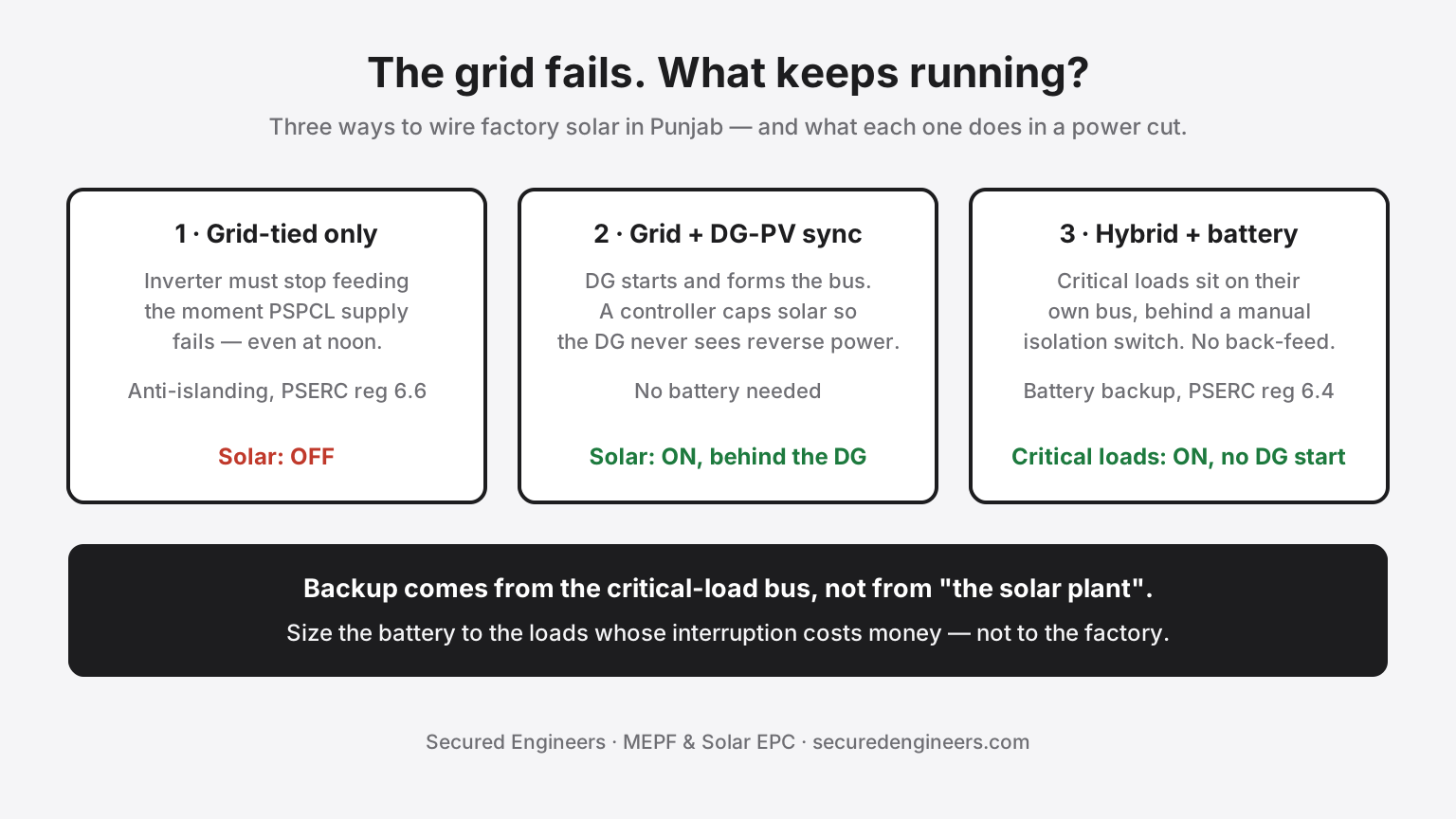
A factory owner with 300 kW on the roof reasonably assumes the plant will carry something when PSPCL supply trips. It will not. The moment the grid fails, a grid-tied rooftop plant in Punjab has to stop feeding — and it does, at noon, in full sun, with the panels producing exactly what they produced a second earlier.
That is not a fault. It is the law, and it exists so that a lineman working on a feeder he believes is dead is not electrocuted by your inverter. Everything about "solar with battery backup" follows from understanding that one rule — what it forces you to build, and when a battery is the right answer to it and when it is not.
Why your solar plant goes dark when the grid does
The PSERC (Grid Interactive Rooftop Solar Photo Voltaic Systems) Regulations, 2021 say it plainly. The rooftop system must be capable of detecting an unintended islanding condition and must have anti-islanding protection to prevent any feeding into the grid in case of failure of supply, tested to the applicable IEC/IEEE standards (regulation 6.6).
A grid-tied inverter is a grid follower. It synchronises to the voltage and frequency the grid provides and pushes current into it. Take the grid away and the inverter has nothing to follow, so it disconnects — by design, and by regulation. The array has not stopped working. The system has simply lost the one thing it needs to deliver power: a live bus to deliver it into.
So the useful question is not "will my solar give me backup?" It is: when the grid fails, what else will form the bus? In a Punjab factory there are only two candidates — the DG set you already have, or a battery.
What the regulation says about adding a battery
Batteries are not a grey area. Regulation 6.4 says a grid-interactive rooftop system may be installed with or without battery backup. It then sets two conditions where a battery is installed, whether for full-load or partial-load backup:
- the inverter must have an arrangement that prevents battery power flowing into the grid in the absence of grid supply; and
- a manual isolation switch must also be provided.
Read as an engineer, that describes an architecture. When the grid fails, the loads you want to keep running must be separated from the PSPCL network and fed from the battery as their own island — with a switch a person can operate and lock, so nobody has to trust a relay setting to know the factory is not back-feeding the feeder. Regulation 6.5 adds that the consumer is responsible for the safe operation and maintenance of the system up to the net meter.
The regulations were notified on 18 August 2021. The first amendment, notified in March 2024, changed the settlement period for certain seasonal industries; the amendments PSPCL proposed in Petition No. 43 of 2024 concern feasibility timelines, infrastructure upgrades and gross-metering accounting. None of them touches regulations 6.4 to 6.6 — but regulations change, and the text that binds your application is the one in force on the day you file.
The three ways to wire it — and which one a factory actually needs
| Architecture | What runs in a power cut | What it costs you | When it fits |
|---|---|---|---|
| 1. Grid-tied only | Nothing on solar. The DG, if you start it, carries the factory alone. | The lowest. No extra equipment. | Outages are rare or short, and the DG already covers them without complaint. |
| 2. Grid-tied plus DG-PV synchronisation | The DG starts and forms the bus; solar runs alongside it. A controller caps solar output so the DG never sees reverse power. | A controller and its integration — a fraction of a battery. | Most Punjab factories that already run a DG and lose diesel, not production, to outages. |
| 3. Hybrid with a battery on a critical-load bus | Selected loads keep running with no DG start, or ride through the seconds before the DG picks up. | The highest. The battery is the expensive part. | Loads where the interruption itself does the damage — a scrapped batch, a lost process, a crashed control system. |
Option 2 deserves saying out loud, because a battery vendor will rarely say it: if your factory already has a DG and the complaint is that solar sits idle during cuts, you probably do not need a battery. You need the DG and the solar plant to work together, which is a control problem, not a storage problem. We cover that control layer in our piece on factory microgrids. A DG set running with solar behind it burns less diesel per hour of outage, and that is often the entire business case.
A battery earns its place in option 3 for a different reason: the gap. A DG takes time to start and accept load. For lighting, that gap is an annoyance. For an injection-moulding cycle, a furnace's control system or a PLC-sequenced line, it can be a scrapped batch and an hour of restart. That is the cost a battery removes, and it is the only honest basis for buying one.
Size the battery to the critical load, not the factory
Backup does not come from "the solar plant". It comes from the critical-load bus — the section of your distribution, behind the isolation arrangement regulation 6.4 requires, that the battery feeds when the grid is gone. What sits on that bus is the most important decision in the project, and it is a production decision before it is an electrical one.
Start from a list, not a percentage. Walk the plant and write down every load whose interruption costs money: process controls, PLC panels, servers and networking, safety and alarm systems, emergency lighting, perhaps one critical machine. Then size two numbers against that list, because they are separate ratings:
- Power (kW) — can the inverter and battery carry those loads simultaneously? Include starting current: an induction motor draws several times its running current as it starts, so the inverter's surge rating, not its nameplate kW, decides whether a compressor or pump restarts on battery.
- Energy (kWh) — for how long? Twenty minutes to bridge to the DG and an hour to ride out a cut without one are very different batteries.
The kW-versus-kWh trap is the commonest sizing error in storage, and we go through it in our BESS peak-shaving guide. For a first number, the solar battery storage calculator gives an indicative size — indicative, because only your load list makes it real.
What not to do is the shortcut you will find in generic answers: backing up a fixed share of sanctioned load. Sanctioned load says nothing about which loads matter. Size against it and you get a battery that is either unaffordable or unable to restart the one machine you cared about.
What it does to the economics — and what it doesn't
The solar portion of a hybrid system prices like any rooftop plant; our published per-kW basis is on the Punjab solar EPC page. The battery is a separate line, and we deliberately do not publish a battery price here — cell prices move month to month, and a number in an article is out of date before it is read.
Be clear about what pays for the battery. In a factory it is rarely the energy saving. It is the avoided cost of interruptions — scrap, restart time, lost output — plus the diesel and wear of DG starts it prevents. Where the tariff rewards shifting consumption or cutting recorded peak demand, a battery cycled daily can stack a second saving; whether that applies depends on your PSPCL tariff category and the tariff order in force, which is a check to make against your own bill rather than a number to assume. Our guide to reading a Punjab factory electricity bill shows where those figures sit.
So the payback calculation is specific to your plant and simple to frame: how many interruptions a month, multiplied by what each one costs you. If that number is small, choose option 1 or 2 and keep your money. If it is large, the battery is the cheapest insurance you will buy.
Where to put the battery — the part that becomes a fire question
A lithium battery bank is a concentrated fire load, and where it sits is decided at layout stage, not when the container arrives. It needs separation from the production floor and from escape routes, detection suited to thermal runaway, and ventilation — the discipline we set out in our lithium battery fire-safety guide. Parking it against the factory wall because that is where the cable is shortest is the decision most often regretted.
The battery, the hybrid inverter and the isolation arrangement are also part of the electrical installation. On a connection that requires inspection by the Chief Electrical Inspector, they are part of what the inspector sees, so they belong on the drawings that go into the CEIG approval in Punjab rather than being added afterwards.
What we would ask you first
Three questions settle which of the three architectures fits, before anyone prices a battery:
- What does an outage cost you? Not the hours — the scrap, the restart and the lost output per interruption.
- What is on your DG today, and how is the changeover wired? That decides whether DG-PV synchronisation is available to you at all.
- Which loads cannot stand even a few seconds' break? That list is your critical-load bus, and it sizes the battery.
We design the critical-load bus, the DG-PV control and the isolation arrangement as one system, and handle the PSPCL and CEIG side in-house. If the honest answer is that you need a DG-PV controller and not a battery, we will say so. Request a solar assessment and choose the battery/hybrid option — or send your bill and a list of the loads you cannot afford to lose.
Frequently asked
Does rooftop solar work during a power cut in Punjab?
Not on its own. A grid-tied rooftop plant must detect the loss of grid supply and stop feeding — the PSERC Rooftop Solar Regulations, 2021 require anti-islanding protection so that no power is fed into the grid when supply fails (regulation 6.6). That is why a plant switches off in a cut even in full sun. It keeps running only if something else forms the electrical bus: a DG set through a DG-PV synchronisation controller, or a battery-backed hybrid system feeding an isolated critical-load bus.
Is a battery allowed with net metering in Punjab?
Yes. Regulation 6.4 of the PSERC Rooftop Solar Regulations, 2021 says a grid-interactive rooftop system may be installed with or without battery backup. Where a battery is installed, for full-load or partial-load backup, the inverter must prevent battery power flowing into the grid in the absence of grid supply, and a manual isolation switch must also be provided. The condition is about how the system is wired, not whether a battery is permitted.
Do I need a battery if my factory already has a DG?
Often not. If the problem is keeping solar running during outages, a DG-PV synchronisation controller lets the plant run alongside the DG, capping solar output so the DG never sees reverse power — at a fraction of the cost of a battery. A battery earns its place where the interruption itself is the problem: loads that scrap a batch or lose a process in the seconds before the DG picks up, or where you want to avoid DG starts altogether for short cuts.
How big should a factory solar battery be?
Size it to the critical load, not the factory. List the loads whose interruption costs money — PLC-controlled lines, process controls, IT, safety systems, emergency lighting — and size two separate numbers against them: power in kW, including the starting surge of any motor that must restart on battery, and energy in kWh, for how long those loads must run. Sizing the battery against sanctioned load or a percentage of it produces a battery that is either unaffordable or unable to carry the loads that matter.
What does PSPCL require when solar has battery backup?
Under the PSERC Rooftop Solar Regulations, 2021 the inverter must have an arrangement that prevents battery power flowing into the grid when grid supply is absent, a manual isolation switch must be provided (regulation 6.4), the system must have anti-islanding protection tested to the applicable IEC/IEEE standards (regulation 6.6), and the consumer is responsible for safe operation and maintenance of the system up to the net meter (regulation 6.5). Confirm the current text of the regulations when you apply; the amendments on record in 2024 concern settlement periods, feasibility timelines and gross-metering accounting, not these clauses.
Related services
More insights
You Were Going to Build a Parking Shed Anyway. Put Solar on It Before the EV Chargers Go In.
Factories with EV logistics fleets, hotels, and corporate campuses adding EV charging usually treat the charger and the parking structure as two separate decisions. A solar carport combines them — shaded parking plus a generation source sized to actually offset the new charging load, rather than dumping it straight onto the grid connection.
Solar EnergyRooftop Solar Payback in India: What Businesses Should Expect
For commercial and industrial rooftops, solar typically pays back in 3–5 years and then delivers free power for two decades. Here's how the maths works.