
Rainwater Harvesting for Factories and Commercial Sites
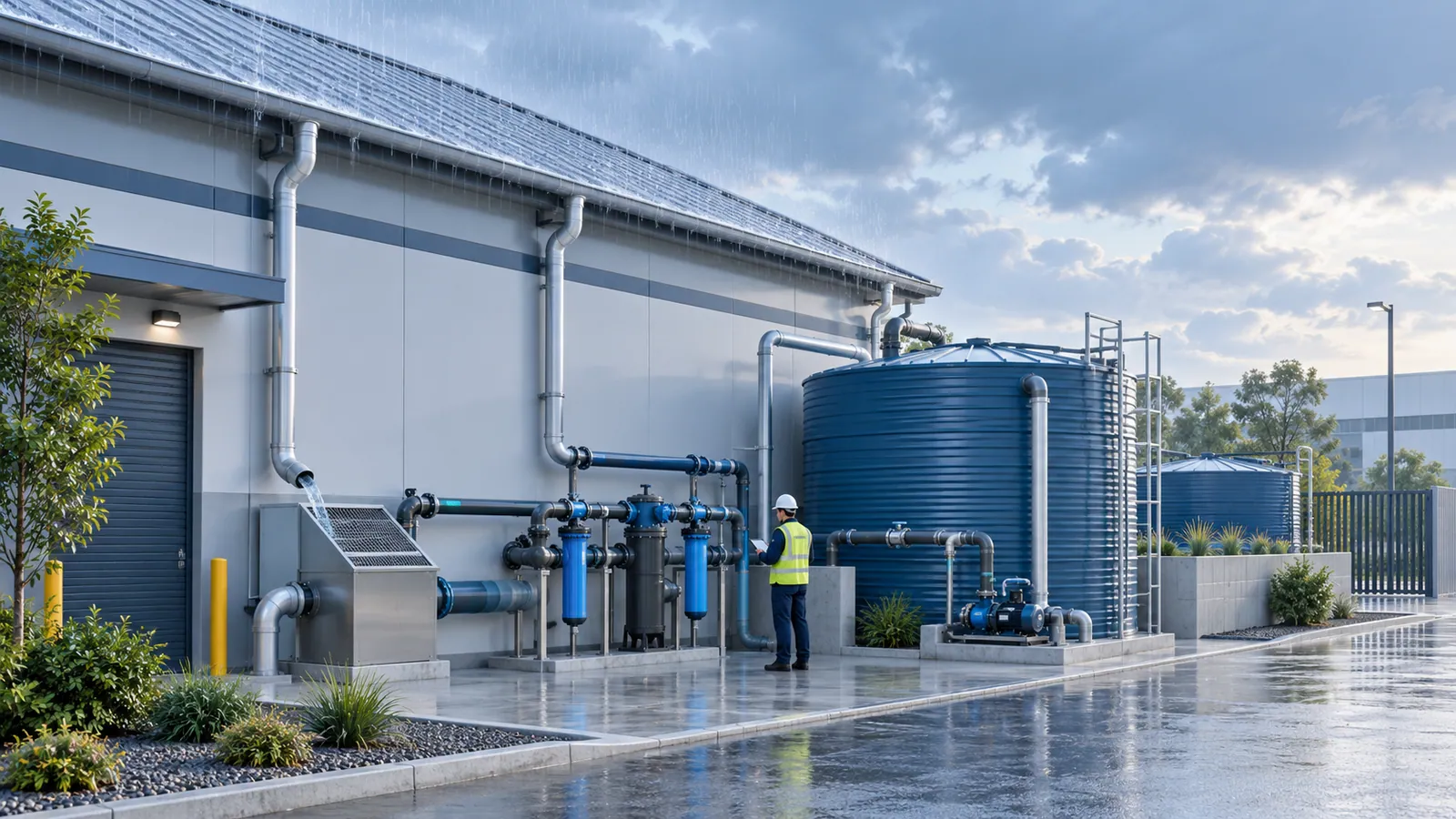
Rainwater harvesting on an industrial or commercial site is two decisions that often get blurred. The first is how much water the roofs and paved areas can deliver, which is arithmetic with local rainfall data. The second is what to do with it: store it for use, recharge it to the aquifer, or both. That depends on the soil, the water quality, what the site uses water for and the conditions in its approvals. A token pit drawn on the plan to pass a sanction answers neither question.
This guide follows that order: rainfall and catchment, losses and first flush, storage versus recharge, and soil, water quality and local permissions, with a catchment checklist and a decision table.
1. Rainfall and catchment
The volume available is the rainfall multiplied by the catchment area and a runoff coefficient for losses. One millimetre of rain on one square metre is one litre. IS 15797:2008, the BIS guideline for rooftop rainwater harvesting, applies a roof runoff coefficient of 0.8 to 0.95 depending on the roof. As an example, a 1,000 m² roof in a district with 800 mm of annual rainfall receives 800 kL a year, of which roughly 640 to 760 kL runs off before first-flush and overflow losses.
Use the district's rainfall normals from the India Meteorological Department rather than a state average, and look at the monthly pattern as well as the annual total. Much of the year's rain arrives in the monsoon months, often in short heavy spells, so storage fills quickly and then overflows; that timing decides how much water a tank can actually deliver.
| Record | Why it matters | Where it comes from |
|---|---|---|
| District annual and monthly rainfall normals | Sets the volume and when it arrives | India Meteorological Department district rainfall statistics |
| Short-duration rainfall intensity | Sizes gutters, downtakes and drains for peak flow, not annual totals | Local intensity data used for the storm-drainage design |
| Roof area of each catchment segment, and its roof type | Area and runoff coefficient for each segment | Roof plan; metal sheet, RCC, skylights noted |
| Roof condition and fallout: process emissions, dust, coatings, birds | Sets the first-flush volume and filtration, and whether the water is fit to recharge | Site walk and a review of the processes |
| Paved areas: car parks, roads, loading yards | Oil, tyre dust and spills; often better routed to storm drainage or treated separately | Site plan and yard uses |
| Existing gutters, downtakes and storm drains | What can be reused and what needs new conveyance | As-built drainage drawings |
| Space for tanks or recharge structures | Limits the storage and recharge options | Site plan with buried services marked |
| Uses that could take harvested water, by month | Decides how much storage is worth building | Water balance: flushing, cooling-tower make-up, landscaping, washing, process |
| Groundwater source and NOC conditions | Rainwater harvesting and recharge conditions may already apply | The NOC from the Central Ground Water Authority or the state authority |
The rainwater harvesting calculator runs this arithmetic for your roof area and rainfall, and the water demand calculator shows how much of the site's demand that water could meet.
2. Losses and first flush
- Losses. The runoff coefficient covers splash, absorption and evaporation on the roof. Further losses come from first-flush diversion, overflow when storage is full, and leaks.
- First flush. IS 15797 says the first runoff from a roof should be discarded, because it carries dust, leaves and other debris. Divert a first-flush volume for each roof segment before anything enters storage or recharge; industrial roofs with process fallout need more care than clean roofs.
- Screens and desilting. Mesh at gutters and outlets to stop leaves, then a desilting or filter chamber. IS 15797 calls for silt-free water in recharge structures, and the filtration for stored water should match its end use.
- Conveyance for the cloudburst. Gutters, downtakes and drains are sized for short-duration intensity, not the annual average. NBC 2016 Part 9 Section 2 covers the conveyance of rain and storm water within the drainage design the site needs anyway.
- Metering. A flow meter on the reuse line turns the system from a belief into a monthly number that can be checked against the water bill.
3. Storage versus recharge
Storage delivers a direct saving: every kilolitre used displaces water the site would otherwise buy or pump. Its cost is the tank, and its yield depends on demand: a tank that is drawn down between storms captures far more over a season than one that fills once and overflows. Recharge returns water to the aquifer through pits, trenches, existing dug wells or tube wells, or purpose-built recharge wells, the structures IS 15797 describes. It costs less per kilolitre handled, works only where the soil and the depth to the water table allow, and needs its silt layer cleaned periodically to keep the recharge rate.
The groundwater rules also shape the choice. Under the Central Ground Water Authority's guidelines of 24 September 2020 (amended on 29 March 2023), industries drawing groundwater need a No Objection Certificate from the CGWA or, in states with their own groundwater law, the state authority. The 2020 guidelines require rooftop rainwater harvesting or recharge in the project premises, ask for a harvesting proposal as per the Model Building Bye-Laws with the application, require industries likely to pollute groundwater (such as chemicals, pharmaceuticals, dyes, paints, textiles, tanneries and fertilisers) to store harvested rainwater in surface tanks for use rather than recharge it, and prohibit injecting treated or untreated wastewater into the aquifer.
| Situation | Lean towards | Why | Check before design |
|---|---|---|---|
| Water bought by tanker or at a high tariff, with year-round non-potable demand | Storage sized to the demand | Each kilolitre used displaces purchased water | Water balance, tank space, treatment for the use |
| Industry is one the CGWA guidelines class as likely to pollute groundwater | Surface storage for use in the industry | The guidelines require harvested rainwater to be stored in surface tanks for these industries | Your NOC conditions and the state authority's rules |
| Permeable soil, deep water table, little non-potable demand | Recharge | Low cost per kilolitre handled; meets recharge conditions | Hydrogeological check; distance from contamination sources |
| Clay soil or a shallow water table | Storage, or recharge wells to a deeper aquifer after a study | Shallow pits will not take the water and can waterlog the site | Percolation test and a hydrogeologist's advice |
| Roof or yard runoff carrying process fallout, oil or chemicals | Treat it or route it to storm drainage; do not recharge it | Contaminated recharge pollutes the aquifer the site may draw from | Water-quality testing; consent conditions |
| A groundwater NOC and a large non-potable demand | Storage first, overflow to recharge | Captures the direct saving and meets the recharge condition | Overflow route; desilting before recharge |
4. Soil, water quality and local permissions
- Soil and siting. Test percolation and find the water-table depth before choosing recharge. Keep recharge structures clear of foundations, septic tanks, effluent lines, chemical stores and fuel tanks, and make sure no contaminated water can reach them.
- Water quality for the use. Flushing, cooling-tower make-up, landscaping and washing need modest treatment; drinking use needs treatment and testing against IS 10500:2012, the BIS drinking-water specification. Keep harvested-water pipes separate and labelled. Harvested water is not fire water: fire water storage is dedicated to firefighting and sized by the fire design.
- Local permissions. Building bye-laws can require rainwater harvesting at plan sanction or completion, with thresholds that vary by state and city, so read the bye-law that applies to your plot. Check the groundwater NOC and the pollution-board consent for conditions on harvesting, recharge or storm water from process areas.
- The money. Value stored water at the site's marginal cost: the tanker rate where water is bought, pumping and treatment where it comes from a borewell, or the municipal tariff. Count only what the storage can deliver given the rain pattern. The 2020 CGWA guidelines also give existing projects whose recharge structures comply and perform a 50% rebate on groundwater abstraction or restoration charges, subject to verification; confirm the current position, since the guidelines have been amended.
Rainwater systems are designed and installed under plumbing and public health engineering, with the harvesting layout, sizing calculation and compliance drawings covered under rainwater harvesting and recycling. To plan yours, share the water balance, the occupancy or shifts and any wastewater test data through a scope request; more planning guides are in Insights.
Sources and how to verify
- Bureau of Indian Standards, IS 15797:2008, Roof top rainwater harvesting: Guidelines (Ground Water and Related Investigations Sectional Committee, WRD 3): runoff coefficients, first flush, storage and recharge structures.
- Bureau of Indian Standards, Guide for Using National Building Code of India 2016: Part 9 Section 2 (conveyance of rain and storm water) and Part 11 (rainwater harvesting within the approach to sustainability) of NBC 2016.
- Central Ground Water Board, ground water regulation: the CGWA Guidelines to regulate and control ground water extraction in India (Gazette notification S.O. 3289(E), 24 September 2020) and the amendment of 29 March 2023; state groundwater authorities issue NOCs in states with their own law.
- India Meteorological Department, district rainfall statistics.
- Bureau of Indian Standards, IS 10500:2012, Drinking Water: Specification (second revision).
Confirm locally: the bye-law that applies to your plot, the conditions in your groundwater NOC and pollution-board consent, the current text of the CGWA guidelines, and the site's hydrogeology before building recharge structures.
Frequently asked
What information do I need to size rainwater harvesting for a factory?
The district's annual and monthly rainfall normals from the India Meteorological Department, roof and paved areas by surface type, the condition of the roofs and any process fallout on them, the existing gutters, downtakes and storm drains, space for tanks or recharge structures, the site's water uses and monthly demand, the groundwater source and any NOC conditions, and soil or percolation data. The checklist in this guide lists each item with where it usually comes from.
Which site conditions change the scope or cost of an industrial rainwater system?
Soil and depth to the water table (which decide whether recharge is feasible), contamination on roofs and yards, whether the industry is one the CGWA guidelines require to store harvested water in surface tanks rather than recharge it, the space and structure available for tanks, long runs from downtakes, existing drains that need rework, the treatment level the intended use needs, and conveyance sized for heavy short storms rather than annual totals.
What should I send an engineer to design rainwater harvesting for a site?
Site and roof plans with areas and roof types, the drainage drawings, the water balance with bills or tanker records, the occupancy or shift pattern, any wastewater test data, the groundwater NOC and pollution-board consent conditions, borewell and soil or percolation data if available, and photographs of the roofs, downtakes and yards. From those an engineer can size the catchments and propose storage, recharge or both.
Is rainwater harvesting mandatory for industries?
It can be required through more than one route. Local building bye-laws can require it at plan sanction or completion, with thresholds that differ by state and city. A site drawing groundwater needs a No Objection Certificate from the Central Ground Water Authority or its state authority, and the CGWA guidelines of 24 September 2020 require rooftop rainwater harvesting or recharge in the premises of NOC holders. Pollution-board consent conditions can add more. Confirm each with the authority concerned.
Can harvested rainwater be used for drinking or process water?
Roof water suits non-potable uses such as flushing, cooling-tower make-up, landscaping and washing, with treatment matched to the use. Drinking use needs treatment and testing against IS 10500:2012, the BIS drinking-water specification, and process use needs the quality the process demands. Keep harvested-water pipes separate and labelled, and never count harvested water as fire water.
Related services
More insights
The Plant Room Meets Code. The Resident Next Door Still Can't Sleep.
A DG set, chiller plant or cooling tower can be fully compliant with equipment noise ratings and still generate a valid neighbour complaint, a Pollution Control Board notice, or an insurance and reputational headache — because ambient noise limits, not just equipment specification sheets, are what actually gets enforced. Acoustic enclosures and vibration isolation are plant room design decisions, not optional add-ons priced out under budget pressure.
ComplianceThe Thresholds Moved. Your Factory May Have Changed Category Without Doing Anything.
MSME classification is set by investment in plant and machinery and by turnover. When the notified limits rise, enterprises change category without any change in their own operations — and both the benefits and the obligations move with them.
More on Plumbing & Public Health · all insights