
The Builder Handed Over the Keys. Did Anyone Test the Fire Pump First?
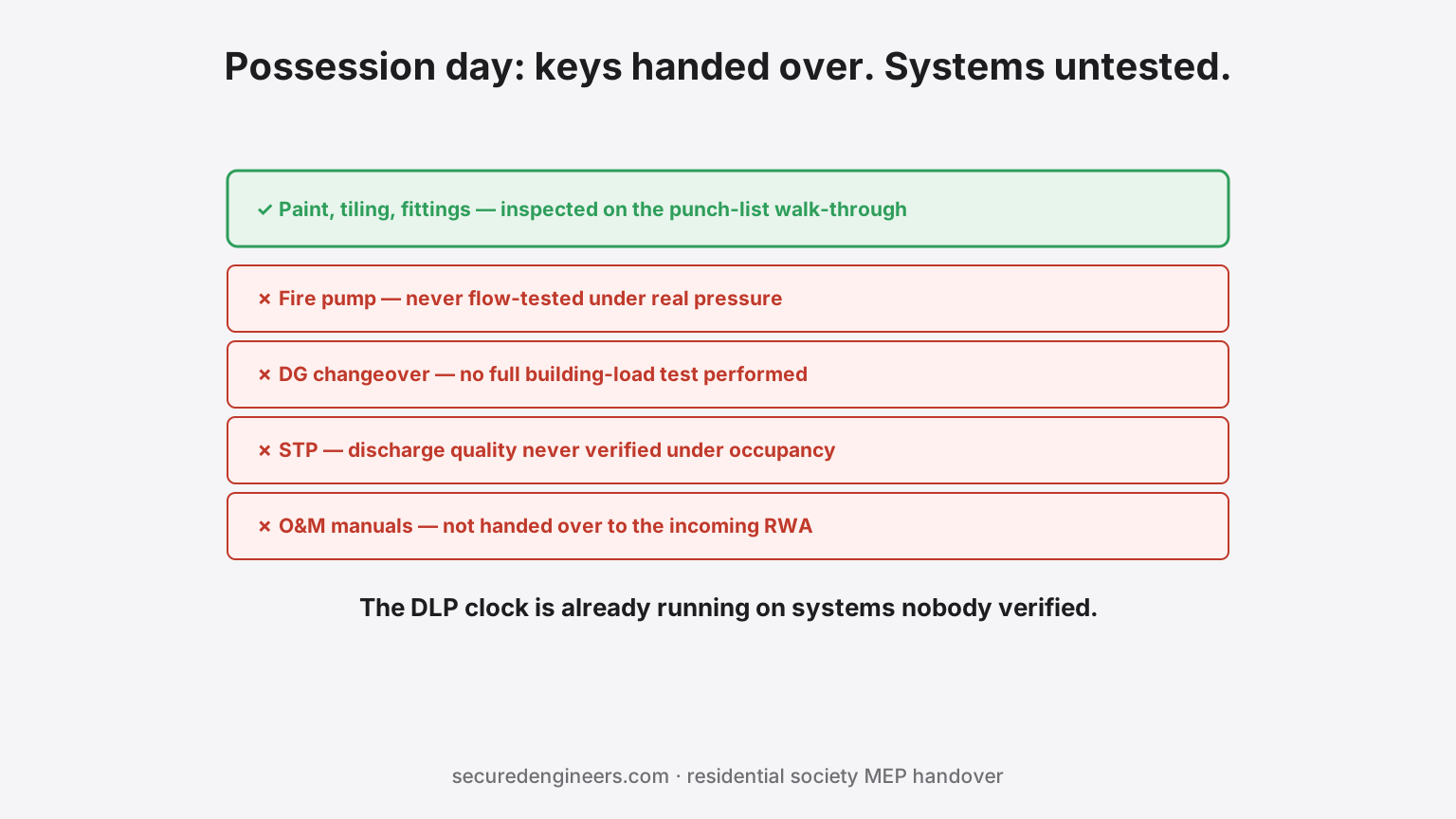
An Occupation Certificate confirms a building is legally fit to occupy against sanctioned plans. It does not confirm that the fire pump primes correctly, that the STP meets discharge norms under real load, or that the DG set has ever run a full-building test. Those are separate questions — and in most residential handovers, nobody asks them before the resident welfare association (RWA) formally takes over common-area MEP systems from the builder.
This gap matters because once possession is taken and the builder's team moves to the next project, the RWA — usually a committee of residents with no engineering background — becomes contractually responsible for systems it never actually tested.
What "handover" usually means in practice
- A punch list walk-through, focused overwhelmingly on visible finishes — paint, tiling, fittings — not on operating common-area MEP systems under load
- A single demonstration, if any — someone starts the DG set once, in isolation, without simulating an actual grid-failure changeover under building load
- No O&M documentation, or a generic manufacturer's manual for individual equipment with no building-specific operating procedure
- No test certificates for fire pump flow/pressure, earthing resistance, or STP discharge quality handed to the RWA committee
None of this is deliberate concealment in most cases — it is simply what happens when a technical handover is treated as an administrative one, and the receiving party (a resident committee) doesn't know which questions to ask.
What should actually be verified before accepting common-area MEP
| System | What "working" actually means | How it's verified |
|---|---|---|
| Fire pump & hydrant system | Meets required flow and pressure at the hydraulically farthest point, not just "pump switches on" | Flow test with pressure gauges, not a visual check |
| DG set & changeover | Full building load transfers automatically within the specified time on grid failure | A real load test, not a no-load start-up demonstration |
| STP (sewage treatment plant) | Treated water meets discharge norms under actual occupancy load, not design-day flow | Lab test of treated water quality after real occupancy begins |
| Lifts | Valid safety certification and a functioning AMC in place from day one | Documented AMC handover, not an assumption it continues automatically |
| Water pumping & storage | Domestic and fire water storage genuinely separated, pumps sized for actual (not design-minimum) demand | Tank capacity and pump curve verification against occupied-building demand |
Why this becomes the RWA's problem, not the builder's
Most builder-buyer agreements include a defect liability period, mirroring the DLP disputes seen on commercial projects — but a defect can only be claimed if it's identified and documented within that window. An RWA that doesn't inspect systems properly at handover, and doesn't know what a genuine defect looks like versus normal wear, frequently discovers real gaps only after the DLP has lapsed — at which point the cost of fixing an undersized fire pump or a never-commissioned STP falls entirely on the society's maintenance corpus.
The same pattern that causes occupancy certificate delays on the commercial side — systems built to satisfy an inspection checklist rather than genuine operating performance — shows up here in a different form: systems that satisfied the OC inspection but were never verified to actually perform for the people who now depend on them daily.
What an incoming RWA committee should insist on
- Independent, third-party testing of fire, electrical and STP systems before formal handover sign-off — not a builder-conducted demonstration
- Complete O&M manuals and as-built drawings for every common-area system, specific to the actual installed equipment
- All statutory test certificates — fire NOC, lift certification, electrical safety certificate, STP consent-to-operate — collected and filed before taking over AMC responsibility
- A documented snag list with committed closure dates, signed by the builder, before the DLP clock is treated as having started
- AMC continuity arranged from day one for fire, lifts, DG and STP — a gap in AMC coverage between builder handover and RWA-arranged maintenance is exactly when a latent fault surfaces uncovered
We support RWA and CHS committees with independent common-area MEP handover audits — testing systems the builder demonstrated but never proved, before the DLP window closes on an unverified claim. Our testing & commissioning and AMC teams can also step in directly where a society needs maintenance continuity from possession day one.
FAQs
Is an Occupation Certificate proof that MEP systems work correctly?
No — OC confirms the building is fit to occupy against sanctioned plans and statutory minimums. It does not verify operating performance of fire, electrical, water or STP systems under real load.
What should an RWA do before accepting common-area systems from the builder?
Commission independent testing of fire pump flow/pressure, DG load transfer, STP discharge quality and lift certification, and obtain full O&M documentation — before signing off on handover.
Can a society still claim a defect after possession if it wasn't caught at handover?
Only within the defect liability period defined in the builder-buyer agreement, and only if the defect can be evidenced as a genuine installation fault rather than normal wear or later neglect — which is much harder without a documented handover baseline.
Can you test a newly handed-over society's MEP systems?
Yes — testing and commissioning with the records and O&M documentation a handover needs, timed to fit within the DLP window. Get in touch.
More insights
The Plant Room Meets Code. The Resident Next Door Still Can't Sleep.
A DG set, chiller plant or cooling tower can be fully compliant with equipment noise ratings and still generate a valid neighbour complaint, a Pollution Control Board notice, or an insurance and reputational headache — because ambient noise limits, not just equipment specification sheets, are what actually gets enforced. Acoustic enclosures and vibration isolation are plant room design decisions, not optional add-ons priced out under budget pressure.
ElectricalYour Data Centre's Bottleneck Isn't Construction. It's the DISCOM Queue.
Data centres, cold storage and EV logistics hubs share one constraint that has nothing to do with how fast you can build: getting a new HT/EHT connection or a sanctioned-load enhancement approved. That queue can run longer than the construction programme it's supposed to feed.