
Your Data Centre's Bottleneck Isn't Construction. It's the DISCOM Queue.
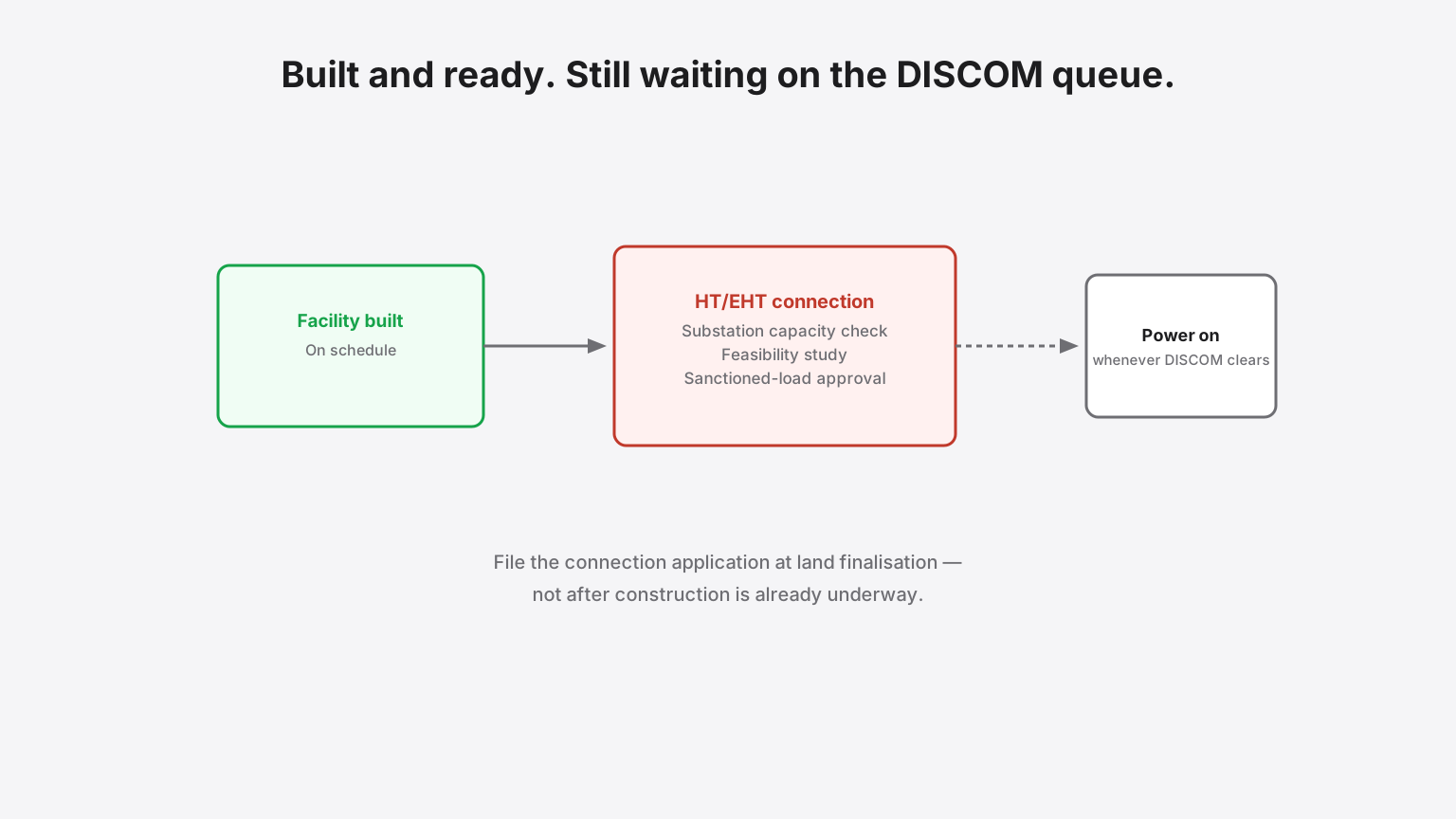
A high-load facility — a data centre, a large cold-storage plant, an EV charging or logistics hub — usually gets planned around the construction programme: design time, procurement lead times, build duration. The constraint that actually decides the commissioning date is often a different one entirely: how long the DISCOM takes to approve and provide a new HT/EHT connection, or to sanction a load enhancement, at the capacity the facility needs. This is not a solar-specific interconnection question — see our solar grid interconnection guide for that — this is the base power-supply connection every high-load facility needs before it can run at all.
Why this queue runs longer than buyers expect
- Substation and feeder capacity isn't guaranteed at every location. If the nearest substation doesn't have spare capacity for your sanctioned load, the DISCOM's answer isn't "no" — it's "after we augment," which can mean a multi-year capacity-addition programme outside your control or your contractor's.
- Large sanctioned-load applications get more scrutiny, not less. A request materially larger than the area's typical load profile triggers a technical feasibility study before it's even queued for approval.
- Dedicated feeder or transformer requirements for genuinely large loads can mean the DISCOM requires a dedicated substation built to their specification — which is itself a design-and-approval project, not a formality.
What to check before the site is finalised
| Question | Why it matters |
|---|---|
| What's the actual spare capacity at the nearest substation, today? | Not the DISCOM's stated theoretical capacity — the real headroom after existing sanctioned loads in the area are accounted for. |
| Does this load size trigger a dedicated substation requirement? | Changes both cost and timeline substantially, and needs to be known before land and layout decisions are finalised, not after. |
| Is there a captive or open-access power option in parallel? | For facilities that can't wait on grid augmentation, a phased approach — partial DISCOM supply plus DG or open-access solar for the balance — can decouple commissioning from the DISCOM's full-capacity timeline. |
| What does the DISCOM actually require in the application package? | Load calculations, single-line diagrams and site layout that don't match their format restart the review clock — the same coordination discipline covered in our Fire NOC coordination guide applies here too. |
The planning implication
For a genuinely high-load facility, the HT/EHT connection application should be filed as early as land finalisation allows — in parallel with design, not after it. Treating grid connection as a late-stage electrical task rather than a long-lead approval item is the single most common reason a fully built facility sits waiting for power months after construction is complete.
What we do differently
Our electrical infrastructure team scopes the DISCOM connection and any substation requirement at the earliest planning stage, specifically so it runs in parallel with construction rather than becoming the last domino standing after everything else is ready.
More insights
Nothing Has Tripped in Years. That Is Not the Same as Safe.
Factories treat an uneventful electrical system as a healthy one. An audit measures what an absence of incidents cannot tell you — and the findings are usually the same handful of things, quietly getting worse.
ElectricalYou Sized the DG. Nobody Sized the Safety Distance Its Diesel Tank Needs.
A DG set is easy to place; its diesel storage tank isn't. Safety-distance rules from the fire and PESO frameworks can push a tank — and everything around it — further from your building than the plot allows for. Decide tank type and location at layout stage, not after the DG is ordered.