
When One Inverter Fails, How Much of Your Plant Fails With It?
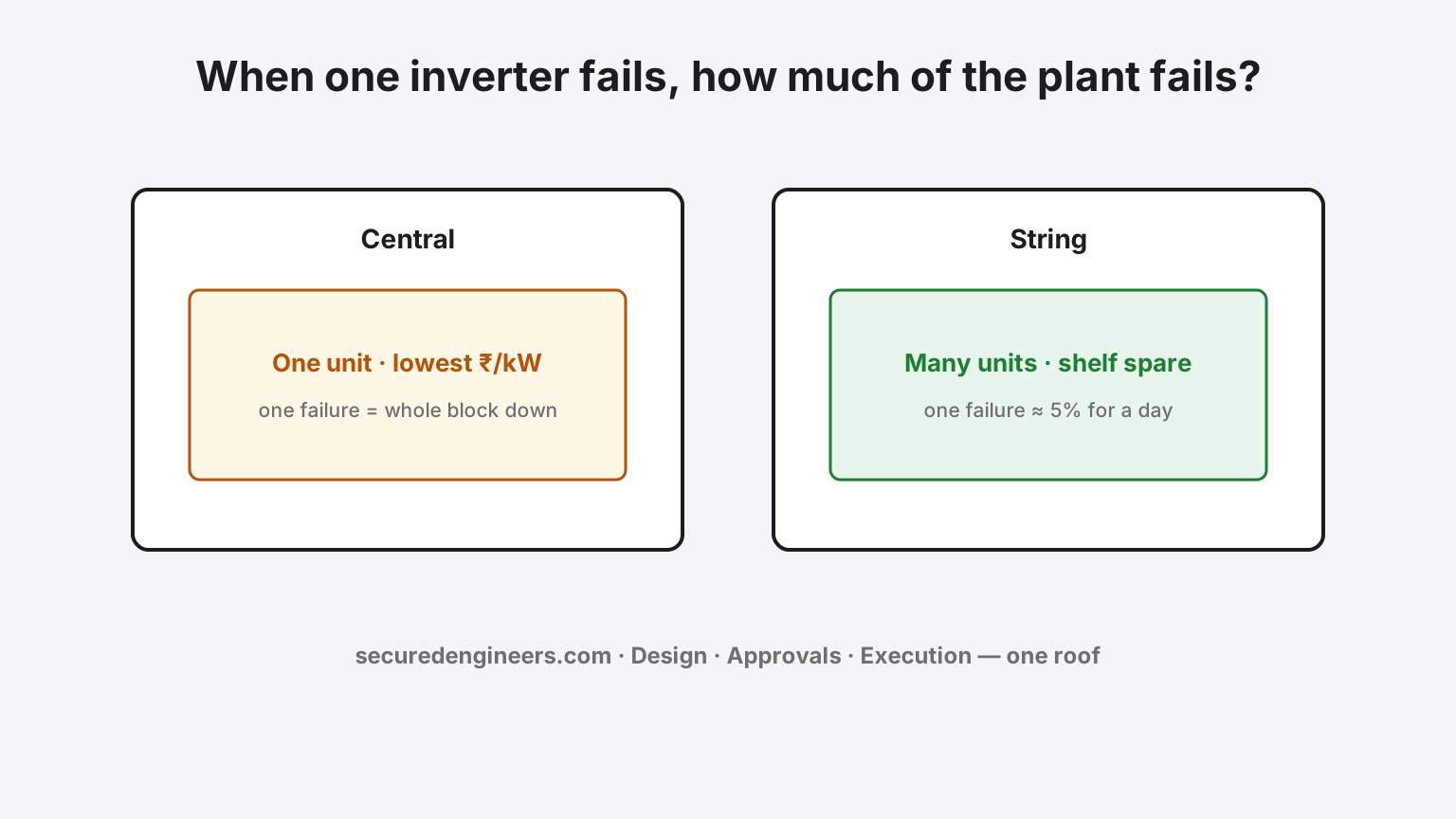
Two 1 MW rooftop plants, same modules, same city. Plant A runs twenty string inverters of 50 kW; Plant B runs one central unit. In year four, an inverter fails in each. Plant A loses 5% of generation for the week the spare takes to arrive. Plant B loses 100% — a week of the entire plant's output riding on one service call.
Neither architecture is "right". But the trade-offs are structural, they are set on day one, and they surface at exactly the moments — failures, expansions, year-12 replacements — when changing course is most expensive.
The three architectures, honestly compared
| Criterion | String inverters | Central inverter | Microinverters |
|---|---|---|---|
| Typical C&I role | The rooftop default — units from tens to a few hundred kW, paralleled | Large single roofs / ground-mount blocks (MW-class) | Small, shaded or complex roofs; premium residential |
| Failure blast radius | One unit ≈ its share of plant (5–10% typical) | The whole block | One module’s worth |
| MPPT granularity | Per string-group — good tolerance of mixed orientations/partial shade | Few MPPTs — wants a uniform, unshaded array | Per module — maximum tolerance |
| Monitoring resolution | String-level: underperformance is findable | Block-level: faults hide inside averages unless string monitoring is added at the combiner | Module-level: everything visible (and a lot of data) |
| Service model | Swap the unit, plant keeps running — keep one spare on shelf | Specialist service visit; downtime measured in days | Roof access per failure — labour-heavy at scale |
| Cost per kW | Competitive and falling as unit sizes grow | Lowest at MW scale, plus BOS savings | Highest — pays only where its tolerance earns money |
The Indian C&I reality: string architecture has eaten most of the rooftop market precisely because availability and serviceability dominate economics at rooftop scale — a shelf spare and a two-hour swap beat any service SLA. Central units still win on very large uniform arrays where their per-kW cost and simpler DC field pay for proper on-site service arrangements.
Selection questions that actually decide it
- What does a week of downtime cost you? Multiply your plant’s daily generation value by a realistic service lead time — that number, weighed against the architecture, is the availability argument in rupees.
- Is the roof uniform? Multiple orientations, parapet shadows, future rooftop equipment — each pushes toward more MPPTs (string) or, in extremes, module-level electronics.
- Grid compliance is non-negotiable either way: whatever you choose must meet your DISCOM’s interconnection and protection requirements — anti-islanding, ride-through and power-quality behaviour per the applicable standards your state enforces. This is a checklist item at approval, not a preference.
- DC/AC ratio and clipping: modern designs deliberately oversize the array relative to inverter capacity; sensible ratios trade tiny midday clipping for better capacity utilisation. Ask to see the clipping estimate in the yield simulation, not just the ratio.
- Who stocks the spare? An EPC promising “48-hour replacement” should be asked: from which warehouse, and is it in the contract?
The year-12 question nobody prices on day one
Inverters are the plant’s wear item — design lives of 10–15 years against modules warranted for 25. Whatever you install today will likely be replaced once within the plant’s life:
- String units: replacement is granular and budgetable — a few units a year as they age out, at whatever the market then charges (budget in real terms; treat vendor “extended warranty” pricing as the ceiling, not the plan).
- Central units: one large, lumpy capex event — and a compatibility question if the model family is discontinued. Confirm the frame footprint and DC field compatibility of plausible successors.
- Either way, write the replacement into the financial model — a plant IRR that omits it is fiction.
Get the plant’s basic electrical sizing right first — panel count, inverter rating and DC/AC ratio — with our Solar Panel & Inverter calculator, then pressure-test the economics (including that year-12 line) in the full Solar Financial Model.
What we do differently
As an EPC, our solar practice is architecture-agnostic — we install string and central plants both, so the recommendation follows your roof, your downtime economics and your DISCOM’s rulebook, not a distributorship. Designs ship with string-level monitoring, contractual spare arrangements, and a financial model that already contains the inverter’s second life.
The three takeaways
- Choose architecture by failure blast-radius and service reality, not brochure efficiency decimals.
- Uniform roofs widen your options; messy roofs demand MPPT granularity.
- The year-12 replacement is part of the price — any model that hides it is flattering the IRR.
Comparing two solar offers right now? Book a Free Project Blueprint & Statutory Approvals Roadmap or call +91 70099 85817 — we’ll show you where the two BOQs will behave differently in year four.
Related services
More insights
Rooftop solar without roof leaks — penetrations, ballast and the monsoon test
The plant works and the roof does not. Leak complaints arrive with the first monsoon, months after the installer demobilised. Here is how the detail is done properly.
Solar EnergyThat Cheap Module Quote May Not Be an Eligible Module Anymore. ALMM List-II Changed the Rules.
From June 2026, ALMM compliance extends to solar cells (List-II), not just modules. A module that was fine to buy last year may now be ineligible for government schemes and net metering — and the cheapest quote on your table is the most likely to be built on non-compliant cells.
More on Solar & Renewables · all insights