
CAPEX vs OPEX Solar in India: Compare Ownership and a PPA on the Same Load
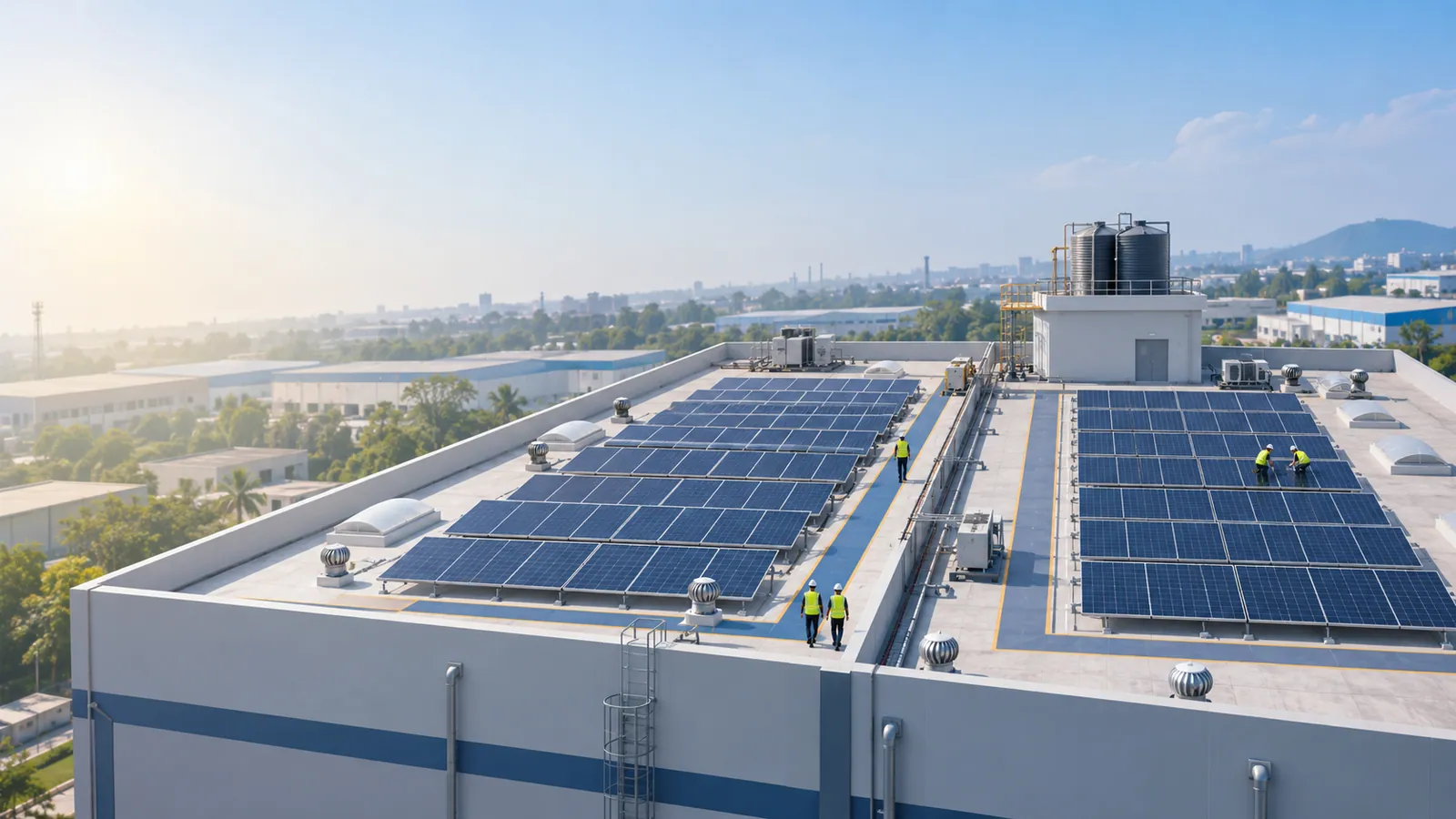
Every factory solar discussion reaches the same fork: buy the plant, or buy the power? Under CAPEX you pay for the plant, own it and keep its output. Under OPEX — a RESCO model or a solar power purchase agreement (PPA) — a developer builds and owns the plant on your roof and sells you its generation at a contracted tariff for the term of the agreement, usually with escalation, obligations and an exit schedule attached.
Both can be sound decisions. They are not the same product at two prices, and the comparison is fair only when both are modelled on the same load and the same generation, with every input that differs written down and verified.
Same load, same generation
The most common error is comparing two proposals built on different assumptions: one sized for maximum generation, another for maximum self-consumption; one using a higher irradiation figure; one ignoring degradation. Fix the plant and the load first, then vary only what the ownership model changes.
| Input | Same in both cases? | Where the number comes from | Common trap |
|---|---|---|---|
| Plant size (kWp DC and kW AC) | Yes | The roof layout, and the capacity limits in your state's rooftop solar regulations | Two proposals of different sizes compared on totals |
| Annual generation and degradation | Yes | One generation estimate, with its irradiation source and degradation stated | Each bidder's own optimistic yield |
| Share used on site, share exported | Yes | Your interval load data against the hourly generation profile | Assuming every unit offsets grid purchases |
| Value of exported units | Yes | The export settlement in your state's current regulations | Valuing exports at the retail tariff without a settlement that says so |
| Grid tariff avoided | Yes | Your tariff order: energy charge per kWh or kVAh, ToD periods | Assuming fixed and demand charges fall with solar |
| Grid tariff escalation | Yes | An assumption you state and test both ways | One optimistic escalation used to flatter both options |
| Cost of the solar units | No — this is the difference | CAPEX: capital, O&M, insurance, inverter replacement. OPEX: PPA tariff and escalation | Leaving O&M and inverter replacement out of CAPEX |
| Obligations | No — this is the difference | The PPA draft: minimum offtake, deemed generation, take-or-pay | Ignoring shutdown years and grid outages |
| Financing and tax | No — this is the difference | The lender's sanction terms; your tax adviser | Depreciation assumed from a brochure |
| Exit and end of term | No — this is the difference | Buyout schedule, termination compensation, transfer terms | Reading the tariff page and not the termination clause |
Two physical facts apply to both models. A grid-tied plant is not backup power: it shuts down when the grid fails, by design. And the plant is limited by the same roof, structure and approvals whoever owns it.
Tariff escalation and obligations
A PPA's headline tariff is the year-one tariff. With an annual escalation e, the tariff in year n is the year-one tariff × (1 + e)n−1. As an example input only, a 3% escalation makes the year-ten tariff about 1.30 times the year-one tariff, and the ten-year total about 14.6% more than ten flat years. Run the same arithmetic on the escalation you are actually offered.
Then read the obligations, because they decide what you pay when production does not go to plan:
- Minimum offtake or deemed generation — whether you pay for units you could not use in a shutdown, a slow year or a grid outage.
- Performance commitments — what the developer owes if generation falls short, and how shortfall is measured: which meter, which irradiation data.
- Billing and payment security — the invoicing basis, late-payment terms, and any letter of credit or escrow.
- Change in law — who carries a change in duties, settlement rules or taxes.
- Metering — PPA billing needs a generation meter both parties trust; name it in the agreement.
The PPA glossary entry covers the vocabulary.
Roof access and tenure
Under OPEX, your roof carries someone else's asset for the life of the agreement. The roof lease or licence decides how that works in practice:
- Term against roof life. If the roof will need replacing during the term, agree who removes and reinstates the plant, who pays, and how lost generation is treated.
- Access. Hours, safety rules, notice periods and who may go on the roof — for the developer's O&M and for your own maintenance.
- Structure. Whether the roof can carry the plant is for a structural engineer to decide, in either model; see our note on structural loading on older roofs.
- Sale, lease or extension of the premises. Whether the agreement transfers to a buyer, whether a lender can step in, and what happens if you extend the building over part of the roof.
A CAPEX owner faces the same roof questions but answers them alone. Under OPEX, every one of them has a third party at the table.
Financing, tax and exit terms as verified inputs
These inputs move the answer most, and they are the ones most often assumed:
- Financing. Debt-funded ownership keeps the plant's later-year economics with you while spreading the outflow. Use the lender's sanction terms — interest, tenure, your own contribution and the security asked for — not a generic rate. Our solar finance page sets out the PPA, RESCO and bank-loan routes, with the borrower contribution that published bank schemes ask for.
- Tax. The Income-tax Act, 2025 came into force on 1 April 2026, replacing the Income-tax Act, 1961. Depreciation on a solar plant — the rate and the conditions for claiming it — should be confirmed by your tax adviser under the law in force for the year the plant is put to use, not copied from an older proposal written under the 1961 Act. Ask the same adviser how GST on the EPC contract will be treated.
- Exit. The year-wise buyout schedule, termination compensation if either side defaults, and the transfer terms at the end of the term, including the plant's condition and who pays for outstanding repairs.
- Subsidies. PM Surya Ghar is a residential scheme; do not build household subsidy into a commercial or industrial comparison. Check MNRE's scheme pages for anything that genuinely applies to your category.
| If this is true for you | It points towards | Check before deciding |
|---|---|---|
| Capital is available and the business can use the depreciation | CAPEX, cash or debt-funded | Lender terms; your tax adviser's view under the Income-tax Act, 2025 |
| Capital is constrained, or earns more elsewhere in the business | OPEX | The total paid over the term, not the year-one tariff |
| Debt covenants or borrowing headroom are tight | OPEX, or a smaller owned plant | How the agreement will be treated in your accounts — ask your auditor |
| You may sell, relocate or re-roof during the term | CAPEX, or an OPEX agreement with clear transfer and relocation terms | Assignment and termination clauses |
| Production has seasonal shutdowns or uncertain future load | CAPEX, or OPEX without minimum-offtake exposure | Deemed-generation and take-or-pay wording |
| You do not want to run the plant's O&M | OPEX, or CAPEX with an O&M contract that carries performance terms | Who measures performance, and the remedy for a shortfall |
Run both on your own numbers
The CAPEX vs OPEX solar calculator runs both structures on your bill and tariff, and the solar payback calculator tests the ownership case on its own. Feed both the same plant size and generation, then change one input at a time — escalation, export value, financing — to see which one decides the answer for you. For the indicative turnkey cost of an owned plant by size, the 500 kW solar plant cost page shows a published band and states its tax basis.
Secured Engineers builds owned plants for commercial and industrial rooftops through its solar EPC service, including the DISCOM and electrical inspection filings. If you are weighing a PPA offer, the useful comparison is the same plant, owned, on the same load: share twelve months of bills, interval load data and the roof layout, with the offer, through a scope review request. More solar planning guides are on the Insights page.
Sources and how to verify
- Ministry of New and Renewable Energy — solar schemes (scheme index) and the PM Surya Ghar: Muft Bijli Yojana guidelines (a residential scheme).
- Press Information Bureau, Ministry of Finance — "Income-tax Act, 2025 comes into force from today (1st April, 2026)", 1 Apr 2026.
- Central Electricity Authority — CEA (Measures relating to Safety and Electric Supply) Regulations, 2023, notified 8 June 2023: regulation 34 (generating units, including renewable units, above the capacity your state notifies are inspected by the Electrical Inspector before commissioning).
Confirm locally: your state commission's current rooftop solar and export-settlement regulations, the DISCOM's capacity limits for your connection, your tax adviser's view under the Income-tax Act, 2025, and your lender's terms. A PPA's commercial terms are whatever the signed agreement says — read the draft, not the summary.
Frequently asked
What information do I need before comparing CAPEX and OPEX solar?
Twelve months of electricity bills and, ideally, interval load data; the roof layout and a structural engineer’s view of the roof; whether you own or lease the premises and for how long; your tax position and your lender’s terms; and, for OPEX, the draft PPA and roof lease — not just the tariff sheet.
Which site conditions could change a CAPEX vs OPEX solar comparison?
Remaining roof life and structural capacity; shading and usable area; how much of the generation your daytime load can absorb; your state’s export settlement and capacity limits; a planned expansion, relocation or sale; and HT metering or other connection changes. Each changes the plant size or the value of its units under both models, so fix them before comparing.
What should I send an engineer to compare CAPEX and OPEX for my site?
Twelve months of bills, interval load data if you have it, and the roof layout — plus any PPA offer you hold. With those, both models can be run on one plant size and one generation estimate, so the comparison shows the effect of ownership rather than of different assumptions.
What clauses should I check in an OPEX or RESCO solar PPA?
The tariff and its annual escalation; the term and lock-in; minimum offtake or deemed generation; the year-wise buyout schedule; performance commitments and how they are measured; the roof-lease terms; what happens on sale or lease of the premises; change in law; and termination compensation. Two PPAs with the same year-one tariff can cost very different amounts over their terms.
How is depreciation on a CAPEX solar plant treated for tax?
Treat it as an input to confirm, not assume. The Income-tax Act, 2025 replaced the Income-tax Act, 1961 from 1 April 2026, so rates and conditions quoted in older proposals may not apply. Ask your tax adviser what depreciation applies in the year the plant is put to use, and run the comparison with and without it.
Which is cheaper over ten years, CAPEX or OPEX solar?
There is no general answer. Once an owned plant has recovered its cost, each further unit costs only its O&M, while a PPA buyer keeps paying an escalating tariff — but financing cost, tax position, offtake obligations and exit terms can reverse that. Run both on the same load and generation with verified inputs.
Related services
More insights
Rooftop solar without roof leaks — penetrations, ballast and the monsoon test
The plant works and the roof does not. Leak complaints arrive with the first monsoon, months after the installer demobilised. Here is how the detail is done properly.
Solar EnergySolar, DG and Battery Integration for a Factory: Outages, Protection and Control
A grid-tied solar plant stops the moment grid supply fails, by design. Making solar, a DG set and batteries work together during outages is an architecture decision — which loads are critical, which source serves them, and the protection and controls that keep the grid, the DG and the inverters out of each other's way.
More on Solar & Renewables · all insights