
The Solar Quote Looked Great. Nobody Checked If Your Roof Can Carry It.
Most rooftop solar conversations start and end with generation and payback — our own solar savings calculator included, deliberately, because that's the number that gets a project greenlit. The question that determines whether the array survives its first monsoon is a different one, and it rarely comes up until the panels are already on order: can this roof actually carry them?
Two loads, not one
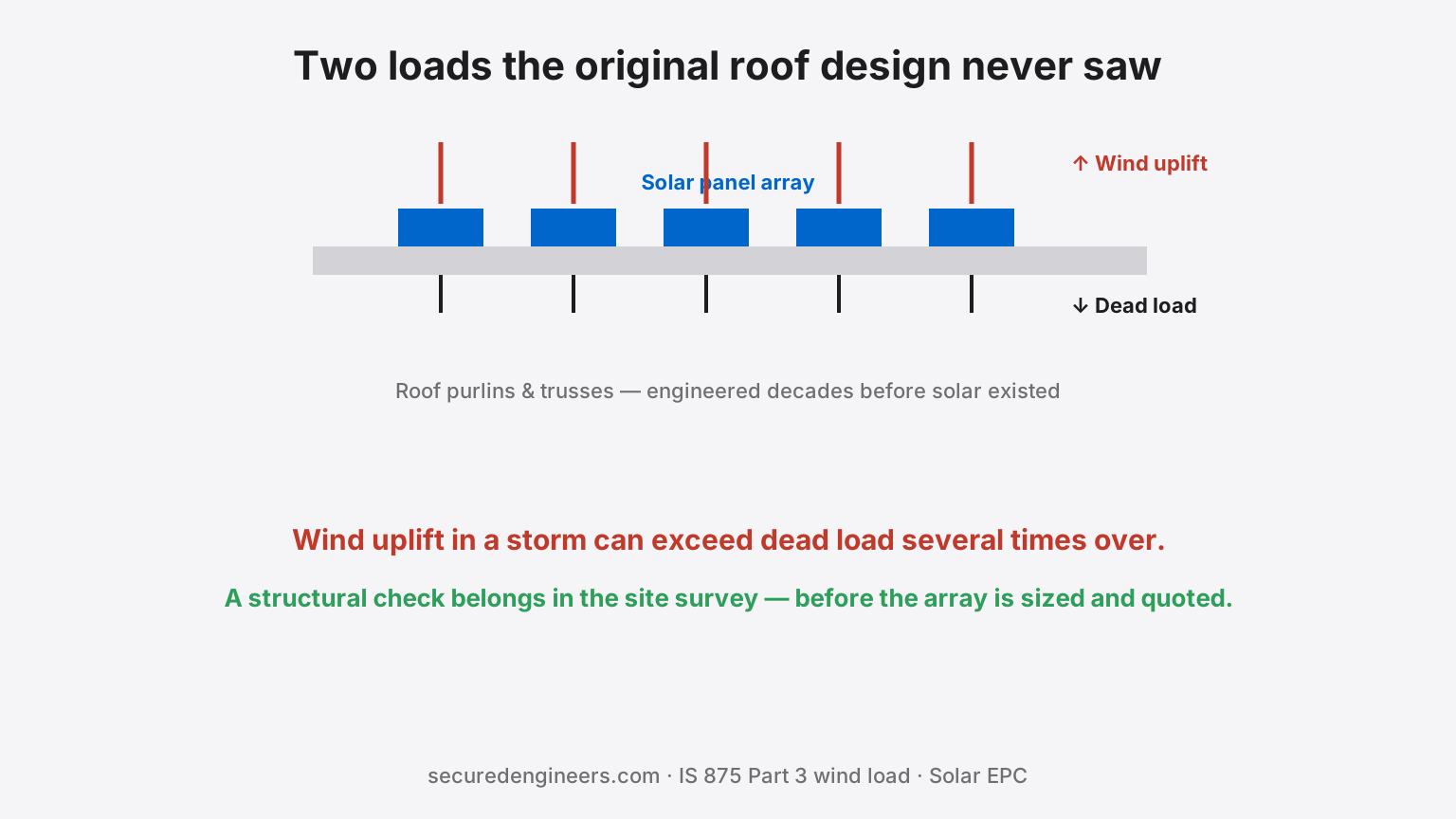
A solar installation adds two structural demands to a roof that was never designed with either in mind:
- Dead load — the static weight of panels, mounting structure and cabling, distributed across the roof sheeting and its supporting purlins/trusses. Modest per panel, but additive across a large array, and concentrated at mounting-rail points rather than spread evenly.
- Wind uplift — the far bigger factor in most failures. A tilted panel array acts like an aerofoil in high wind; uplift forces on the mounting structure and its roof fixings can exceed the dead load by several times during a storm, and North Indian pre-monsoon squalls regularly produce exactly that kind of wind event.
Factory roofs built in the 1990s–2000s were engineered for their own sheeting, insulation and maybe a walkway load — not for a permanently fixed structure designed to resist uplift. Many carry it fine. A meaningful number don't, and the failure mode isn't gradual: it's panels and rail sections coming off in a storm, which is both a safety hazard and a total loss of the array section involved.
What a structural check actually looks at
| Check | Why it matters |
|---|---|
| Purlin and truss condition & spacing | Determines how much additional point-load the structure can take before reinforcement is needed |
| Roof sheeting age and corrosion | Corroded sheeting fails at lower loads than its original rating assumed |
| Mounting system & fixing points | Ballasted vs penetrative mounting changes both the load path and the roof-membrane risk |
| Local wind-load basis (IS 875 Part 3) | Uplift design must use the actual site wind zone, not a generic assumption |
Where this changes the plan, not just the price
A structural assessment doesn't usually kill a solar project — it changes how it's built: reinforcing specific truss bays before mounting, choosing a ballasted system over roof penetration (or vice versa) based on membrane condition, or de-rating the achievable array size on a genuinely weak roof rather than maximising kW on paper and finding the limit in a storm. All of this needs to happen before the mounting structure is fabricated, not after — retrofitting reinforcement under an installed array is far more disruptive than designing for the actual roof from the start.
Our Solar EPC scope includes a structural assessment as part of the site survey, before the array is sized and quoted, alongside the plant-area and shadow-free-area checks in our plant area and shadow-free area calculators — so the kW number you get is one the roof can actually carry.
More insights
Your Solar Plant Has Been "Awaiting Meter" for 11 Weeks. Here Is Why.
The panels are up, the inverter hums through commissioning mode — and the plant cannot legally export a unit because the bidirectional meter and synchronisation approval are stuck. Why net-metering files stall at North Indian DISCOMs, and how to sequence solar so the paperwork finishes with the plant.
SolarYour Solar ROI Model Assumed Average Sun. December in Punjab Isn't Average.
Rooftop solar payback models often use an annual average generation figure — but North India's dense winter fog belt (Punjab, Haryana, western UP) can cut December–January generation sharply for weeks at a time. Realistic ROI needs month-wise generation, not an annual average smoothed flat.