
How to choose a solar EPC company in India — the checks that actually matter
Type "solar EPC company in India" into Google and look carefully at what comes back. A large share of page one is "Top 5 Rooftop Solar EPC Companies" and "India's Top 10 Solar EPC Companies" — and the bylines belong to solar EPC companies. They are marketing pages wearing the clothes of a buyer's guide.
We could publish one too. We decided not to, because to rank ourselves alongside Tata Power or Hartek we would have to make comparative claims about their delivery that we cannot verify. What we can do is the harder and more useful half: give you the evaluation framework, including the questions we would want a serious buyer to put to us.
First, know what you are actually buying
"EPC" means engineering, procurement and construction under one contract — one party carries the design, buys the equipment, builds it and hands over a working plant. The value is single-point accountability: when generation underperforms, there is nobody to point at but the contractor.
That only holds if the scope boundary is written down. The most common failure in Indian C&I solar is not a technical one; it is a plant that works while the paperwork stalls, because nobody agreed who files what.
| Scope element | Who typically carries it | What to confirm in writing |
|---|---|---|
| Feasibility & yield estimate | EPC contractor | The shadow-free area assumed, and the basis of the generation figure |
| Structural assessment | EPC contractor | Wind-load design basis (IS 875 Part 3) and the condition survey of your existing roof |
| Module supply | EPC contractor | Exact make/model and its ALMM listing — not "ALMM-approved tier-1" |
| DISCOM / net metering | Varies — the usual gap | Who prepares, files and follows up the application |
| CEIG / Electrical Inspectorate | Varies — the other usual gap | Whether your installation needs it, and who owns the file |
| O&M after handover | Separate contract | Response times and generation commitment, not visit counts |
The engineering checks
1. Shadow-free area, not roof area
Capacity should be derived from the area that is actually free of shadow through the year — including December, when the sun is lowest and inter-row shading is worst. A proposal that sizes the plant from gross roof area will overstate both capacity and generation. Run your own first number with the shadow-free area calculator before you read anyone's proposal, then ask how they arrived at theirs. If the answers diverge sharply, the difference is the conversation.
2. The yield basis behind the number
Two contractors can quote the same kW and promise generation figures 15% apart. The gap lives in assumptions — soiling, temperature losses, inverter clipping, shading, and how honest the degradation curve is. Ask which of those are modelled. Our guide on why yield estimates differ walks through where the optimism usually hides.
3. Structure design, not structure weight
Mounting structures are the easiest place to save money and the worst place to discover it. The design basis should reference wind loading under IS 875 (Part 3) for your location, and — on an existing building — a structural assessment of what the roof can actually carry. Old roofs deserve particular care: the panels last 25 years, and the sheet under them may not.
4. Module eligibility, in writing
Ask for the specific model and check it against the MNRE ALMM list yourself. "Tier-1" is a financial classification, not a quality standard, and it is not a substitute for ALMM eligibility where your project needs it. We covered what changed and why it matters for bankability in the ALMM guide.
5. Inverter architecture
String or central changes what happens on a bad day. Central inverters concentrate risk — one failure takes a large block offline; string architectures fail smaller. Neither is universally right; what matters is that the choice was reasoned against your load profile and downtime tolerance rather than inherited from the last quote the contractor sent someone else.
The compliance checks
This is where projects lose months, and where the difference between contractors is starkest — because it is unglamorous work that no photograph captures.
- Net metering: the regime, the sanctioned-load cap and the settlement mechanics are state-specific. Ask who files, and what happens if the application is queried. Delays in UP, Punjab and Haryana are usually resubmission delays, not authority delays.
- CEIG: where thresholds apply, drawings are approved and the installation inspected before energisation, with continuing duties under the CEA (Safety) Regulations 2023. The CEIG process should appear in the proposal, not as a surprise.
- Protection and interconnection: the DISCOM will witness protection settings. A contractor who cannot describe the interconnection scheme at proposal stage has not designed it yet.
The commercial checks
The engineering can be right and the contract still leave you exposed. Four things decide that.
| Ask this | A good answer sounds like | Red flag |
|---|---|---|
| What exactly do you guarantee? | A performance ratio or annual generation figure, measured, with a remedy if missed | "Industry-standard performance" with no number |
| What does O&M cover? | Response times, cleaning cycles, monitoring, and a generation commitment | A visit count per year |
| How are payments staged? | Milestones tied to delivery, commissioning and approval — not front-loaded | Most of the value due before commissioning |
| What happens in the defect liability period? | A defined DLP with the contractor carrying rectification | DLP that quietly excludes the things most likely to fail |
On price: turnkey C&I rooftop generally lands in a ₹24,000–32,000 per kW band (from ₹28k–32k at 100 kW down to ₹24k–26k at 1 MW), moving with structure design, module choice, cable runs, HT interface and site access. Treat that as a test for quotes, not a budget — and remember a quote well below it is usually a smaller scope, not a better price. Run your own payback first with the solar payback calculator, and if you are weighing ownership against a RESCO deal, the CAPEX vs OPEX ten-year TCO comparison does that arithmetic properly.
Four red flags worth walking away from
- A capacity number before a site visit. Roof condition, shading and the electrical interface cannot be assessed from a satellite image.
- Generation promised without assumptions. If the losses modelled aren't stated, the number is marketing.
- Approvals described as "we'll help". Help is not a scope. Filing is.
- A performance guarantee with no remedy. A guarantee that costs the contractor nothing when missed is a sentence, not a guarantee. Our guide on what to check in a performance guarantee covers the wording that matters.
The takeaways
- The shortlists are marketing. Nearly every "Top 10 Solar EPC" page ranking for this query is published by a company on the list — evaluate the contractor, not the ranking.
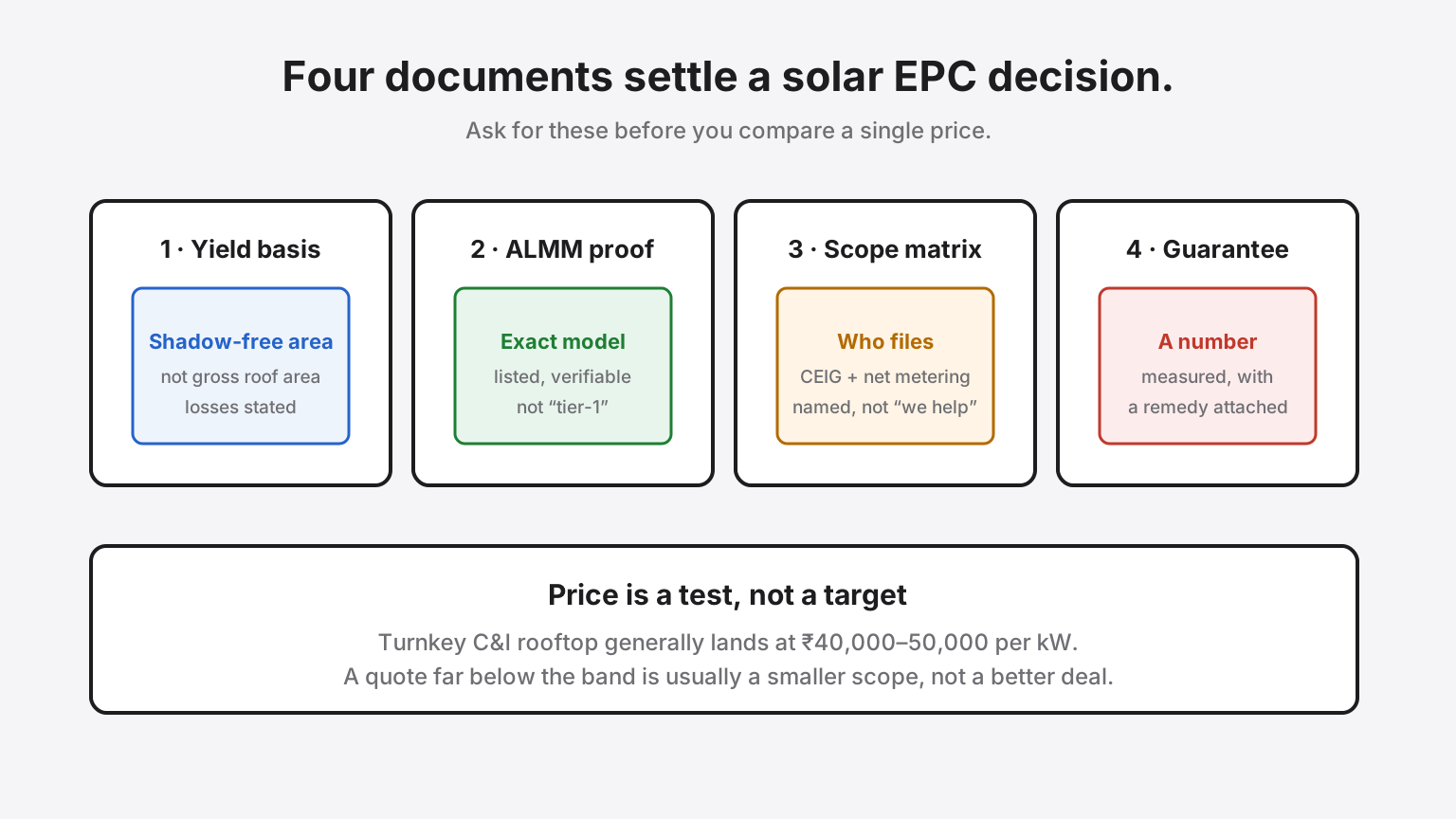
- Four documents settle it: shadow-free area and yield basis, ALMM reference for the exact module, a scope matrix naming who files CEIG and net metering, and a measurable performance guarantee with a remedy.
- Price is a test, not a target. Against the ₹24–32k/kW band, an outlier quote is usually a different scope — find the missing line before you find it on site.
Evaluating solar EPC proposals right now? Book a Free Project Blueprint & Statutory Approvals Roadmap — we'll size the plant, map the approvals and tell you what a fair quote looks like for your roof — or call +91 70099 85817. If you'd rather start with our own scope, see how we deliver solar EPC.
Frequently asked
How do I verify a solar EPC company in India before signing?
Ask for four things in writing: the shadow-free area and yield basis behind the proposed capacity, the ALMM list reference for the exact module model quoted, a scope matrix stating who files CEIG and DISCOM net-metering applications, and the performance guarantee expressed as measurable generation or performance ratio with a remedy attached. A contractor who can produce all four quickly has done the engineering; one who cannot is quoting from a price list.
What should a C&I solar EPC quote cost per kW in India?
Turnkey commercial and industrial rooftop solar generally lands in a ₹24,000–32,000 per kW band (from ₹28,000–32,000/kW at 100 kW down to ₹24,000–26,000/kW at 1 MW), varying with structure height and design, module choice, cable runs, HT interface and site access. A quote far below the band is not usually a better price — it is normally scope leaving the room: lighter structures, thinner cables, no monitoring, or approvals pushed back onto you.
Does a rooftop solar plant need CEIG approval?
It depends on voltage and state thresholds. Systems interfacing at high tension, and installations that fall within the state Electrical Inspectorate's ambit, require CEIG drawing approval and inspection before energisation, and the CEA (Safety) Regulations 2023 carry ongoing duties afterwards. Whether it applies to your plant is a question your EPC contractor should answer at proposal stage, not after the panels are on the roof.
Is the cheapest solar EPC quote ever the right one?
Sometimes — but only once you have normalised the four things that move price most: module make and ALMM eligibility, structure design and wind-load basis, inverter architecture, and how much of the approval and O&M scope sits with the contractor. Compare those line by line and the cheap quote is usually revealed as a different, smaller scope rather than a better deal.
Related services
More insights
Solar for Cold Storages: Sizing, Roof, Approvals and Payback (50 kW+)
How a cold storage owner sizes a 50 kW+ solar plant from the electricity bill, what the roof and the insulated panels mean for mounting, which approval route fits the size, the sector-specific risks, and how to read payback.
Solar EnergySolar EPC for Factories in Telangana: DISCOM Rules, Approvals and Cost
What a Telangana factory needs to know before buying 50 kW or more of rooftop solar: TGERC 2025 caps, the TGSPDCL and TGNPDCL approval steps, CEIG above 56 kWp, and where the national cost band sits at 100 kW, 500 kW and 1 MW.
More on Solar & Renewables · all insights